The Best Camping Gear for Kids, Bought in the Order That Matters
Children do not need miniature versions of everything. They need four things to work properly, and the one that decides the night is the one nobody buys first.
20 lumens measured to ANSI/PLATO FL1 at 80 g, on three AAA cells, with a battery compartment closed by a screw and an automatic shut-off after an hour.
A child who needs their own light and cannot be trusted with 400 lumens
The criteria: what actually decides a child's night
The short answer
Warmth from below, a bag that fits, their own light, and somewhere of their own to sit. In that order. A child who is warm, can see, and has a chair will put up with almost anything else; a child who is cold at 2am has ended the trip regardless of what else you bought. Everything on this page is judged against those four, and nothing is here because it is a smaller version of an adult item.
Three facts drive the whole list, and they are all physical rather than preferential.
Children lose heat faster than adults. A higher surface-area-to-volume ratio means more skin per unit of body to lose heat from, and less muscle mass means less heat generated in the first place.
Sleeping bag ratings do not describe them.ISO 23537 ratings are measured with a standardized adult manikin in a climate chamber. No part of that test is a seven-year-old, which is why a maker's number should be read as optimistic for a child.
Empty space in a bag is cold space. A bag warms you by trapping air your body heats, so a child in an adult-length bag is heating two or three times the volume they should be.
Read together, those three explain why the pad is first on this list and the sleeping bag is second. It is the least intuitive ordering in children's camping gear and the one that makes the most difference.
The four that matter, and what to look for
Priority
Item
The specification that matters
What to ignore
1
Insulated pad
R-value, and whether it can puncture
Thickness, for a child who weighs 60 lb
2
Sleeping bag
Fits-to length, and whether it shortens
The temperature number, unless it names a standard
3
Headlamp
Low output, secured battery door, snag release
Peak lumens
4
Camp chair
Seat height, so their feet reach the ground
Capacity ratings well beyond a child's weight
Our criteria. Every pick below is judged on the third column.
The free fix, if you are not buying anything yet
You do not need a child-sized bag to solve the empty-volume problem tonight. Stuff the foot of an adult bag with a dry fleece and tomorrow's clothes, or clip a strap around the bag a foot below their feet. Both shorten it without damaging anything, and the clothes come out pre-warmed in the morning. What does not work is putting two children in one adult bag: neither can close it around themselves and the combined empty volume is enormous.
The bag rating problem, stated plainly
Two of the bags a family will look at illustrate the issue. Kelty publishes 30 F for the Big Dipper and TETON publishes 20 F for the Celsius Junior — and neither is an ISO figure, because children's bags are generally not tested to ISO 23537 at all. Compare that with an adult bag such as the Kelty Cosmic Down 20, which publishes ISO comfort 31 F and ISO limit 21 F as two separate, standardized numbers.
The practical consequence is not that the makers are being dishonest; it is that you have no standardized figure to plan around. Treat a children's bag rating as a mild-conditions number, put a real pad underneath, and add a blanket over the top when the forecast drops. What the ISO numbers mean when you do have them is in sleeping bag temperature ratings explained.
Sizing, without buying three of everything
Children outgrow gear on a schedule that makes buying precisely fitted equipment expensive. Three tactics keep the cost sane.
Buy to the top of the size range, not to today's height. Kelty publishes a fits-to height of 5 ft on the Mistral Kids 30, which covers most of childhood from one purchase. Extendable bags — a junior body with a zipper at the foot that lets it grow a foot longer — are better still, but they come and go: Kelty's Big Dipper 30 was the one this site used to recommend and it has been discontinued, with no current equivalent we could find as of October 2026. Until one returns, buy long and fix the spare volume with clothing stuffed into the footbox.
Buy adult where the size does not matter. A foam pad, a lantern and a blanket are size-agnostic; a Z Lite Sol at 72 by 20 in works for a six-year-old and for the adult who inherits it. Only the bag, the chair and the headlamp genuinely need to be child-scaled.
Buy the rest secondhand. Children's camping gear is outgrown rather than worn out, which makes it unusually good on the used market — and unusually good to sell on afterwards. What to check before handing over money is in how to buy used camping gear.
What not to buy
A child-sized tent. Children want to sleep near adults on a first trip, and a second tent is a second thing to pitch, dry and store. Size the family tent up instead, per what size tent do I need.
A miniature multi-tool or a knife. Not a gear opinion; a supervision one. If it is coming, it belongs with an adult.
A bright headlamp. Handing a child 400 lumens produces one outcome, and it is everybody else's night vision.
An inflatable pad, initially. Pinhole leaks are the most common gear failure in camping and they reveal themselves at 3am. Foam first; add an inflatable when they are old enough to look after it — and see how to repair a sleeping pad for when you do.
Character-branded anything, at full price. The license is the price premium and the specification is usually worse.
The two things that are not gear
A dedicated set of dry sleep clothes. Base layer, dry socks and a hat that are never worn during the day and live in a bag with the bedding. Children sweat through the day and then get into a sleeping bag in damp clothes, and damp fabric moves heat away from skin roughly twenty times faster than dry fabric. This costs nothing and outperforms a bag upgrade.
Insect protection, applied by an adult. Bites end more children's trips than cold does. This site's approach is three layers — permethrin on clothing at home, an EPA-registered skin repellent such as 20% picaridin on exposed skin, and a mesh shelter or area repeller where everyone sits still — and the product detail is in best bug protection for camping. We do not publish application guidance for children; follow the product label.
What we did not do
We have not tested any of this gear, and no child has slept on any of it on our behalf. Every figure above is the manufacturer's published specification with a link to where it was read, and where a rating is the maker's own rather than a standardized one — as with both children's sleeping bag ratings — we have said so rather than presenting it as equivalent to an ISO figure. See how we research.
Prices are not printed anywhere on this page. They move, and a number typed into an article is wrong within a month; every buy button checks the current price at the retailer instead. The rest of the family kit, in the order it gets packed, is in the family camping checklist, and the trip itself is in family camping with kids.
The picks in full
1. Buy this first: the pad that keeps them warm
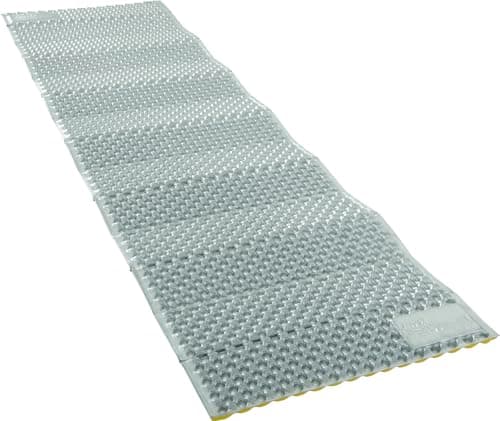
Therm-a-Rest Z Lite Sol
Therm-a-Rest
R 2.0 of closed-cell foam at 14 oz, with nothing inside it that can puncture, deflate or need repairing at 2am.
Therm-a-Rest publishes an R-value of 2.0, a regular size of 72 by 20 by 0.75 in, a regular weight of 14 oz, and closed-cell foam construction.
This is first on the list because it is the item that decides whether a child is warm, and it is almost always the item a family skips. Body weight crushes the insulation underneath a sleeping bag completely flat, so on that side the bag is doing nothing at all and the ground is taking heat straight out of them. A child on a bare tent floor in a good bag will be cold; a child on a pad in a mediocre bag usually will not.
Closed-cell foam is specifically the right kind for children rather than a compromise. It cannot be punctured by a stick, a stone or a badge pin, it does not deflate in the night, it does not need inflating by a tired seven-year-old, and it survives being used as a sledge, a gym mat and a raft. R-values are additive, so laying it under an inflatable in colder weather sums the two — the arithmetic is in R-value explained.
The drawback
0.75 in of foam is thin comfort on hard ground, it is bulky to pack because it does not compress, and R 2.0 is a summer number rather than a cold-ground one.
2. Best kids' sleeping bag, and the one sized to last to about 5 ft
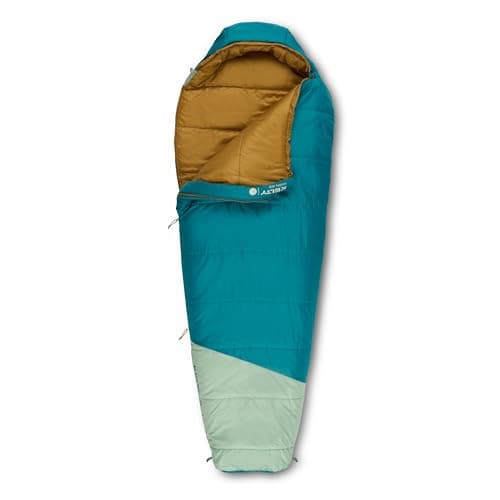
Kelty Mistral Kids 30 Sleeping Bag
Kelty
A 30 F synthetic bag at 2 lb 9 oz with 26 oz of CloudLoft fill, offset-quilt construction and a published fits-to height of 5 ft.
Kelty publishes a 30 F (-1 C) rating, CloudLoft synthetic insulation, a 26 oz fill weight, a 2 lb 9 oz total weight, a fits-to height of 5 ft, a 9 by 15 in stuffed size, a 190T polyester taffeta shell, offset-quilt construction and a natural-fit footbox.
A fits-to height of 5 ft is the reason this beats an adult hand-me-down. A sleeping bag warms you by trapping a layer of air your body heats, so a bag far too long for a child leaves them heating two or three times the volume they should be — which is exactly why passing down an adult bag makes children cold. Five feet covers most of childhood, and the offset quilt is there to stop the cold spots that show up where a stitched-through seam squashes the fill flat.
It is a fixed length, so there is a window where a small child is still heating spare volume. That is worth solving for free rather than with money: stuff the foot of the bag with a dry fleece and tomorrow's clothes, which shortens it and gives them warm clothes in the morning.
Synthetic fill is the right call and not a cost compromise. A child's bag gets spilled on, dragged across a campsite, slept in with a snack and washed far more often than an adult's, and synthetic keeps most of its loft damp and washes with ordinary detergent. Full sizing method in kids' sleeping bags and how to size them.
The drawback
The maker's 30 F figure is not an ISO rating, and children lose heat faster than the adult manikin those tests use. Treat it as a mild-night bag. It is also a fixed length, so a small child has empty volume to heat until they grow into it.
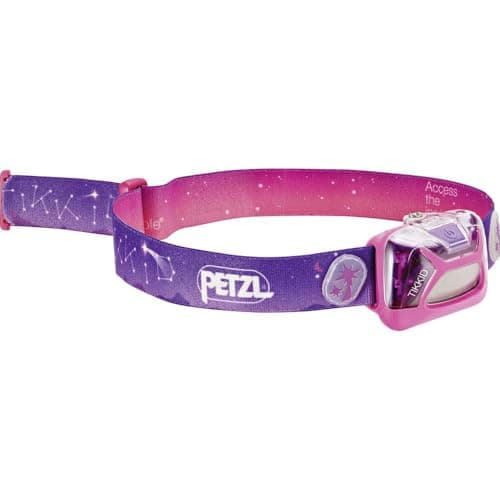
20 lumens measured to ANSI/PLATO FL1 at 80 g, on three AAA cells, with a battery compartment closed by a screw and an automatic shut-off after an hour.
Petzl publishes a 20 lumen output measured to ANSI/PLATO FL1, an 80 g weight, three AAA/LR03 batteries included with CORE rechargeable compatibility, three modes (low for reading, high for playing, and a white strobe to be seen at a distance), a design intended for children three years and older, a battery compartment secured by a flat-head screw, an automatic shut-off after one hour, and an adjustable headband that releases under tension.
The two features that make this a children's product rather than a small adult one are both about parents. The screw on the battery door keeps AAA cells out of small hands, which is a genuine safety consideration rather than a marketing line. The headband that releases under tension is a snag-release: if it catches on something, it lets go.
Twenty lumens sounds absurdly low next to a 400 lumen adult headlamp, and for a child it is about right. Reading in a tent wants 5 to 20 lumens and the walk to the toilet block wants 50 to 100, so this covers the first comfortably and the second adequately — while being far too dim to blind anybody, which is what actually happens when you hand a child a bright lamp. The output arithmetic is in lumens explained for camping lights.
The drawback
Twenty lumens is genuinely dim for anything beyond a tent and a short walk, and the screwed battery door means you need a screwdriver rather than a fingernail to change cells.
Published specs
Output
20 lm, ANSI/PLATO FL1
Weight
80 g with batteries
Power
3x AAA/LR03 included, or the CORE rechargeable battery
Modes
low for reading, high for playing, white strobe to be seen
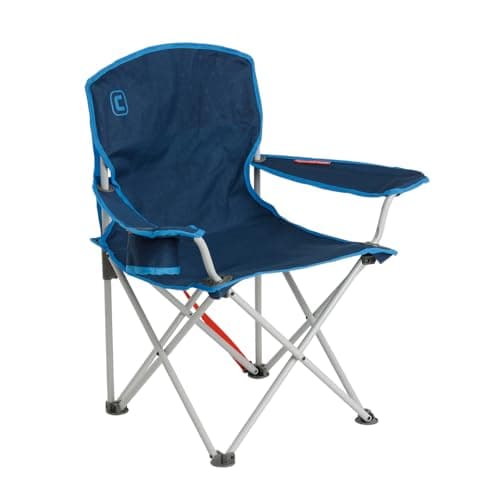
A 14.5 in seat height on a youth-sized frame rated to 120 lb, packing to 28 by 9 in and weighing 4.5 lb.
CORE publishes a 120 lb weight capacity, a 14.5 in seat height, a seat 18.5 in wide by 16 in deep, an open size of about 27.5 by 18 by 28 in, a 28 by 9 in pack size, a 4.5 lb weight, a built-in cup holder and a carry bag with a shoulder strap.
Seat height is the entire specification here. This site judges adult chairs on an 18 to 20 in seat height because that is what puts an adult's feet flat on the ground; 14.5 in does the same job for a child. A child in an adult chair has their feet dangling, which is uncomfortable within minutes and is why they end up on the floor or in your lap.
The lower seat is also a stability feature rather than only a comfort one — a low center of gravity is much harder to tip backwards, which is the failure mode of a child in a tall chair. Be honest about the age range, though: 14.5 in suits a school-age child rather than a toddler, and the 10.2 in kids' chairs that used to be easy to find have largely left the market. Adult options are in the camping chair roundup.
The drawback
A 120 lb capacity means many teenagers outgrow it, and at 14.5 in the seat is a compromise rather than a true toddler height. CORE is also inconsistent about the rating: its product page says 120 lb and its camping-chairs collection page says 125 lb.
Published specs
Capacity
120 lb
Seat height
14.5 in
Seat
18.5 in wide x 16 in deep
Open size
27.5 x 18 x 28 in
Packed size
28 x 9 in
Weight
4.5 lb / 2.1 kg
Extras
built-in cup holder; carry bag with shoulder strap
Note
CORE is inconsistent on the rating: its product page publishes 120 lb and its camping-chairs collection page says 125 lb
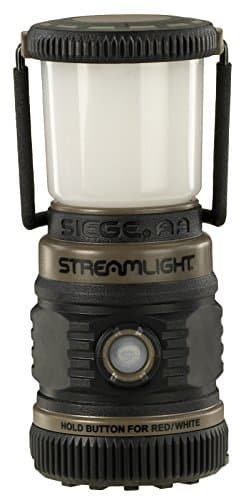
200, 100 and 50 lumen modes running 7, 15.5 and 37 hours on three AA cells, rated IPX7 for one meter of submersion, at about 8.8 oz.
Streamlight publishes outputs of 200, 100 and 50 lumens with runtimes of 7, 15.5 and 37 hours respectively, an IPX7 water resistance rating covering one meter of submersion, power from three AA cells, and a weight of about 8.8 oz.
IPX7 is the specification that makes this the child's lantern rather than the family's. Most camping lanterns are IPX4, which is splash resistance; IPX7 means it survives being dropped in a puddle, a stream or a washing-up bowl, which is a realistic forecast for anything a nine-year-old is carrying.
AA cells are the other reason. A rechargeable lantern is brighter and cheaper to run and it is dead until an adult remembers to charge it; a child with a AA lantern and two spare cells in their bag is self-sufficient. The 50 lumen setting running 37 hours is the one they will actually use in a tent. The trade-offs between the two power types are in rechargeable vs battery camping lights.
The drawback
AA cells are a running cost and a thing to remember, and 200 lumens on high is modest next to a rechargeable lantern several times the output.
6. Best blanket for the evening and the extra layer at 3am
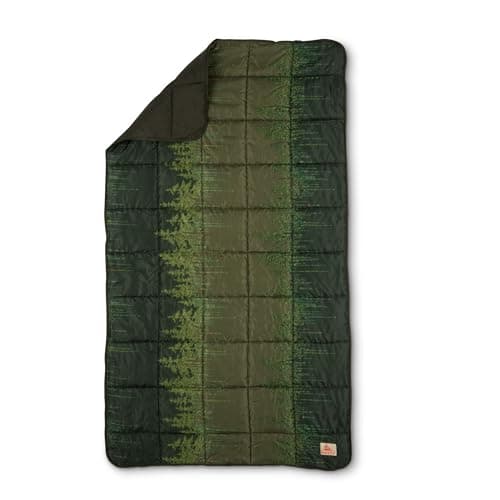
Kelty Bestie Blanket
Kelty
1.54 lb of CloudLoft synthetic at 75.59 in long in soft 75D taffeta and pongee, packing to a 6.75 by 11.5 in stuff sack.
Kelty publishes a 75.59 in length, a 42.13 in shoulder width, a 1.54 lb weight, CloudLoft synthetic insulation, a 75D printed polyester taffeta shell with a 75D polyester pongee liner, and a 6.75 by 11.5 in stuff sack.
The heavier 75D fabrics are the point. This is a blanket whose main job is being wrapped around a child in a camp chair while the temperature drops fifteen degrees after sunset, and for that a soft, substantial fabric beats an ultralight one that packs smaller.
Its second job is going over a sleeping bag on a colder night than planned — never inside it, where it compresses the bag's own fill and can leave a child colder than before. That distinction, and the rest of the sequence for a cold night, is in how to keep kids warm camping.
The drawback
42.13 in across the shoulder is one person only, and there is no attachment system, so it slides off a child who moves in the night.
Four things, in this order: an insulated sleeping pad, a sleeping bag that fits their length, their own headlamp, and a chair at their height. A child who is warm, can see and has somewhere to sit will tolerate almost everything else about camping.
QWhy does a sleeping pad matter more than the sleeping bag for kids?
Body weight crushes the insulation underneath a bag completely flat, so on that side the bag does nothing and the ground takes heat straight out of them. A child on a bare tent floor in a good bag will be cold; a child on a pad in a mediocre bag usually will not.
QCan a child use an adult sleeping bag?
It works badly. A bag warms you by trapping air your body heats, so a small child in an adult bag is heating two or three times the volume they should be. Shorten it instead: stuff the footbox with spare clothing or strap the bag a foot below their feet.
QAre kids' sleeping bag temperature ratings reliable?
Treat them as mild-conditions numbers. Children's bags are generally not tested to ISO 23537, so figures like Kelty's 30 F for the Mistral Kids 30 or TETON's 20 F for the Celsius Junior are the maker's own rather than standardized, and children lose heat faster than the adult manikin those tests use anyway.
QHow many lumens should a kids' headlamp have?
Far fewer than an adult's. Petzl publishes 20 lumens for the TIKKID, which covers reading in a tent (5 to 20 lm) and is adequate for a short walk. A 400 lumen adult headlamp in a child's hands mostly destroys everybody else's night vision.
QWhat seat height should a kids' camp chair be?
Low enough that their feet reach the ground. CORE publishes 14.5 in for the Youth Quad, against the 18 to 20 in this site looks for in adult chairs. A child whose feet dangle is uncomfortable within minutes, and a low seat is also much harder to tip over backwards.
How we picked
Everyone else in this category will tell you they tested twenty of these. We have not tested any of them, and we would rather say so than pretend. There is no gear closet here and no test lab.
What we did instead: pulled the published specifications from each manufacturer's own spec sheet or manual, named the standard behind every rating so you can check what it actually promises, did the arithmetic that turns a spec into a decision, and pulled today's real retail price rather than quoting one from memory. Every pick states a drawback, because a list where nothing is wrong with anything is an advert.
The limits of that method, stated plainly: published specs do not capture zipper quality, seam durability, or how a tent behaves at 2am in a storm. Where that matters, we say so on the pick. The full method is here.