Trail & Tarp earns a commission from qualifying purchases made through links on this page, at no extra cost to you. Full disclosure.
The honest summary
The short answer
Rechargeable lights are brighter, lighter and cheaper to run. Disposable-battery lights are more predictable, work better in the cold, and can be brought back to life at a gas station at 9pm. Take one rechargeable and one battery light and stop thinking about it. The failure modes are different, which is precisely why owning one of each is not redundancy for its own sake.
Rechargeable lithium
Disposable AA / AAA
Peak brightness
Higher for the weight
Lower
Runtime at low
Long, and regulated
Very long, and it fades
Cold weather
Capacity drops noticeably
Lithium primaries excel; alkalines suffer
Refilling in the field
Needs a power source
A shop, or the spares in your pocket
Cost per night
Effectively zero
Ongoing
Long storage
Self-discharges; store at part charge
Alkalines leak; lithium primaries store for years
When it dies
It is a paperweight until charged
Two minutes and a new cell
How the two power types behave in the situations that actually come up at a campsite.
Where rechargeable wins
Output for weight, and running cost. A Coleman OneSource 1000-Lumen Rechargeable Lantern publishes 1,000 lm on high and 50 lm on low, 2 hours at high and up to 100 hours at low, a 4,800 mAh lithium-ion battery and an IPX4 rating. Nothing running on AA cells produces 1,000 lumens in a package you would carry, and nothing running on AA cells gets 100 hours out of a single fill.
Regulation is the less obvious advantage. Lithium cells hold voltage until they are nearly empty, so a regulated rechargeable light stays at its stated output and then drops off quickly. That is useful: what you get is what was advertised, right up to the end.
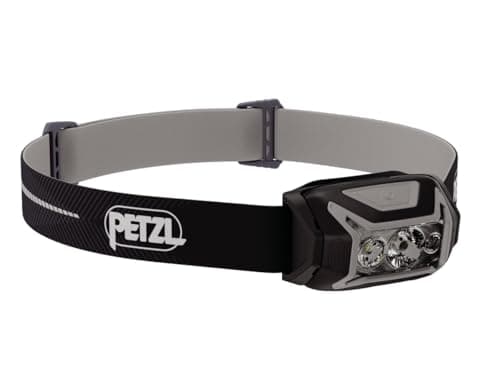
The same logic holds for headlamps. A Petzl Actik Core publishes 600 lm, 2 hours at 600 lm and up to 100 hours at 7 lm, on a 1,250 mAh CORE battery — and it accepts 3 AAA cells as a fallback, which is the hybrid answer discussed below.
Where disposable batteries win
Three situations, and they are not edge cases.
Cold. Lithium-ion capacity falls as temperature drops, and a battery that gave you a weekend in July gives noticeably less in October. Lithium primary cells — the disposable AA lithiums, not alkalines — are the best performers in cold of anything on this page.
Long trips without power. Beyond about three nights with no vehicle and no power station, a set of spare cells in a pocket beats a battery you cannot refill.
The light that lives in the box all year. A lithium-ion cell self-discharges and degrades if stored flat or full. Lithium primary cells hold charge for a decade. For the emergency light in the car, disposables win outright.
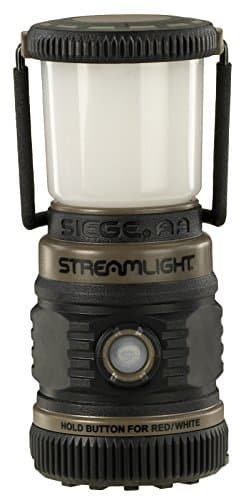
A Streamlight Siege AA publishes 200, 100 and 50 lm modes with 7, 15.5 and 37 hour runtimes on 3 AA cells, an IPX7 rating for 1 m submersion and about 8.8 oz. Two hundred lumens is not impressive on paper and is entirely adequate for a tent or a table, and IPX7 is a genuinely higher water rating than most rechargeables carry.
The hybrid is the real answer for headlamps
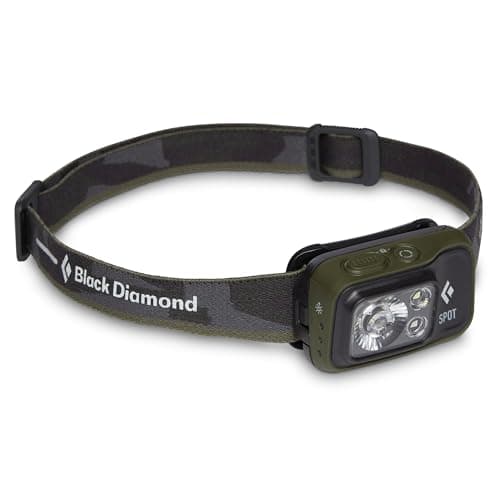
Several headlamps take a proprietary rechargeable pack or standard AAA cells in the same housing. The Petzl Actik Core takes its CORE battery or 3x AAA; the Black Diamond Spot 400 publishes 400 lm, 2.5 hours at high and 200 hours at low on 3 AAA, or the BD 1500 rechargeable, plus an IPX8 rating for 1.1 m for 30 minutes. That combination removes the entire argument: recharge at home, carry three AAAs as insurance. Full comparison in the headlamp roundup.
Runtime numbers, and how to read them fairly
Headlamps sold in the US and EU usually publish figures to ANSI/PLATO FL1, which defines how output, runtime, beam distance and water resistance are measured. Lanterns often do not, and camping lights of other kinds almost never do. That means a headlamp runtime figure is comparable across brands and a lantern figure may not be.
Two habits protect you. First, compare the low setting, because that is where a light spends its evening — and note that a 100-hour low on a lantern and a 37-hour low on a AA lantern are both far more than a weekend needs. Second, treat any single number without a mode attached as marketing.
Cost, over a realistic number of trips
A camping family runs maybe eight to fifteen nights a year. At two lanterns and three headlamps, all on disposables, that is a meaningful number of cells over a season, and it is the recurring cost people forget when they compare purchase prices.
Rechargeable lights remove that cost and add a different one: you need somewhere to recharge. In a campground with hookups, or with a power station, that is solved. Without either, a weekend is fine and a week is not. The sizing math for how much power lighting actually needs is in what size power station do I need — the short version is that lights are a rounding error next to charging phones.
The rule this site uses
One rechargeable lantern as the main light, because it is the brightest thing you own for its weight and it costs nothing to run. One AA or AAA lantern or headlamp as the backup, kept with fresh cells taped to it, because the failure mode of the first one is a dead battery and the failure mode of the second is a shop being closed.
For anything ambient — the light over the table that makes an evening pleasant rather than functional — neither of these is the right tool, and the answer is in the string light roundup. The whole three-part lighting system is laid out in the lantern roundup.
The gear this page points to
Coleman OneSource 1000-Lumen Rechargeable Lantern
Coleman
1,000 lm high and 50 lm low, 2 h to 100 h, on a 4,800 mAh lithium pack. Nothing on AA cells matches this output for the size.
QAre rechargeable camping lights better than battery ones?
Brighter for their weight and effectively free to run, yes. But they need a power source to refill, and lithium-ion capacity falls in the cold. The practical answer is one rechargeable as the main light and one AA or AAA light as backup, because their failure modes are different.
QDo rechargeable lights work in cold weather?
Less well. Lithium-ion capacity drops as temperature falls, so a battery that lasted a weekend in summer gives noticeably less in autumn. Disposable lithium primary AA cells are the strongest cold-weather performers, well ahead of alkalines.
QWhat runtime do I need from a camp lantern?
Less than you think, if you read the low setting. A Coleman OneSource publishes up to 100 hours at 50 lm and a Streamlight Siege AA publishes 37 hours at 50 lm. Both cover a weekend of evenings several times over; the high-output figures are for short bursts.
QAre headlamp runtime figures comparable between brands?
Usually yes, because most headlamps sold in the US and EU publish to ANSI/PLATO FL1, which defines how output, runtime, beam distance and water resistance are measured. Lantern figures often are not published to any standard, so compare those more cautiously.
Sources
Every figure on this page comes from a published source. We have not tested this gear, so the numbers are the manufacturer's or the standard body's, not ours. How we research.