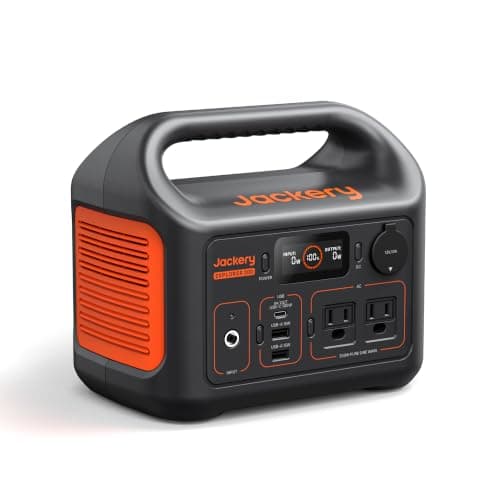
Jackery Explorer 300
Jackery
292 Wh and 300 W on LiFePO4 cells rated to over 4,000 cycles. The size that fits a family weekend.
$259.00 · Check price on Amazon
#ad how this is funded · price as of October 23, 2026
Two numbers decide this, and people shop on the wrong one. Watts is what you can run. Watt-hours is how long you can run it. Nearly everyone buys watts.
Trail & Tarp earns a commission from qualifying purchases made through links on this page, at no extra cost to you. Full disclosure.
The short answer
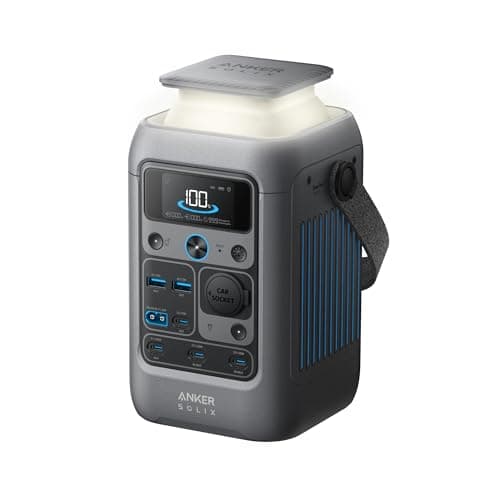
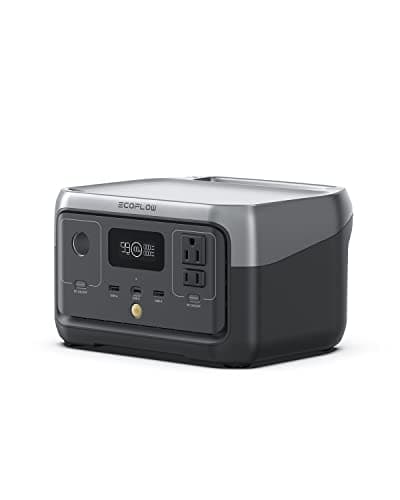
Watts (W) is the maximum a station can supply at any instant — it decideswhether a device will run. Watt-hours (Wh) is the size of the tank — it decides how long. For camping, watt-hours is almost always the number that runs out first. The Jackery Explorer 300 publishes 292 Wh and 300 W. The Anker SOLIX C300 publishes 288 Wh. The EcoFlow River 2 240 publishes 243 Wh and 300 W. Those 300 W figures are all identical in practice; the interesting differences are elsewhere.
A rough energy figure for a device is watts multiplied by hours. A 10 W fan running for six hours is 60 Wh. A phone battery is typically around 15 to 20 Wh, so charging one from flat costs about 20 Wh plus conversion losses. Assume roughly 85% real-world efficiency through an AC inverter and you will not be far out.
| What | Draw | Per day | Two-day total |
|---|---|---|---|
| 4 phones charged from half | About 10 Wh each | 40 Wh | 80 Wh |
| Rechargeable lantern top-up | About 18 Wh | 18 Wh | 36 Wh |
| 2 headlamp top-ups | About 5 Wh each | 10 Wh | 20 Wh |
| Tablet for the rained-off afternoon | About 30 Wh | 30 Wh | 30 Wh |
| Small 12 V fan, 4 hours | About 40 Wh | 40 Wh | 80 Wh |
| Total | About 138 Wh | About 246 Wh |
That is a normal, comfortable family weekend, and it lands under 250 Wh. Which is why a 292 Wh or 288 Wh station like the Jackery Explorer 300 or the Anker SOLIX C300 covers the overwhelming majority of camping trips, and why the 1,000 Wh units people are steered toward are solving a problem most campers do not have.
Everything above is electronics, and electronics are cheap in energy terms. Three things change the calculation completely, and all three involve making heat or cold:
Check the watts before you check the watt-hours
Capacity is useless if the device exceeds the output limit. A 300 W station runs laptops, fans, lights, chargers, a CPAP and most small appliances. It will not run a kettle, a toaster, a hair dryer, a microwave or a coffee machine, all of which draw 800 to 1,500 W. Look at the label on the device: if the wattage is above the station's continuous rating, no amount of capacity helps.
For a weekend of car camping, often not. Two rechargeable lanterns charged at home, a couple of headlamps with fresh batteries, and a decent USB power bank will cover two nights for a family without any of this complexity. A 20,000 mAh power bank holds roughly 74 Wh, weighs under a pound, and charges phones for a weekend.
A power station starts to earn its place at three nights and up, when there is a fridge or a medical device involved, when you camp somewhere with no hook-up and want the tent lit properly, or when you work from a campsite. Below that it is a heavy box you charge at home and carry back nearly full. The full comparison is in best portable power stations.
On a two-night trip you leave home full and never think about it. Beyond that, how you refill matters more than capacity.
From the car. A 12 V socket typically supplies around 100 W, so a 288 Wh station takes roughly three hours of driving to refill. That is genuinely useful on a trip with a drive between sites, and useless if you park and stay.
From solar. A 100 W panel in good conditions realistically delivers 50 to 70 W, so around five hours of usable sun to refill 288 Wh. Cloud, angle and temperature all cut that hard, and the honest planning figure is half the panel's rating.
From mains at a hook-up pitch. Fastest by far: EcoFlow publishes 60 minutes to full for the River 2 240. Jackery publishes no AC recharge time for the Explorer 300 at all, only a solar figure: 80% in about 2.8 hours on a 100 W panel.
All three stations above publish LiFePO4 chemistry, and Jackery and EcoFlow both publish 3,000 cycles to 80% capacity. That is roughly ten years of using it most weekends, against a few hundred cycles for the older lithium-ion chemistry. It is heavier for the same capacity, and for camping that trade is clearly the right way round.
Cold is the other consideration. Lithium batteries lose usable capacity in the cold and should not be charged below freezing; on a cold trip the station is better off in the car or the tent than in an unheated vestibule, exactly like a water filter.
Under 300 Wh covers phones, lights and a tablet for a family weekend, which is most camping. 500 to 800 Wh covers longer trips, working from a campsite, or a fan running most of the night. 1,000 Wh and up is for a 12 V fridge, a CPAP, or several days off-grid without a recharge. Buy for the trip you take, not the trip you might.
Jackery
292 Wh and 300 W on LiFePO4 cells rated to over 4,000 cycles. The size that fits a family weekend.
#ad how this is funded · price as of October 23, 2026
Anker
288 Wh at 6.17 lb, with four USB-C ports and up to 140 W over USB-C, if your devices are all USB rather than mains.
#ad how this is funded · price as of October 23, 2026
EcoFlow
243 Wh with a published 60 minute recharge, which is the one to take if you can plug in briefly between trips.
#ad how this is funded · price as of October 23, 2026
For a family weekend of phones, lights and a tablet, under 300 watt-hours is enough, which is why 288 Wh models cover most camping. Longer trips or working from a campsite want 500 to 800 Wh, and a 12 V fridge or a CPAP pushes you to 1,000 Wh or more.
Watts is the maximum power a station can deliver at once, which decides whether a device will run at all. Watt-hours is the stored energy, which decides how long it runs. For camping, watt-hours is usually the limit you hit first.
Not in this size class. Kettles, toasters and hair dryers draw roughly 800 to 1,500 W, well above the 300 W continuous output of the stations most campers buy. Boil water on a camp stove instead.
Plan on about half a panel's rated output in real conditions. A 100 W panel realistically delivers 50 to 70 W, so a 288 Wh station takes roughly five hours of usable sun. Cloud, panel angle and heat all reduce it further.
Every figure on this page comes from a published source. We have not tested this gear, so the numbers are the manufacturer's or the standard body's, not ours. How we research.