Decibels are the first specification, not the last
The short answer
Most campgrounds that allow generators at all restrict them to set hours and cap them at around 60 dB(A), and the decibel scale is logarithmic: 60 dB(A) is roughly twice as loud as 50 dB(A), not 20 percent louder. A generator that runs at 48 dB(A) at light load and one that runs at 58 are not in the same category of neighbor.
The complication is that published noise figures are not measured the same way. Honda quotes a range across loads. Champion publishes a single figure at 23 feet. Westinghouse publishes a single figure without stating the distance on the listing we read. Comparing them directly is approximate at best, which is worth knowing before you treat a 1 dB difference as meaningful.
What is comparable is the design. Every generator here is an inverter model, which means the engine speed varies with load rather than running flat out constantly. That is what makes modern camping generators tolerable, and it is also what produces clean enough power for laptops and phones.
Compared on published numbers
Generator
Running watts
Noise
Weight
Run time
Fuel
Honda EU2200i
1,800 W
48-57 dB(A)
47.4 lb
up to 8.1 h at 25 percent
gasoline
Champion 201183
1,850 W gas / 1,665 W propane
53 dB(A) at 23 ft
39 lb
11.5 h gas / 34 h propane
gasoline or propane
Westinghouse iGen4500
3,700 W
52 dB(A)
104.7 lb
up to 18 h at 25 percent
gasoline
Figures as published by each manufacturer. Noise measurement distances differ between makers.
How many watts you actually need
Running watts is the continuous figure and starting watts is the brief surge a motor draws as it spins up. Anything with a compressor or a motor in it — a fridge, an air conditioner, a power tool — needs the starting figure, and that is usually two to three times the running figure.
What you are running
Typical continuous draw
Comfortable generator size
Phones, lights, laptop charging
under 200 W
any of these, or no generator at all
12V fridge or small cooler
40-90 W running, higher on startup
1,800 W
Coffee maker or electric kettle
900-1,500 W
1,800 W, one appliance at a time
Microwave in a trailer
900-1,500 W
1,800 W minimum
RV air conditioner
1,200-1,800 W running, much higher starting
3,700 W
Our working guide. Check the nameplate on your own appliance rather than a category average.
The honest answer for most tent campers is that you do not need a generator at all. If the load is phones, lights and a camera battery, a power station is quieter, legal everywhere and needs no fuel — the sizing arithmetic is in what size power station do I need and the options in best portable power stations.
Carbon monoxide is the reason people die using these
A generator produces carbon monoxide continuously while running. It is odorless, and it kills people who put a generator under an awning, in a vestibule, in a truck bed with a canopy, or inside an RV compartment. Run it outdoors only, at least 20 feet from any tent or vehicle you sleep in, with the exhaust pointing away. Champion publishes a CO Shield automatic shutoff on the 201183 and it is a feature worth paying for, not a substitute for placement. The full account is in carbon monoxide and stove safety when camping, and a detector is covered in best carbon monoxide detectors for camping.
The rules you have to check before buying
Generator hours. Most campgrounds that permit them set windows, commonly something like 8am to 10am and 4pm to 8pm. Outside those hours the generator is off regardless of how quiet it is.
Loop restrictions. Many campgrounds have generator-free loops. Some state and national park campgrounds ban them entirely.
Decibel caps. Where a limit is published it is usually around 60 dB(A) measured at a set distance.
Fire restrictions. During high fire danger, generators are sometimes banned alongside campfires because of the exhaust and the fuel.
Check the specific campground, not the agency. These rules vary loop by loop, and the reservation page usually states them.
What to buy with it
A heavy-gauge outdoor extension cord is the first thing, because the generator needs to sit 20 feet away and the cord is what makes that practical. Undersized cords drop voltage over distance and heat up, so buy for the length you need rather than the length you have.
Beyond that: a running cover for weather so rain does not end the evening, and a fuel container if you are running gasoline. Store gasoline outside a sealed vehicle, never in the passenger compartment.
Which to buy
Buy the Honda EU2200i if you are camping near other people and quiet is the constraint. Buy the Champion 201183 if you want the lightest option, dual fuel, and CO shutoff at a lower price. Buy the Westinghouse iGen4500 only if you are running a trailer or an air conditioner, because at 104.7 lb it is the wrong tool for anything smaller.
And if all of this feels like a lot of machinery for charging a phone, it is. Compare it against a battery first in power banks vs power stations.
The picks in full
1. Best overall
Honda EU2200i
Honda
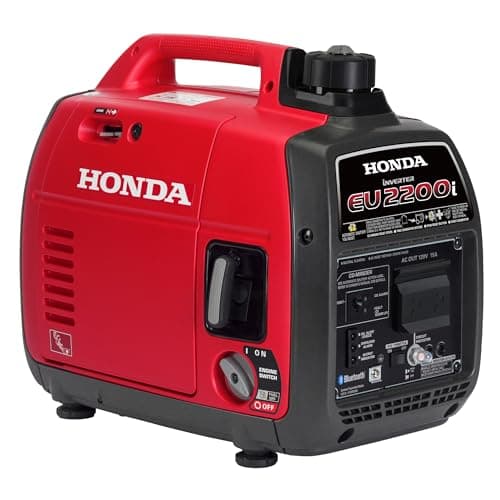
1,800 running watts at 48 to 57 dB(A), 47.4 lb, and up to 8.1 hours at quarter load on 0.95 gallons.
Honda publishes 1,800 running watts and 2,200 starting watts, a 47.4 lb dry weight, a noise range of 48 to 57 dB(A) depending on load, a 0.95 gallon tank, up to 8.1 hours at 25 percent load and about three hours at full load, sine-wave inverter output, and parallel capability with a second unit.
The 48 dB(A) figure at light load is the reason this generator has the reputation it does. It is the quietest thing in its class by a real margin, and at a campground where the alternative is being asked to turn it off, quiet is the specification that matters.
The drawback
It is gasoline only, so there is no propane option, and 0.95 gallons is a small tank. At full load it runs about three hours, which means refueling in the middle of an evening.
Published specs
Running output
1,800 W
Starting output
2,200 W
Dry weight
47.4 lb
Noise
48 to 57 dB(A) depending on load
Fuel tank
0.95 gal
Run time
up to 8.1 h at 25 percent load; about 3 h at full load
1,850 running watts on gasoline at 53 dB(A) from 23 feet, 39 lb, with CO Shield automatic shutoff.
Champion publishes 2,500 starting and 1,850 running watts on gasoline, 2,500 starting and 1,665 running on propane, a 39 lb weight, 53 dB(A) at 23 feet, up to 11.5 hours on gasoline and up to 34 hours on a 20 lb propane tank, a 79cc four-stroke engine, a 120V 20A duplex outlet plus 12V DC and dual USB, and a CO Shield carbon monoxide auto shutoff.
Thirty-nine pounds is the lightest here and the dual fuel capability is genuinely useful: a 20 lb propane tank you already own for the grill runs this thing for a day and a half, and propane does not go stale in the tank between trips.
The drawback
53 dB(A) is measured at 23 feet while Honda quotes its range at 7 meters, so the two numbers are not directly comparable. Propane output drops to 1,665 running watts.
No product photo: we don't take our own
Published specs
Gasoline output
2,500 W starting / 1,850 W running
Propane output
2,500 W starting / 1,665 W running
Weight
39 lb
Noise
53 dB(A) at 23 ft
Run time
up to 11.5 h gasoline; up to 34 h on a 20 lb propane tank
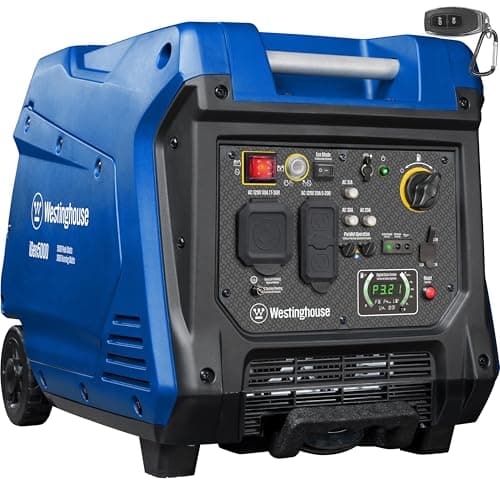
3,700 running watts at 52 dB(A), with a 30-amp RV outlet, remote start and up to 18 hours at quarter load.
Westinghouse publishes 4,500 peak and 3,700 running watts, a 104.7 lb weight, 52 dB(A) of noise, a 3.4 gallon tank, up to 18 hours at 25 percent load, less than 3 percent total harmonic distortion, a TT-30R 120V 30A RV outlet with two household outlets and two USB ports, and electric, recoil and remote starting.
The TT-30R outlet is the reason to buy this one specifically. If you are plugging in a travel trailer, that plug is what the trailer's cord fits, and everything smaller requires an adapter and a compromise on what you can run.
The drawback
104.7 lb. That is a two-person lift into a truck bed, and it is far more generator than tent camping needs.
For lights, phones and laptop charging, under 200 W, which no generator is needed for. For a coffee maker, a microwave or a 12V fridge, 1,800 running watts covers one appliance at a time. For an RV air conditioner, 3,700 running watts.
QHow quiet does a camping generator need to be?
Where campgrounds publish a limit it is usually around 60 dB(A). The scale is logarithmic, so 60 dB(A) is roughly twice as loud as 50. Honda publishes 48 to 57 dB(A) for the EU2200i and Champion publishes 53 dB(A) at 23 feet for the 201183.
QAre generators allowed at campgrounds?
It varies by campground and often by loop. Many permit them only during set hours, some have generator-free loops, and some ban them outright. Check the specific campground's reservation page rather than the agency's general rules.
QIs a generator or a power station better for camping?
For a tent camper charging phones, lights and a laptop, a power station is better: silent, legal everywhere, no fuel and no exhaust. A generator wins when you need to run high-draw appliances for hours, or recharge repeatedly without sun.
QWhere should I put a generator at a campsite?
Outdoors only, at least 20 feet from any tent or vehicle people sleep in, with the exhaust pointing away. Carbon monoxide is odorless and kills people who run generators under awnings, in vestibules or in covered truck beds.
How we picked
Everyone else in this category will tell you they tested twenty of these. We have not tested any of them, and we would rather say so than pretend. There is no gear closet here and no test lab.
What we did instead: pulled the published specifications from each manufacturer's own spec sheet or manual, named the standard behind every rating so you can check what it actually promises, did the arithmetic that turns a spec into a decision, and pulled today's real retail price rather than quoting one from memory. Every pick states a drawback, because a list where nothing is wrong with anything is an advert.
The limits of that method, stated plainly: published specs do not capture zipper quality, seam durability, or how a tent behaves at 2am in a storm. Where that matters, we say so on the pick. The full method is here.