Household CO alarms are deliberately slow at low concentrations to avoid nuisance alarms. Forensics Detectors states that home alarms typically sound above 70 ppm over 60 to 240 minutes, while its travel unit alarms above 9 ppm after 60 seconds. In a house that delay is a reasonable trade. In a tent or a van, the volume of air is tiny and the source is feet away.
This is the single most useful thing to understand about the category. Buying any CO detector is much better than buying none, but a low-level travel detector is doing a different job from the one screwed to your hallway ceiling.
Carbon monoxide is colorless and odorless, and the early symptoms — headache, nausea, confusion — are indistinguishable from being cold, tired and slightly altitude-affected, which is precisely the state most campers are in. You cannot detect it yourself. That is the whole argument for the device.
Compared on published numbers
Detector
Lowest alarm
Display
Battery
Weight or power
Rating
Forensics Detectors Travel CO
9 ppm after 60 sec
none
1 year, 2x CR2032
1.8 oz
not published
Forensics Detectors Portable CO
25 ppm TWA
0-100 ppm at 1 ppm
2 years, sealed
buzzer, LED, vibration
IP67
Kidde COB
household thresholds
LED status only
2x AA
85 dB alarm
UL 2034 5th Ed.
Figures as published by each manufacturer.
What produces carbon monoxide at a campsite
Any fuel-burning stove. Propane, butane, white gas, alcohol and canister stoves all produce CO, and they produce far more of it when the flame is starved of oxygen — which is exactly what happens inside a zipped tent.
Charcoal, in any quantity. Charcoal brought into a tent or an awning to warm it is the classic fatal mistake, because it produces CO for hours after the visible glow has gone.
Generators. A generator under an awning, in a truck bed with a canopy, or in an RV compartment kills people every year. Options and placement are in best camping generators.
Catalytic and propane tent heaters. These consume oxygen from the space they are heating, and CO output rises as oxygen falls.
A vehicle idling nearby, particularly if you are sleeping in it or beside it with a window open.
Carbon monoxide is very close to the density of air, so it mixes rather than sinking or rising the way people assume. Put the detector at roughly head height where you sleep, not on the tent floor and not in the peak. Keep it out of the direct path of stove exhaust, which will trip it on a reading that does not represent the air you are breathing. In a van or an RV, put it in the sleeping area rather than the galley. And test it before the trip, not at the campsite.
What the numbers mean
Concentration
What it represents
0-2 ppm
normal outdoor background
9 ppm
the maximum indoor level in long-term public health guidance
25-35 ppm
occupational exposure limits over an eight-hour shift
70 ppm
roughly where household alarms begin to respond, over one to four hours
150 ppm and up
an acute hazard requiring immediate fresh air
Reference points reflected in the alarm thresholds the makers above publish.
Note that all of these are exposure over time, not instantaneous doses. That is why a detector that alarms in 60 seconds at 9 ppm is doing something structurally different from one that alarms in an hour at 70.
What to do when it goes off
Open the tent or the van and get everyone outside into moving air. Do not spend time diagnosing it first. Turn off any burning appliance if you can do that on your way out, and do not go back in until the alarm has cleared and stayed clear.
If anyone has a headache, nausea, dizziness or confusion, treat that as a medical emergency rather than as tiredness, because the symptoms worsen with continued exposure and judgment is one of the first things affected. A basic kit and a plan are in best camping first aid kits.
Which to buy
Buy the Forensics Detectors Travel CO Detector if you camp in a tent, a van or a rented cabin and want the lowest alarm threshold in the smallest package. Buy the portable industrial model if you want a live reading you can use to check your own ventilation. Buy the Kidde for a cabin or a trailer that needs a permanent alarm.
And whichever you buy, replace it on schedule. Electrochemical CO sensors degrade whether or not they have ever seen carbon monoxide, so an old detector is a decoration. A pack of spare CR2032 cells in the same pocket is the cheapest way to make sure it is actually working when it matters.
The picks in full
1. Best overall
Forensics Detectors Travel CO Detector
Forensics Detectors
Alarms at 9 ppm and 25 ppm, sounding above 9 ppm after 60 seconds, at 1.8 oz and 2.7 inches long.
Forensics Detectors publishes alarm points at 9 ppm and 25 ppm, an alarm above 9 ppm after 60 seconds, thresholds set against WHO, EPA, ASHRAE, OSHA and NIOSH guidance, one year of battery life from two installed CR2032 cells, dimensions of 2.7 by 1.9 by 0.8 in, and a weight of 1.8 oz / 50.8 g.
The 9 ppm figure is the entire reason to buy a travel-specific unit. The maker contrasts it directly with household alarms, which it states typically alarm above 70 ppm over 60 to 240 minutes. In a small enclosed space that difference is not academic.
The drawback
One year of battery life from two CR2032 cells, so it needs replacing or re-batterying annually, and it has no numeric display.
An electrochemical sensor reading 0 to 100 ppm at 1 ppm resolution, with four alarm setpoints, IP67 and a two-year battery.
Forensics Detectors publishes an electrochemical sensor measuring 0 to 100 ppm at 1 ppm resolution, alarm setpoints of 25 ppm TWA, 30 ppm STEL, 50 ppm low instantaneous and 150 ppm high instantaneous, a triple-alert system of buzzer, LED and vibration, IP67 water and dust protection, and a two-year sealed battery life.
The reason to want a reading rather than an alarm is diagnosis. If a number climbs from 2 to 12 ppm when you run a heater, you have learned something specific about your ventilation. An alarm that stays silent tells you only that you are below its threshold.
The drawback
It is an industrial instrument with industrial alarm thresholds, the lowest of which is 25 ppm. As a low-level early warning it is less sensitive than the travel unit.
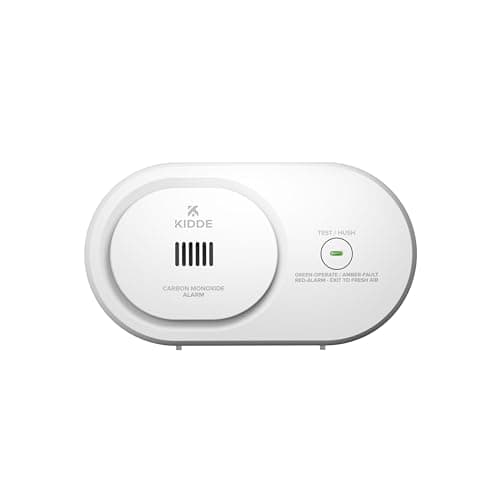
An 85 dB alarm with an LED warning light, running on two AA batteries, with a Test/Hush button and no display.
Kidde publishes an 85 dB alarm with an LED warning light for the hazard, power from two included AA batteries with no wiring, LED status lights rather than a numeric display, a Test/Hush button that both tests the unit and temporarily silences it, wall or tabletop mounting, testing to UL 2034 5th Edition with an ETL listing, and a 10-year limited warranty on the alarm.
For a cabin, a trailer or a long-term basecamp this is a sensible, inexpensive fixture. For a tent it is the wrong shape and the wrong threshold, and it is here so the difference is visible.
The drawback
It is a household alarm, so it follows household thresholds designed to avoid nuisance alarms rather than to give early warning. It gives you a noise rather than a number, and Kidde publishes no weight or dimensions for it, so you cannot compare its bulk against a travel unit on paper.
Published specs
Alarm
85 dB, with an LED warning light for the hazard
Power
2x AA batteries, included; no wiring
Display
none; LED status lights only
Controls
Test/Hush button, for a check or a temporary silence
QDo I need a carbon monoxide detector for camping?
If you use any fuel-burning stove, heater or generator near a tent, van or RV, yes. Carbon monoxide is colorless and odorless, and its early symptoms are indistinguishable from being cold and tired, which is the state most campers are already in.
QCan I use a household CO alarm in a tent?
It is better than nothing and it is the wrong tool. Household alarms are deliberately slow at low levels to avoid nuisance alarms; Forensics Detectors states they typically sound above 70 ppm over 60 to 240 minutes, against 9 ppm after 60 seconds for its travel unit.
QWhere should a CO detector go in a tent?
At roughly head height where you sleep. Carbon monoxide is close to the density of air so it mixes rather than sinking or rising. Keep it out of the direct path of stove exhaust, and test it before the trip rather than at the campsite.
QWhat CO level is dangerous?
Normal outdoor background is 0 to 2 ppm, 9 ppm is the maximum in long-term indoor public health guidance, 25 to 35 ppm reflects eight-hour occupational limits, and 150 ppm and above is an acute hazard. All of these are exposure over time rather than instant doses.
How we picked
Everyone else in this category will tell you they tested twenty of these. We have not tested any of them, and we would rather say so than pretend. There is no gear closet here and no test lab.
What we did instead: pulled the published specifications from each manufacturer's own spec sheet or manual, named the standard behind every rating so you can check what it actually promises, did the arithmetic that turns a spec into a decision, and pulled today's real retail price rather than quoting one from memory. Every pick states a drawback, because a list where nothing is wrong with anything is an advert.
The limits of that method, stated plainly: published specs do not capture zipper quality, seam durability, or how a tent behaves at 2am in a storm. Where that matters, we say so on the pick. The full method is here.