The Best Camping First Aid Kits, Sized by People and Days
A first aid kit is the one purchase you hope stays sealed. Which is exactly why buying a finished one beats assembling your own and discovering the gap at 10pm.
Blister treatment, adhesive bandages, painkillers, antiseptic wipes and tweezers. In that order, by a wide margin. The dramatic contents of a first aid kit are insurance. The consumables above are what empties, and the failure mode of a self-assembled kit is not missing a splint, it is running out of plasters on day two with a blister still to dress.
That is the practical case for buying a finished kit rather than building one. Not that a bought kit is better stocked — you can beat any of them by shopping deliberately — but that it is complete. A homemade kit is reliably missing the item you did not think of, because the item you did not think of is precisely the one you need.
Kit
Sized for
Weight
Waterproofing
Standout
AMK Mountain Series Hiker
2 people, 1-2 days
Under 8 oz
Water-resistant bag
External kit map, first aid manual
AMK Ultralight/Watertight .7
1-2 people, 1-4 days
5.8 oz
Waterproof DryFlex inner
Tick forceps, seam-sealed outer
Surviveware Small
Family or vehicle use
Not published
Water resistant (IPX7 version sold separately)
Compartments labeled by injury type
All figures as published by the manufacturers.
Sizing by people and days beats counting pieces
Adventure Medical Kits labels its Mountain Series by group size and trip length, and it is the most useful shorthand in the category. Two people for two days is a weekend for a couple. A family of four on a five-day trip is roughly five times that demand, and the honest answer is to buy the larger kit rather than to hope.
The other way to size it is by distance from help. At a developed campground twenty minutes from a town, your kit needs to handle the small stuff until you can drive somewhere. Two hours up a trail, it needs to handle the same small stuff for considerably longer, plus the first hour of something serious.
Add these five things to any kit you buy
Every bought kit is missing something personal, and these are the five that matter. Your own medication, including anything prescribed, plus antihistamines. More blister treatment than the kit contains — it is always the first thing to run out. Extra moleskin or blister pads costs very little. A tick remover if the kit lacks one. Burn dressings, because camp stoves and fire rings produce more small burns than any other camping activity. And a card with names, contacts and allergies for everyone in the group, because the person who knows that information may be the casualty.
Restock it on the same day, every time
A kit that has been used and not restocked is worse than no kit, because you plan around having it. Build the check into the end of every trip: unpack the kit at the same time as the camp bin, replace what was used, and check the expiry dates on medication and the adhesive on the tape, both of which fail with age and heat. A kit that spent two summers in a hot car has tape that no longer sticks.
What no kit contains, and what it is worth
Supplies are the easy half. The hard half is knowing what to do, and no product solves that. A wilderness or outdoor first aid course — typically a weekend — is the single highest-value purchase in this category and it is not a purchase we can link you to. It teaches the thing kits cannot: when to treat and go on, and when to stop and get help.
We publish no medical advice, no dosages and no treatment instructions. We are not qualified to, and a camping website that pretends otherwise is a hazard rather than a resource. What this page does is compare kits on their published contents so you can buy a complete one. More on where we draw that line in how we research, and the rest of the safety kit in campfire safety basics.
The picks in full
1. Best all-round camping kit
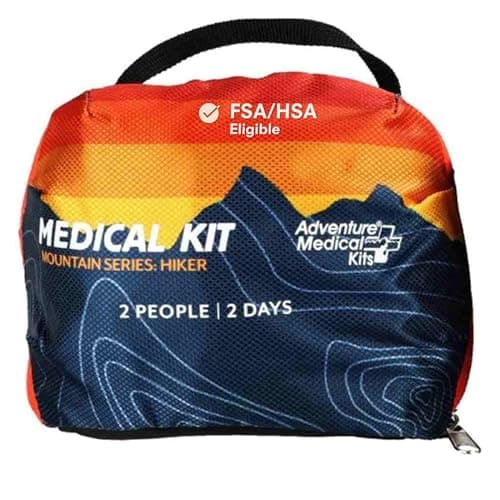
Adventure Medical Kits Mountain Series Hiker
Adventure Medical Kits
Under 8 oz for two people over one to two days, in a reflective water-resistant bag with an external contents map.
Adventure Medical Kits publishes a sizing of two people for one to two days, a weight under 8 oz, a durable water-resistant bag, an external kit map showing where each supply sits, a reflective design for finding it at night, and contents including a trauma pad, butterfly closures, conforming gauze, cloth tape, sterile gauze dressings, five fabric adhesive bandages and five knuckle bandages, alongside a wilderness first aid manual.
The kit map is the feature that separates a usable kit from a bag of supplies. Finding gauze in an unfamiliar pouch by headlamp while someone is bleeding is a genuinely unpleasant experience, and printing the layout on the outside removes it entirely.
The manual is the other reason this leads. Nobody reads it in advance and everybody is grateful for it when a decision has to be made about whether a cut needs closing. It weighs almost nothing and it is the only part of the kit that improves your judgment rather than your supplies.
The drawback
Sized for two people and two days, so a family of four burns through it fast. Water-resistant is not waterproof.
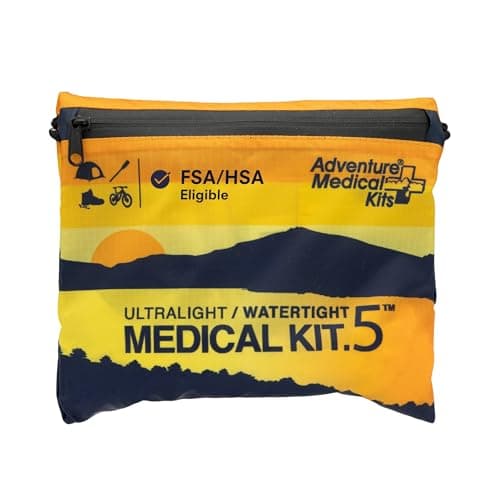
5.8 oz with a genuinely waterproof DryFlex inner bag inside a seam-sealed outer, covering one to two people for up to four days.
Adventure Medical Kits publishes a 5.8 oz weight, dimensions of 10 x 7.5 x 2 in, a 100% waterproof DryFlex inner bag, an outer seam-sealed nylon bag with a water-resistant zip and a durable water repellent finish, sizing for one to two people over one to four days, and contents including bandages, gauze, moleskin for blisters, nitrile gloves, tweezers, antiseptic wipes and tick removal forceps.
A soaked first aid kit is a useless one. Gauze wicks water instantly, tape stops sticking and paper packaging disintegrates, and a kit that lives in the bottom of a pack in sustained rain will get wet. The DryFlex inner is the answer to that, and it is the reason this is the backpacking pick rather than the camp pick.
Note the tick forceps. On a camping trip in most of North America and Europe, removing a tick correctly and promptly is a far more likely intervention than anything dramatic, and doing it with fingers or ordinary tweezers is how the mouthparts get left behind.
The drawback
The double bag is slower to open, and 5.8 oz buys fewer consumables than a heavier kit. It is a personal kit, not a group one.
100+ supplies in labeled compartments sorted by injury type, in a 600D shell with MOLLE straps and a removable panel.
Surviveware publishes 100+ first aid supplies, a 6 x 7 x 3 in footprint, a rip-resistant 600D polyester shell, internal contents protected in laminate pouches, labeled inner compartments sorted by injury type — bleeding, burns, medications, tools, wound care — MOLLE straps and snaps, and a removable velcro panel. A separate waterproof version rated IPX7 is also sold.
Sorting by injury type rather than by item type is the right idea, and it is rarer than it should be. Under stress you do not think “I need 4x4 gauze,” you think “this is bleeding,” and a compartment labeled the second way is the one you can use.
Be skeptical of the piece count. 100+ pieces sounds comprehensive and mostly counts individual adhesive bandages and wipes. Judge a kit on whether it contains the five categories in the table below, not on how many things are in it.
The drawback
Piece counts are inflated by consumables such as individual bandages, and the standard version is water resistant rather than waterproof.
Blister treatment, adhesive bandages in several sizes, gauze and tape, antiseptic wipes, tweezers or tick forceps, nitrile gloves, painkillers, and any personal medication. Blister treatment and bandages are what run out first on almost every trip.
QWhat size first aid kit do I need for camping?
Size it by people and days, and by distance from help. Adventure Medical Kits labels its Mountain Series that way: the Hiker covers two people for one to two days. A family of four on a longer trip needs a substantially larger kit.
QShould I buy a first aid kit or build my own?
Buy one and then add to it. A bought kit is complete, which is its real advantage; a homemade one is usually missing the item you did not think of. Add personal medication, extra blister treatment, a tick remover and burn dressings to whatever you buy.
QDoes a camping first aid kit need to be waterproof?
For backpacking and paddling, yes. Gauze wicks water instantly, tape stops sticking and paper packaging disintegrates. The AMK Ultralight/Watertight .7 uses a waterproof DryFlex inner bag inside a seam-sealed outer for exactly this reason.
How we picked
Everyone else in this category will tell you they tested twenty of these. We have not tested any of them, and we would rather say so than pretend. There is no gear closet here and no test lab.
What we did instead: pulled the published specifications from each manufacturer's own spec sheet or manual, named the standard behind every rating so you can check what it actually promises, did the arithmetic that turns a spec into a decision, and pulled today's real retail price rather than quoting one from memory. Every pick states a drawback, because a list where nothing is wrong with anything is an advert.
The limits of that method, stated plainly: published specs do not capture zipper quality, seam durability, or how a tent behaves at 2am in a storm. Where that matters, we say so on the pick. The full method is here.