The Best Emergency Blankets and Bivvies, for the Night You Did Not Plan
The two-dollar foil sheet in every kit reflects 90 percent of your body heat and then soaks you in your own condensation. There is a better version and it weighs eight ounces.
Reflection and breathability pull against each other
The short answer
A metalized surface reflects radiant body heat back at you. The more completely sealed that surface is, the better it reflects and the more of your own moisture it traps. A foil blanket reflects 90 percent and condenses; a breathable bivvy reflects 70 percent and lets vapor through. For minutes, take the reflection. For a night, take the breathability.
This is the whole decision and it maps cleanly onto use. Treating someone for shock or cold at a trailhead for twenty minutes while help arrives is a blanket job. Sitting out an unplanned night because you misjudged the daylight is a bivvy job, because eight hours of trapped sweat will make you colder than the reflection makes you warmer.
An adult at rest produces a meaningful amount of water vapor overnight, and none of it can escape a sealed foil bag. That is the mechanism, and it is why experienced people carry the heavier item.
Compared on published numbers
Item
Weight
Heat reflection
Breathable
Form
Durability
SOL Escape Bivvy
8.5 oz
70 percent
yes
bag with hood, zip and footbox
reusable
SOL Escape Lite Bivvy
5.5 oz
70 percent
yes
bag
emergency use, or a bag liner
SOL Heatsheets Blanket
2.9 oz; XL 3.2 oz
90 percent
no
flat sheet, 56 x 84 in
will not shred if nicked, repairable
Figures as published by SOL.
What these are actually for
An unplanned night out. The commonest real scenario: a day hike that ran long, an injury, a wrong turn. A bivvy plus an insulating layer plus a headlamp turns this from an emergency into a bad night.
First aid for cold and shock. A blanket wrapped around a casualty while you wait. This is the one job where the 90 percent figure is the right choice.
Ground insulation. Underrated. Laid on the ground, a blanket stops conductive heat loss into cold earth, which is where most of your heat goes when you are lying down.
A shade tarp. Silver side out, it reflects sun rather than body heat, which matters in desert conditions.
Signalling. The orange side of the Heatsheets is visible from the air in a way that almost nothing else in your pack is.
A bivvy is not a shelter on its own
These reflect heat you are producing; they do not generate any. Someone who is already hypothermic, soaked and exhausted will not be rewarmed by a reflective bag alone. The sequence that works is get out of the wind, get something insulating between the person and the ground, get wet layers off if you have a dry one, add calories and warm fluid, and then use the bivvy to hold what heat there is. Ground insulation matters more than the bivvy — the mechanism is the same one in why you get cold in a sleeping bag.
Where to keep them
The value of an emergency item is entirely a function of whether it is with you, and these are light enough that there is no argument for leaving one behind. A Heatsheets at 2.9 oz belongs in every daypack, every first aid kit and the glovebox permanently.
Keep the packaging sealed until you need it. Once a blanket has been opened it will never go back into anything close to its original size, which is the practical reason people end up carrying an opened one loose in the bottom of a pack for years and then find it torn.
The rest of the unplanned-night kit
A bivvy is one of four things, and on its own it is the least important. A headlamp with working batteries is first, because most unplanned nights start with running out of daylight — see best headlamps for camping. An insulating layer is second. A way to call for help is third, and in genuine backcountry that means a satellite messenger rather than a phone.
Buy a Heatsheets blanket regardless — at 2.9 oz there is no reason not to have one in every bag. Add the Escape Bivvy if you hike far enough from the trailhead that a night out is a real possibility. Take the Escape Lite instead if you are counting grams, and use it as a bag liner on ordinary trips so it earns its place.
The picks in full
1. Best overall
SOL Escape Bivvy
SOL
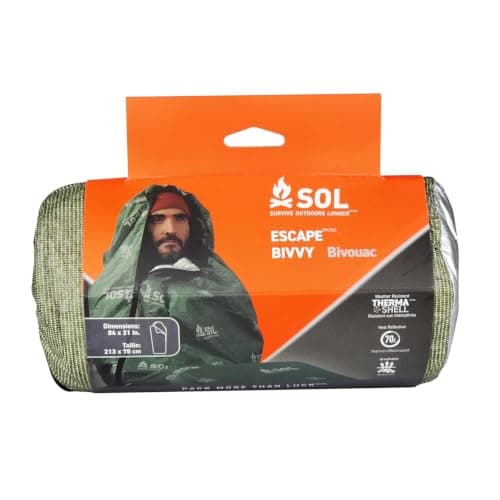
8.5 oz reflecting a published 70 percent of body heat, in a breathable ThermaShell fabric with a hood, side zip and formed footbox.
SOL publishes a weight of 8.5 oz, an Escape ThermaShell metalized spunbonded olefin fabric, 70 percent body heat reflection, breathable construction producing less condensation than a standard emergency blanket, and a full hood, drawcord closure, 23 in side zipper and a fully formed footbox.
Breathability is the entire reason this exists. A non-breathable emergency bag traps every gram of moisture you produce, and by morning you are lying in a wet sack, which is actively worse than being dry and cold. Ten percent less reflection in exchange for that is a good trade.
The drawback
Reflects 70 percent against 90 for a foil sheet, and weighs nearly three times as much. You are paying weight and reflectivity for breathability.
Published specs
Weight
8.5 oz
Material
Escape ThermaShell, metalized spunbonded olefin
Heat reflection
70 percent of body heat
Breathable
yes, so less condensation than a foil blanket
Features
full hood, drawcord closure, 23 in side zipper, formed footbox
5.5 oz with the same published 70 percent heat reflection and breathable construction.
SOL publishes a weight of 5.5 oz, 70 percent body heat reflection, breathable construction, and use as either an emergency shelter or a lightweight sleeping bag liner.
The liner use is the one worth planning around. Slipping this inside a bag adds a reflective layer and a few degrees on a night that turned colder than forecast, which means the thing you carry for emergencies is not dead weight on ordinary trips — see do you need a sleeping bag liner.
The drawback
Three ounces lighter means thinner and less durable. It is an emergency item rather than something to sleep in repeatedly, and it lacks the full feature set of the standard Escape.
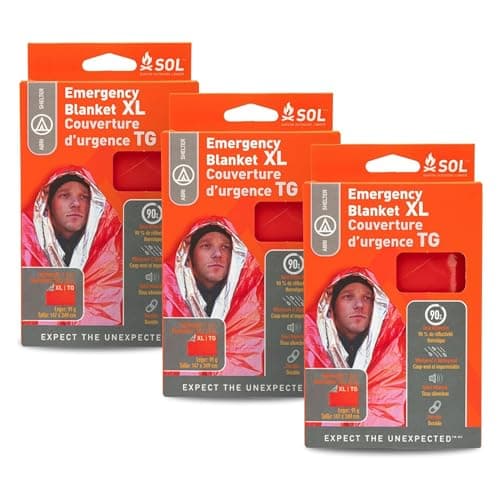
2.9 oz reflecting a published 90 percent of body heat, in polyethylene that will not shred when nicked, with a high-visibility orange side.
SOL publishes a 56 by 84 in size at 2.9 oz, an XL at 58 by 98 in and 3.2 oz, vacuum-metalized polyethylene, 90 percent body heat reflection, construction that will not shred if nicked and can be repaired, a high-visibility orange exterior, and waterproof and windproof performance.
The difference from a supermarket mylar sheet is that this does not disintegrate. A cheap foil blanket tears from the first nick and is confetti within minutes in wind, which is exactly when you need it to stay in one piece.
The drawback
Not breathable. Used as a wrap for hours it will condense your own sweat against you, which is the classic failure of every foil blanket ever carried.
For short periods, yes. SOL publishes 90 percent body heat reflection for its Heatsheets blanket. The limitation is that they are not breathable, so used for hours they condense your own moisture against you, which ends up making you colder.
QWhat is the difference between an emergency blanket and a bivvy?
A blanket is a flat reflective sheet, lighter and more reflective. A bivvy is a bag you get inside, heavier and breathable. SOL publishes 90 percent reflection for the blanket and 70 percent for the Escape Bivvy, which reflects less and lets vapor out.
QCan you sleep in an emergency bivvy?
In a breathable one, for a night, uncomfortably. That is what it is for. A non-breathable foil bag will leave you lying in condensation by morning, which is worse than being dry and cold. Ground insulation underneath matters more than the bivvy itself.
QWhere should I keep an emergency blanket?
In every daypack, every first aid kit and the glovebox, permanently. At 2.9 oz the weight argument does not exist. Keep the packaging sealed until you need it, because an opened blanket never repacks to anything like its original size.
How we picked
Everyone else in this category will tell you they tested twenty of these. We have not tested any of them, and we would rather say so than pretend. There is no gear closet here and no test lab.
What we did instead: pulled the published specifications from each manufacturer's own spec sheet or manual, named the standard behind every rating so you can check what it actually promises, did the arithmetic that turns a spec into a decision, and pulled today's real retail price rather than quoting one from memory. Every pick states a drawback, because a list where nothing is wrong with anything is an advert.
The limits of that method, stated plainly: published specs do not capture zipper quality, seam durability, or how a tent behaves at 2am in a storm. Where that matters, we say so on the pick. The full method is here.