The Best Satellite Messengers and Beacons, Compared on What They Actually Do
These devices all have an SOS button and they are not the same product. One sends messages, one sends a distress signal, and the difference decides which you should own.
One-way Globalstar check-ins, custom messages, tracking and SOS at 5 oz, running on 4 AAA lithium cells with 26 to 52 days of tracking at 60-minute intervals.
Check-ins and tracking on a budget, with replaceable batteries
A satellite messenger is a communication device with an SOS function: subscription, two-way or one-way texting, tracking and location sharing. A personal locator beacon is an emergency transmitter on the government-run 406 MHz search and rescue system: no subscription, no messaging, a battery measured in years. Both will summon help. Only one will tell your family you are running late.
Device
Network
Messaging
Weight
Power
Subscription
Garmin inReach Mini 2
Iridium
Two-way text, tracking, sharing
100 g
Rechargeable, 14-30 days tracking
Required
ACR ResQLink 400
406 MHz SAR (Cospas-Sarsat)
None; distress signal only
148 g
Lithium, 5 year interval
None
SPOT Gen4
Globalstar
One-way check-ins and custom messages
142 g
4x AAA, 26-52 days tracking
Required
All figures as published by the manufacturers.
How to choose between them
Buy a PLB if you camp occasionally, want an emergency device that works without maintenance, and do not want a recurring bill. It sits in a pack for years and then works.
Buy a two-way messenger if you go out regularly, if people at home worry, or if you travel solo. The ability to say “delayed, all fine, back tomorrow” is the feature you will actually use, and it prevents the false alarm that a missed return time would otherwise trigger.
Buy a one-way messenger if you want check-ins and tracking at lower cost and can accept never receiving confirmation. The full comparison, including two-way radios which are a different thing again, is in satellite messenger vs PLB vs two-way radio.
None of these replaces telling somebody your plan
The single most valuable safety measure in camping is free: give one person at home your route, your intended site, your return time and your vehicle description. A device summons help once you decide you need it. A filed plan means somebody starts looking even if you never got the chance to press anything. That habit is in dispersed camping for beginners.
What they need to work
A clear view of the sky. All three talk to satellites, and none of them works reliably inside a tent, in a slot canyon, under dense forest canopy or in a vehicle. Take the device outside and give it a clear horizon and a few minutes.
They also need battery, which is the one respect in which they are more fragile than a compass. Keep the device warm in cold weather, because lithium capacity falls with temperature — the same point made in power banks vs power stations. The SPOT's replaceable AAA cells sidestep this partly, because you can carry lithium primary spares.
Registration, which is not optional for a PLB
A 406 MHz beacon must be registered with your national authority — NOAA in the United States. Registration links the beacon's unique identifier to you, your emergency contacts and your typical activities, and it is what turns a distress signal into a fast, informed response rather than a slow, blind one. It is free and it takes a few minutes.
Keep it current when you move house or change contacts, and test the beacon using its self-test function — never by activating it. Subscription messengers have their own equivalent: keep the emergency contacts in your account up to date, because those are the people the coordination center will call.
What this page will not do
It will not tell you when to press the SOS button, what happens afterwards, or how to behave in an emergency. That is search and rescue and emergency services territory, and a gear site inventing protocol is a genuine hazard. The manufacturer documentation and the NOAA and Cospas-Sarsat pages linked below are the authority.
What this page compares is published specifications: network, messaging capability, weight, battery life and subscription model. We have not tested any of these devices and, in the one respect that matters most, could not. See how we research.
The picks in full
1. Best all-round satellite messenger
Garmin inReach Mini 2
Garmin
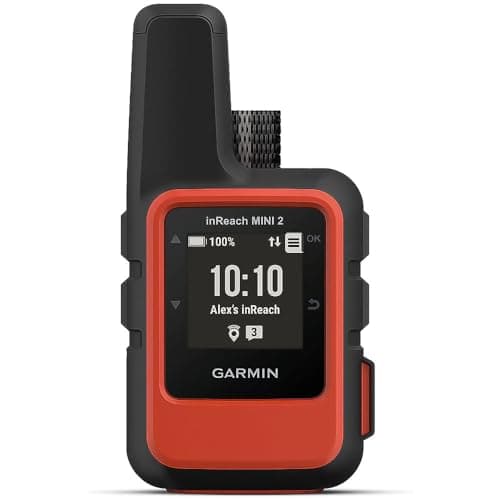
Two-way Iridium messaging with interactive SOS, tracking and location sharing at 100 g, with up to 14 days of battery at 10-minute tracking.
Garmin publishes two-way text messaging over the Iridium satellite network with global coverage, interactive SOS, location sharing and GPS tracking, a 100 g (3.5 oz) weight, a size of about 4 by 2 in, a rechargeable lithium battery giving up to 14 days at the default 10-minute tracking interval and up to 30 days at 30-minute intervals, MIL-STD-810 impact resistance and an IPX7 water rating. A subscription is required.
Two-way messaging is what separates this category from a beacon, and the practical value is not the emergency case. It is being able to tell somebody at home that you are running four hours late, which prevents the search that would otherwise be triggered. Most of the value of a messenger is in the incidents that never become incidents.
Interactive SOS means the coordination center can message you back — ask what happened, tell you what is coming, and how long. From inside an emergency that is a materially different experience from pressing a button and waiting with no confirmation.
The drawback
Requires an ongoing subscription, and typing on a device this small is genuinely tedious without pairing it to a phone.
2. Best if you want an emergency device and nothing else
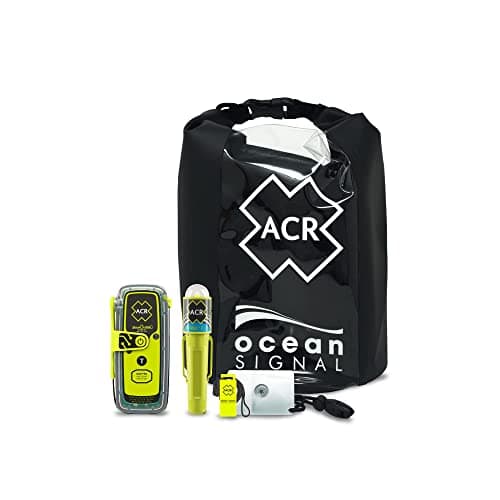
ACR ResQLink 400 Personal Locator Beacon
ACR Electronics
A 406 MHz personal locator beacon with 121.5 MHz homing and multi-constellation GNSS, at 148 g, with a 5-year battery interval and no subscription.
ACR publishes a 406 MHz distress signal with 121.5 MHz homing, a multi-constellation GNSS receiver using GPS and Galileo, a 0.33 lb (148 g) weight, dimensions of 4.52 by 2.03 by 1.49 in, non-hazmat lithium batteries with a 5 year replacement interval, 24+ hours of operational life once activated, manual activation, and buoyancy. No subscription is required.
A PLB transmits on the internationally monitored 406 MHz search and rescue frequency, which is a government-run system rather than a commercial one. There is nothing to renew, nothing to forget to pay, and nothing that stops working because a plan lapsed. For somebody who camps a few times a year, that is a genuinely strong argument.
The five-year battery is the other one. A PLB lives in the top of a pack doing nothing, for years, and then works. The trade is absolute: it cannot tell anybody you are fine, late, or anything else. It is a last resort, and it is very good at being one.
The drawback
It does one thing. No messaging, no check-ins, no tracking, and no way to tell anyone you are simply late.
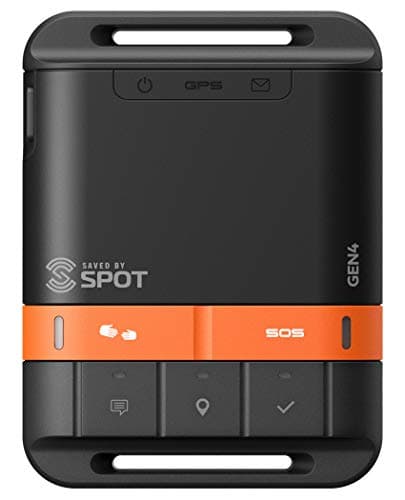
One-way Globalstar check-ins, custom messages, tracking and SOS at 5 oz, running on 4 AAA lithium cells with 26 to 52 days of tracking at 60-minute intervals.
SPOT publishes operation on the Globalstar satellite network with a subscription, one-way check-in and custom messages, tracking and SOS, dimensions of 3.48 by 2.66 by 0.93 in, a 5 oz (142 g) weight with lithium batteries, power from 4 AAA lithium or NiMH cells, up to 1,250 check-in and custom messages on a set of lithium AAAs, tracking battery life of 26 to 52 days at 60-minute intervals down to 3.5 to 7 days at 2.5-minute intervals, and an operating range of -22 F to 140 F up to 21,320 ft.
Replaceable AAA cells are the differentiator, and they are worth more than they look on a long trip: you can carry spares and refill the device indefinitely rather than needing to recharge it. Lithium primary AAAs are also the best cold performers available, which matters in winter.
The limitation is one-way communication. You can send a pre-programmed check-in or an SOS and you cannot receive an acknowledgement, which means you never know whether the message arrived. Coverage is also Globalstar rather than Iridium; check the coverage map against where you actually go before choosing.
The drawback
One-way only: you cannot receive replies or confirmation, and Globalstar coverage is not global in the way Iridium is.
QWhat is the difference between a satellite messenger and a PLB?
A satellite messenger is a communication device with an SOS function - subscription, texting, tracking and location sharing. A personal locator beacon is an emergency transmitter on the government-run 406 MHz search and rescue system, with no subscription and a battery measured in years.
QDo satellite messengers need a subscription?
Messengers do - the Garmin inReach Mini 2 uses Iridium and the SPOT Gen4 uses Globalstar, both with service plans. A personal locator beacon such as the ACR ResQLink 400 does not, because it uses the internationally monitored 406 MHz search and rescue system.
QDo you have to register a personal locator beacon?
Yes. A 406 MHz beacon must be registered with your national authority, NOAA in the United States. Registration links the beacon to you and your emergency contacts, which is what turns a distress signal into an informed response. It is free and takes a few minutes.
QDo satellite messengers work inside a tent?
Not reliably. All of these talk to satellites and need a clear view of the sky, so they will struggle inside a tent, in a canyon, under dense canopy or in a vehicle. Take the device outside, give it a clear horizon, and allow a few minutes.
How we picked
Everyone else in this category will tell you they tested twenty of these. We have not tested any of them, and we would rather say so than pretend. There is no gear closet here and no test lab.
What we did instead: pulled the published specifications from each manufacturer's own spec sheet or manual, named the standard behind every rating so you can check what it actually promises, did the arithmetic that turns a spec into a decision, and pulled today's real retail price rather than quoting one from memory. Every pick states a drawback, because a list where nothing is wrong with anything is an advert.
The limits of that method, stated plainly: published specs do not capture zipper quality, seam durability, or how a tent behaves at 2am in a storm. Where that matters, we say so on the pick. The full method is here.