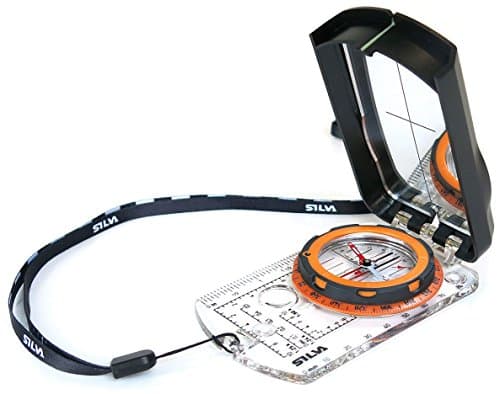
A mirror sighting compass with luminous points, a clinometer reading to plus or minus 90 degrees, and romer scales for 1:24,000, 1:25,000 and 1:50,000.
Taking accurate bearings on distant features, and navigating after dark
Adjustable declination, so every bearing is right without arithmetic. Needle balance, northern-hemisphere or global. And map scales on the baseplate, so you can measure distance without a calculation. Everything else — mirrors, clinometers, magnifiers, global needles if you never leave home — is genuinely optional. A compass with those three is a lifetime purchase for well under the price of a headlamp.
Compass
Weight
Declination
Needle
Scales
Sighting
Suunto M-3
46 g (48 g global)
Screw with built-in key
Jewel bearing; global on the M-3 G
cm, 1:20/25/50k, inch, 1:24k, 1:50k
Baseplate
Silva Ranger 2.0
not published
Built-in screw
Swedish steel on sapphire jewel
Inch, mm, romer 1:24/25/50k
Mirror, luminous
Brunton TruArc 3
1.1 oz / 31 g
Tool-free
Global, tilts to 20 degrees
Inch and millimeter
Baseplate
All figures as published by the manufacturers. Where a maker does not publish a weight we have left it blank rather than estimating one.
Declination, and why it is the first feature
Magnetic north and true north are not the same direction, and the difference — declination — varies by location and changes slowly over time. In parts of the United States it exceeds 15 degrees, which is enough to put you a long way off over a few miles.
A compass with adjustable declination lets you dial that difference in once, so bearings taken from a map and bearings walked on the ground agree without any mental arithmetic. NOAA publishes a declination calculator for any location, and the value is also printed on most topographic maps — how to read that is in how to read a topographic map.
Global needles, and what they fix
The Earth's magnetic field dips toward the ground, and the angle differs by hemisphere. A needle balanced for the northern hemisphere drags on the capsule floor in the southern one and reads sluggishly or sticks. A global needle — Brunton publishes a tilt tolerance of up to 20 degrees for the TruArc, and Suunto offers a globally balanced M-3 G — works in both. If you never navigate outside your own hemisphere, this is a feature you can ignore entirely.
What can go wrong with a compass
A bubble in the capsule. Common at altitude and in cold, and usually cosmetic — small bubbles often disappear at lower altitude and warmer temperature. A large bubble means a leaking seal and a compass that should be replaced.
Reversed polarity. A needle stored next to a strong magnet — a phone case, a speaker, a magnetic clasp — can have its polarity reversed or weakened, and it will then point confidently in the wrong direction. Check against a known direction before every trip, and never store a compass next to electronics.
Local interference. Vehicles, power lines, rebar, ice axes and even a phone in the same hand deflect a needle. Step several paces away from metal before taking a bearing.
The one that is not a compass
Phone compasses are magnetometers and they are genuinely useful, but they are affected by the phone's own electronics, need periodic recalibration, and stop existing when the battery does. The point of carrying a baseplate compass is precisely that it has no failure mode involving power.
The same logic runs through the rest of this section: a phone is an excellent primary navigation tool and a poor sole one. The comparison of what to carry for which trip is in how to navigate without a phone, and the communication side — which a compass will never do — is in best satellite messengers for camping.
What we did not do
We have not field-tested these compasses or verified their accuracy claims. Every figure above is the manufacturer's published specification with a link to where it was read, and where a maker does not publish a number — Silva does not publish a weight for the Ranger 2.0 — we have left it blank rather than sourcing one from a retailer. See how we research.
The picks in full
1. Best all-round hiking compass
Suunto M-3 Baseplate Compass
Suunto
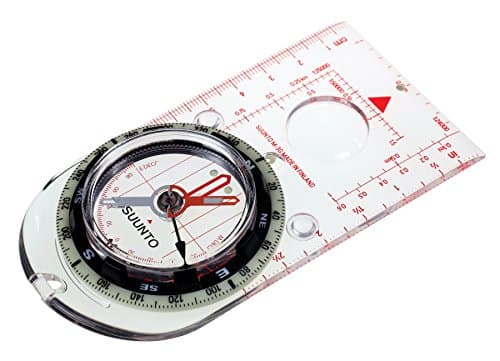
46 g with adjustable declination, 2.5 degree accuracy on a 2 degree resolution bezel, and six map scales printed on the baseplate.
Suunto publishes a 46 g weight (48 g for the globally balanced M-3 G), dimensions of 61 by 120 by 14 mm, 2.5 degree accuracy with 2 degree resolution, declination adjustable by a screw using a built-in key, scales for cm, 1:20,000, 1:25,000 and 1:50,000 plus inch, 1:24,000 and 1:50,000, a jewel-bearing needle, and an operating range of -30 to +60 C.
Six scales on one baseplate is the reason this is the learner's compass. Whatever map you are holding — a US 1:24,000 quad, a 1:25,000 or 1:50,000 sheet — you can measure distance directly off the edge without arithmetic, which removes the step where most beginners give up.
Adjustable declination is the other non-negotiable. Set the local difference between magnetic and true north once and every bearing afterwards is correct; without it you are doing an addition or subtraction on every single bearing, in the wind, and getting the sign wrong is the classic navigation error. The technique is in how to navigate without a phone.
The drawback
The declination screw needs the built-in key, which is one small part to lose, and the baseplate is larger than a minimalist compass at 61 by 120 mm.
Published specs
Weight
46 g (48 g for the global M-3 G)
Dimensions
61 x 120 x 14 mm
Accuracy
2.5 degrees, 2 degree resolution
Declination
adjustable via a screw and built-in key
Scales
cm, 1:20,000, 1:25,000, 1:50,000; inch, 1:24,000, 1:50,000
A mirror sighting compass with luminous points, a clinometer reading to plus or minus 90 degrees, and romer scales for 1:24,000, 1:25,000 and 1:50,000.
Silva publishes dimensions of 4.25 by 2.75 by 0.63 in, mirror sighting with luminous points and a 45-degree bezel view, a dial graduated every 2 degrees, a Swedish steel needle on a liquid-damped sapphire jewel bearing, a built-in declination adjustment screw, a clear protractor baseplate with inch and millimeter scales and romer scales for 1:24,000, 1:25,000 and 1:50,000, a clinometer reading to plus or minus 90 degrees, and luminous markings usable for up to 4 hours after being charged by light.
Mirror sighting is the meaningful upgrade. Holding the compass at eye level and sighting a distant feature through the notch while reading the bezel in the mirror is considerably more accurate than a baseplate held flat at chest height, and on a long leg across open ground that difference compounds.
The clinometer is a specialist feature that most campers will never use — it measures slope angle, which matters for avalanche assessment and for surveying. Buy this one for the mirror and the luminous markings, and treat the clinometer as a bonus rather than a reason.
The drawback
A mirror adds bulk and a hinge to break, and the extra precision is wasted on the routine bearings most campers take.
Published specs
Dimensions
4.25 x 2.75 x 0.63 in
Sighting
mirror with 45-degree bezel view and luminous points
Dial
graduated every 2 degrees
Needle
Swedish steel on a liquid-damped sapphire jewel bearing
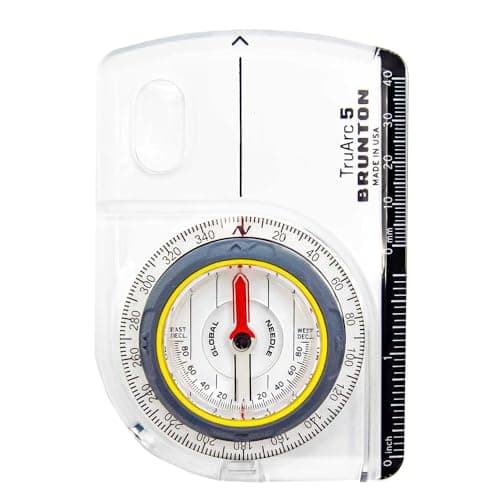
1.1 oz with a global needle that tilts up to 20 degrees, tool-free declination adjustment and a 2 degree resolution azimuth ring.
Brunton publishes a 1.1 oz (31 g) weight, dimensions of 2.5 by 3.5 by 0.6 in, a TruArc global needle that tilts up to 20 degrees for balanced use worldwide, a 2 degree resolution azimuth ring, tool-free declination adjustment, inch and millimeter scales, and manufacture in Riverton, Wyoming.
Tool-free declination is genuinely better than the screw-and-key arrangement, because the key is a small metal object that lives in a pocket and eventually does not. Being able to set declination with your fingers means you will actually do it.
The global needle matters more than it sounds if you ever navigate outside your own hemisphere. A needle balanced for the northern hemisphere drags or sticks in the southern, and a global needle works in both. At 1.1 oz this is also the one that ends up permanently in a pack lid rather than being packed deliberately.
The drawback
Inch and millimeter scales only — no map-scale romers — and a small baseplate is harder to use accurately on a map.
Adjustable declination, so bearings are right without arithmetic; a needle balanced for where you use it; and map scales printed on the baseplate so you can measure distance directly. Mirrors, clinometers and magnifiers are optional for most campers.
QWhat is declination and why does it matter?
The difference between magnetic north and true north, which varies by location and exceeds 15 degrees in parts of the United States. A compass with adjustable declination lets you set it once so map bearings and walked bearings agree, without doing arithmetic on every leg.
QDo I need a global needle compass?
Only if you navigate in both hemispheres. The Earth's magnetic field dips toward the ground at different angles north and south, so a hemisphere-specific needle drags or sticks in the wrong one. Brunton publishes a 20 degree tilt tolerance for its global needle.
QIs a phone compass good enough?
As a primary tool, often. As the only tool, no. A phone magnetometer is affected by the phone's own electronics, needs recalibration, and stops working when the battery does. A baseplate compass has no failure mode involving power.
How we picked
Everyone else in this category will tell you they tested twenty of these. We have not tested any of them, and we would rather say so than pretend. There is no gear closet here and no test lab.
What we did instead: pulled the published specifications from each manufacturer's own spec sheet or manual, named the standard behind every rating so you can check what it actually promises, did the arithmetic that turns a spec into a decision, and pulled today's real retail price rather than quoting one from memory. Every pick states a drawback, because a list where nothing is wrong with anything is an advert.
The limits of that method, stated plainly: published specs do not capture zipper quality, seam durability, or how a tent behaves at 2am in a storm. Where that matters, we say so on the pick. The full method is here.