The Best GPS Watches for Hiking, Ranked by Hours Not Features
Every GPS watch publishes three or four different battery figures, and the gap between the best and worst of them is a factor of ten. That is the whole buying decision.
GPS watches publish a different runtime for each tracking mode, and the modes differ in how often the watch fixes its position and how many satellite systems it listens to. Garmin publishes 30 hours in full GPS and up to 370 in max battery mode for the same watch. Both numbers are true and they describe completely different things.
The trade is straightforward. Fixing position every second across several constellations gives the most accurate track and eats the battery. Fixing it every minute or two gives a track that is still perfectly good for following a route and lasts an order of magnitude longer. For hiking, the reduced modes are almost always the right choice.
Work out the mode you will actually use, find that specific number, and compare on it. A watch that wins on the headline figure and loses in the mode you need is the wrong watch.
Compared on published numbers
Watch
Full GPS
All systems
Extended mode
Daily use
Weight
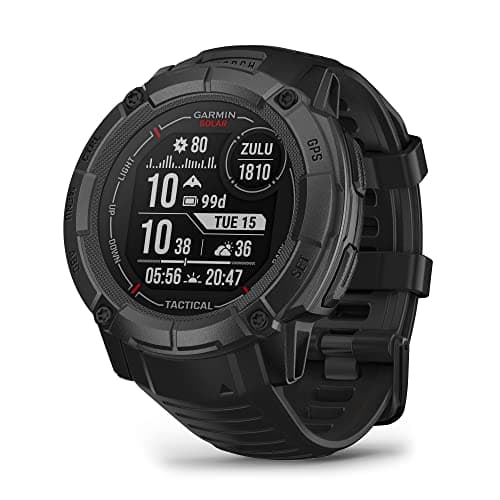
Garmin Instinct 2 Solar
30 h; 48 h with solar
not published
up to 370 h max battery GPS
up to 28 days, unlimited with solar
1.9 oz
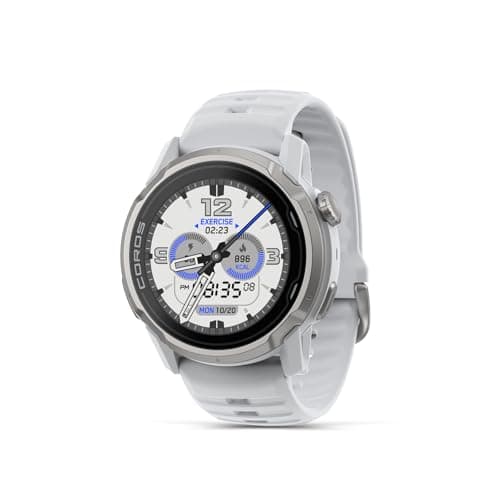
COROS APEX 4 (46mm)
65 h Endurance
included in every mode
41 h Max dual frequency
up to 24 days
64 g silicone / 51 g nylon
Figures as published by each manufacturer.
What solar actually contributes
Garmin publishes the condition alongside the claim, which is unusually honest and worth reading: the unlimited smartwatch figure assumes about three hours a day outdoors at 50,000 lux. Fifty thousand lux is bright direct sun, not an overcast afternoon and certainly not under a jacket sleeve.
In practice solar extends a hiking watch meaningfully in open terrain in summer and contributes very little in forest, in winter, or worn under a cuff. Treat it as a bonus that stretches the interval between charges rather than as a reason you never need a cable. A small power bank is still the thing that guarantees a watch survives a long trip.
A watch is a tracker, not a map
These watches record where you went and show a breadcrumb of it. Neither is a substitute for a map you can see terrain on: a 1.3 inch screen cannot show you the shape of a valley, and following a breadcrumb backwards in fog is a poor plan when the route out is not the route in. Carry a map and a compass regardless, and treat the watch as the thing that tells you how far you have come rather than the thing that tells you where to go. The case is made in how to navigate without a phone.
Materials, and what the premium buys
Sapphire glass, as on the APEX 4, is far harder than mineral glass and effectively immune to the scuffs a watch picks up against rock and pack straps. It is also more brittle under a sharp impact.
Titanium bezels are lighter than steel at the same strength and do not corrode with sweat. Mostly this is a weight and longevity feature rather than a performance one.
Water ratings matter more than people expect. Garmin publishes 10 ATM on the Instinct 2 Solar, which comfortably covers rain, stream crossings and swimming.
The features hikers actually use
A barometric altimeter, because elevation gained is the number that predicts how tired you will be, and a barometer that trends downward is the earliest storm warning you will get. A compass, for orienting a map without stopping to take a bearing. And a back-to-start breadcrumb, which is the one navigation feature on a watch that genuinely earns its place.
What most hikers do not use is the training analysis, recovery scoring and VO2 estimates that occupy most of the marketing. None of that is a reason to choose one watch over another for walking up hills with a pack on.
Which to buy
Buy the Garmin Instinct 2 Solar if your trips are long and charging is genuinely unavailable, because 370 hours in max battery GPS mode is a category of its own. Buy the COROS APEX 4 if you want full-rate tracking for 65 hours and a harder-wearing watch, and accept that it is the most expensive option here by a clear margin.
If accuracy under canopy is your actual problem, a handheld with multi-band reception solves it better than any watch — see best handheld GPS for hiking.
The picks in full
1. Best overall
Garmin Instinct 2 Solar
Garmin
30 hours of full GPS, up to 48 with solar, and up to 370 hours in max battery GPS mode, at 1.9 oz.
Garmin publishes 30 hours in full GPS mode, up to 48 hours in GPS with solar, up to 370 hours in max battery GPS mode, up to 28 days in smartwatch mode and unlimited with sufficient solar, weights of 1.9 oz for the Instinct 2 and 1.5 oz for the 2S, a 10 ATM water rating, and a solar requirement of about 3 hours a day outdoors at 50,000 lux.
Three hundred and seventy hours is the number that matters. Max battery GPS mode records position less often, which is perfectly adequate for tracking a route, and it turns a watch that lasts a weekend into one that lasts a two-week trip.
The drawback
Single-frequency GNSS only, so accuracy under canopy is ordinary. The monochrome display is also genuinely low-resolution next to anything with a color screen.
Published specs
GPS battery life
30 h GPS; up to 48 h with solar; up to 370 h in max battery GPS
65 hours of tracking with every satellite system active, on a watch with a sapphire lens and a grade 5 titanium bezel.
COROS publishes 65 hours in Endurance mode, 53 in High and 41 in Max with dual frequency, all with every satellite system active; up to 24 days of daily use; a 64 g weight with the silicone band and 51 g with nylon; a 1.3 in 260 by 260 display; a sapphire glass lens; a grade 5 titanium alloy bezel; and 5 ATM water resistance.
Sixty-five hours is more than twice what the Instinct manages in full GPS, and it beats even the Garmin's 48-hour solar-assisted figure — without dropping to the reduced-rate mode that produces the Garmin's 370-hour number. For a three-day route recorded properly, this is the one that finishes with charge left.
The drawback
It is comfortably the most expensive watch on this page, well above the Garmin, and 64 g with the silicone band makes it the heaviest unless you fit the nylon strap instead. Using the dual-frequency mode costs you a third of the battery.
Published specs
GPS battery life
65 h Endurance; 53 h High; 41 h Max dual frequency, all systems active
It depends entirely on the tracking mode. Garmin publishes 30 hours in full GPS for the Instinct 2 Solar and up to 370 hours in max battery GPS mode. COROS publishes 65 hours in Endurance mode for the APEX 4 and 41 in dual frequency. Compare the mode you will actually use.
QWhat happened to the COROS APEX 2?
It has been discontinued. New stock has gone and the only APEX 2 listings left are refurbished units, which quote different battery figures from the ones COROS published for the original. The current model in that line is the APEX 4, which keeps the sapphire lens and grade 5 titanium bezel, publishes 65 hours in Endurance mode against the APEX 2's 75 in standard mode, and adds the dual-frequency GNSS the APEX 2 did not have.
QIs a solar GPS watch worth it?
In open terrain in summer, yes. Garmin publishes its unlimited claim against about three hours a day outdoors at 50,000 lux, which is bright direct sun. Under forest canopy, in winter or worn under a sleeve it contributes very little, so still carry a cable or a power bank.
QCan a GPS watch replace a map and compass?
No. A 1.3 inch screen cannot show the shape of terrain, and following a breadcrumb backwards in poor visibility is a weak plan when the way out is not the way in. Use the watch for distance, elevation and back-to-start, and carry a map.
QDo I need dual-frequency GPS in a watch?
Only if you hike in canyons or dense forest where reflected signals cause position errors. The COROS APEX 4 includes it, and it costs battery: 41 hours in Max dual frequency against 65 in Endurance mode. Decide which matters more on the route you are actually walking.
How we picked
Everyone else in this category will tell you they tested twenty of these. We have not tested any of them, and we would rather say so than pretend. There is no gear closet here and no test lab.
What we did instead: pulled the published specifications from each manufacturer's own spec sheet or manual, named the standard behind every rating so you can check what it actually promises, did the arithmetic that turns a spec into a decision, and pulled today's real retail price rather than quoting one from memory. Every pick states a drawback, because a list where nothing is wrong with anything is an advert.
The limits of that method, stated plainly: published specs do not capture zipper quality, seam durability, or how a tent behaves at 2am in a storm. Where that matters, we say so on the pick. The full method is here.