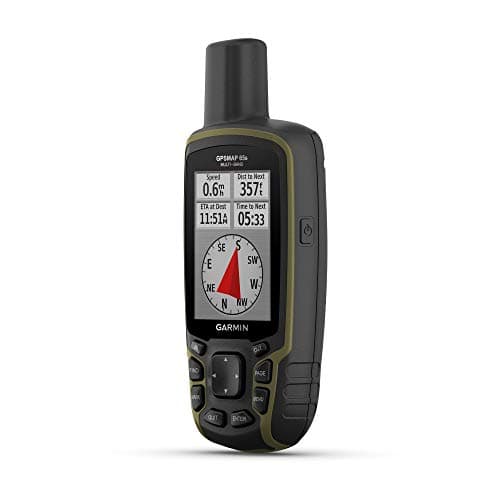
Garmin GPSMAP 65s
Garmin
2.6 in map screen, multi-band across five constellations, 16 h on 2 AAs. The navigator.
$350.00 · Check price on Amazon
#ad how this is funded · price as of October 23, 2026
A watch records your route and tells you the time. A handheld shows you a map you can read with gloves on. Only one of those is navigation.

Trail & Tarp earns a commission from qualifying purchases made through links on this page, at no extra cost to you. Full disclosure.
The short answer
If the question is “where am I and which way is the trail”, buy the handheld: a 2.6 in map screen, replaceable AA batteries and multi-band reception. If the question is “how far have I gone and what is my heart rate”, buy the watch. Most people asking about navigation want the handheld and buy the watch.
| Garmin GPSMAP 65s | Garmin Instinct 2 Solar | |
|---|---|---|
| Display | 2.6 in, 160 x 240, transflective color | watch face; size not published |
| Battery, GPS use | up to 16 h on 2x AA | 30 h GPS, up to 48 h with solar, up to 370 h max battery |
| Battery, standby | swap the AAs | up to 28 days smartwatch, unlimited with enough solar |
| Satellites | multi-band GPS, GLONASS, Galileo, QZSS, IRNSS | single-frequency GPS, GLONASS, Galileo |
| Weight | 7.7 oz with batteries | 1.9 oz (2), 1.5 oz (2S) |
| Sensors | barometric altimeter, barometer, 3-axis compass | not published on the page we read |
| Water resistance | IPX7 | 10 ATM |
Two rows decide this. The handheld reads multi-band across five constellations; the watch is single-frequency across three. Multi-band is what holds a fix in a canyon or under heavy tree cover, which is exactly where navigation gets hard.
And the battery rows are not comparable in the way they look. The watch's 30 to 48 hours is impressive and finite; the handheld's 16 hours is short and you carry spare AAs. On a week-long trip the handheld never runs out and the watch needs a plan.
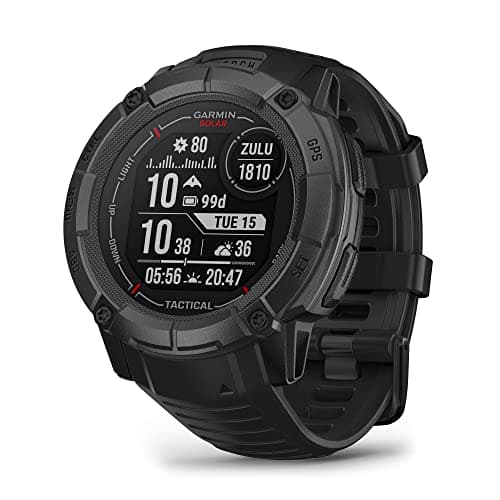
It is on your wrist, which sounds trivial and is the whole point: a device in a pack is a device you do not check. A watch gives you distance, pace, elapsed time and a breadcrumb trail back without stopping or unpacking.
At 1.9 oz against 7.7 oz it also costs nothing to carry, and 10 ATM water resistance beats the handheld's IPX7. For day hikes, trail running and general fitness it is the more useful object by a distance — the field is in best GPS watches for hiking.
Neither one calls for help
A GPS receiver tells you where you are. It does not transmit, and no amount of battery life changes that. If you need someone to come and get you outside cell coverage, that is a satellite messenger or a personal locator beacon, which are separate devices — see satellite messenger vs PLB vs two-way radio. A SPOT Gen4 does the job a GPS cannot.
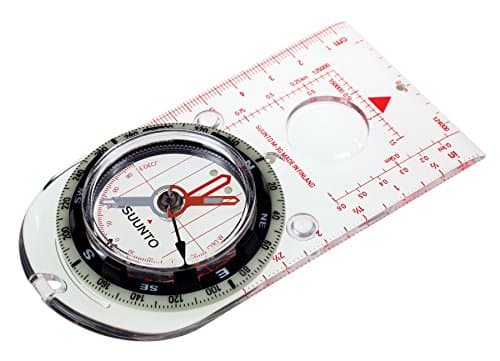
A paper map and a baseplate compass weigh a couple of ounces, cost very little, and do not run out of battery. For the great majority of camping and day hiking in the US, that plus a phone with offline maps is genuinely enough.
Buy a dedicated GPS when you are routinely off marked trail, navigating in poor visibility, or somewhere a phone failure would be serious. Otherwise start with a compass and the skill to use it, which is the argument in how to navigate without a phone.
| If this is you | Buy |
|---|---|
| Navigating off-trail or in poor visibility | the handheld |
| Multi-day trips away from any charger | the handheld, plus spare AAs |
| Canyons, dense forest, steep valleys | the handheld, for multi-band |
| Day hikes, tracking distance and pace | the watch |
| You want one device you always have on you | the watch |
| You need to call for help | neither; a satellite messenger |
| Marked trails and established campgrounds | a map, a compass and a phone |
Garmin
2.6 in map screen, multi-band across five constellations, 16 h on 2 AAs. The navigator.
#ad how this is funded · price as of October 23, 2026
Garmin
30 h GPS, up to 48 with solar, 1.9 oz on your wrist. The tracker.
#ad how this is funded · price as of October 23, 2026
Suunto
No battery, no fix to lose. Start here before either of the above.
#ad how this is funded · price as of October 23, 2026
For following a breadcrumb back, yes. For working out where you are in unfamiliar terrain, no. A watch face cannot show usable map context, and the Instinct 2 Solar is single-frequency across three constellations against the GPSMAP 65s's multi-band across five, which matters in canyons and dense forest.
It depends on whether you can resupply power. Garmin publishes 30 hours of GPS on the Instinct 2 Solar, up to 48 with solar, against 16 hours on two AA batteries for the GPSMAP 65s. On a long trip the handheld effectively never runs out because you carry spare cells.
No. Both only receive; they tell you where you are and transmit nothing. Calling for help outside cell coverage needs a satellite messenger or a personal locator beacon, which are different devices with a subscription in most cases.
Usually not. For marked trails and established campgrounds, a paper map, a baseplate compass and a phone with offline maps cover it for a fraction of the cost. A dedicated GPS earns its place off-trail, in poor visibility, or where a phone failure would be serious.
Every figure on this page comes from a published source. We have not tested this gear, so the numbers are the manufacturer's or the standard body's, not ours. How we research.