Milliamp-hours only mean something alongside a voltage. Watt-hours combine both, and a watt-hour figure can be compared directly across any two batteries. A typical modern phone battery is about 15 to 20 Wh, so a 39 Wh bank is roughly two phone charges and a 90 Wh bank is roughly four to five.
Apply a real-world discount to that. Conversion losses inside the bank, cable losses and heat typically cost you 15 to 25 percent, so a 39 Wh bank delivers closer to 30 Wh of useful charge. That is still two phone charges; it is not the three the box arithmetic suggests.
The same conversion applies one step up the scale to power stations, which is why what size power station do I need works in watt-hours throughout.
Compared on published numbers
Power bank
Capacity
Max output
Weight
Ports
Notable
Nitecore NB10000 Gen 3
10,000 mAh / 39 Wh
22.5 W
150 g
2x USB-C
257 mWh/g energy density
Anker Laptop Power Bank (25K, 165W)
25,000 mAh / 90 Wh
165 W total, 100 W per USB-C port
595 g
2 built-in C cables, 1x USB-C, 1x USB-A
under the usual 100 Wh carry-on limit
BioLite Charge 80 PD
20,000 mAh
USB-C PD plus 2x QC 3.0
1 lb 1 oz
1x USB-C, 2x USB-A
operating range -4 F to 104 F
Figures as published by each manufacturer. BioLite does not publish a watt-hour figure for the Charge 80 PD.
Sizing one to a trip
Trip
What you are charging
Capacity to look for
Overnight
one phone, a headlamp top-up
10,000 mAh / about 39 Wh
Weekend, two people
two phones, a headlamp, a watch
10,000 to 20,000 mAh
Five days, navigation on the phone
phone used heavily as a GPS
20,000 mAh or a solar panel
Any trip with a laptop or camera batteries
laptop, camera, phone
20,000 mAh and 100 W output or more
Our working guide. Phone use as a GPS roughly triples daily consumption.
The single biggest variable is whether you are navigating on the phone. Screen-on GPS use will empty a modern phone in four to six hours, which turns a weekend requirement into a five-day one. Carrying a map and a compass instead is lighter than carrying the battery to cover it — see how to navigate without a phone.
Cold is what actually empties a power bank
Lithium-ion cells lose a substantial fraction of their usable capacity below freezing, and the loss is temporary rather than permanent: a bank that seems dead at 20 F will often work again once warmed. Keep the bank in an inside jacket pocket during the day and in your sleeping bag at night, and charge devices in the tent rather than outside. BioLite is one of the few makers to publish an operating range at all, at -4 F to 104 F.
Power bank or power station?
A power bank charges things over USB. A power station adds an AC outlet, a car socket and five to ten times the capacity, at ten times the weight. The dividing line is whether anything you need to run has a wall plug on it.
Phones, headlamps, watches, e-readers, most camera batteries — a power bank does all of this and weighs a fraction as much.
A CPAP machine, a 12V fridge, a laptop over several days, a projector — a power station, and the options are in best portable power stations.
A power bank is a buffer, not a source. On trips longer than about four days the question stops being how big the bank is and starts being how you refill it. A folding solar panel will recharge a 10,000 mAh bank in a few hours of good sun, and far more slowly in anything less — the honest figures are in best solar panels for camping.
Bring the right cable, and bring a spare. A 165 W bank with a cable rated for 60 W charges at 60 W, and a frayed cable is the most common reason a charging setup fails at a campsite. A short braided 100 W USB-C cable is a couple of ounces and removes the problem.
Which to buy
Buy the Nitecore NB10000 Gen 3 for backpacking, because 150 grams is the version you will actually carry. Buy the Anker Laptop Power Bank if a laptop or camera batteries are part of the trip and you want to stay under the 100 Wh flying limit. Buy the BioLite Charge 80 PD for cold-weather trips and for charging several devices at once.
The picks in full
1. Best overall
Nitecore NB10000 Gen 3
Nitecore
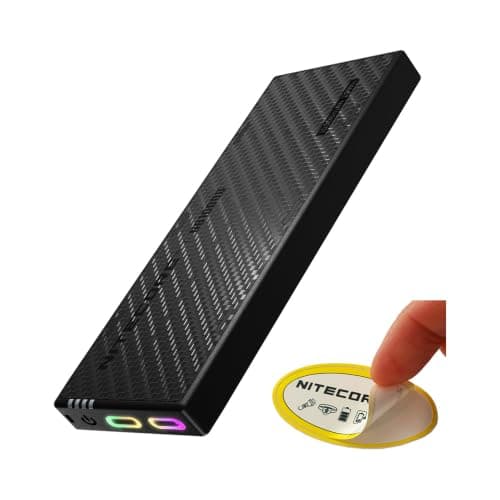
39 Wh in a 150 g carbon fiber body with two USB-C ports, at an energy density of 257 mWh per gram.
Nitecore publishes a capacity of 10,000 mAh / 39 Wh, a weight of 150 g / 5.29 oz, a maximum output of 22.5 W, two USB-C ports, a carbon fiber shell, and an energy density of 257 mWh per gram.
The energy density figure is the one to take seriously. Most 10,000 mAh banks weigh around 200 to 240 grams, so this is roughly a third lighter for the same stored energy. Over a weekend that is a small saving; the reason it matters is that it is the difference between carrying a power bank and leaving it behind.
The drawback
22.5 W maximum output. That charges a phone at a reasonable speed and will not fast-charge a laptop or a large tablet.
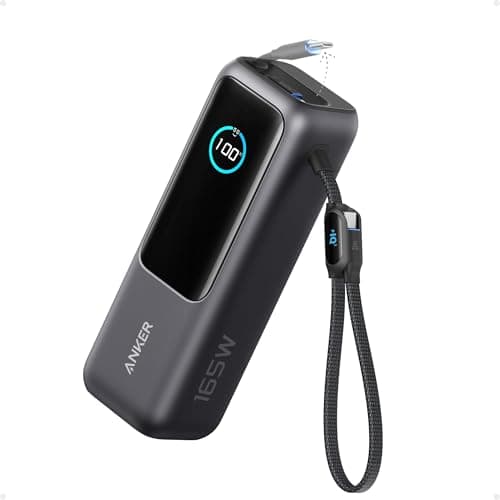
90 Wh with 165 W of total output and 100 W from any single USB-C port, which is enough to charge most laptops at full speed.
Anker publishes a capacity of 25,000 mAh / 90 Wh, 165 W of total output, 100 W maximum from any single USB-C port, two built-in USB-C cables (one of them retractable) plus a USB-C port and a 33 W USB-A port, a weight of 21.0 oz / 595 g, 100 W maximum recharge input over USB-C reaching 30 percent in 20 minutes, and a real-time display of charge, input and output.
90 Wh is also the specification that matters for flying: airline rules generally allow lithium batteries up to 100 Wh in carry-on baggage without approval, and this sits under that line deliberately. Anything larger becomes a conversation at the gate.
The built-in cables are the quiet practical win. The commonest charging failure at a campsite is a cable — forgotten, frayed, or rated for less power than the bank can deliver — and two of them being attached to the bank removes that failure for the two devices you charge most.
The drawback
595 g. That is four times the Nitecore for a bit over twice the capacity, and it is the heaviest thing in most day packs.
20,000 mAh across one USB-C PD and two Quick Charge USB-A ports, with a published operating range down to -4 F.
BioLite publishes a 20,000 mAh capacity, one USB-C Power Delivery port and two USB-A Quick Charge 3.0 ports, a weight of 1 lb 1 oz, dimensions of 8.7 by 3.1 by 0.94 in, a recharge time of about four hours over USB-C PD, and an operating range of -4 F to 104 F.
The published operating range is unusual and it is the reason this one is here. Most manufacturers do not state a cold limit at all, and lithium cells lose a substantial fraction of their usable capacity below freezing. Three ports also means charging three phones at once rather than negotiating.
The drawback
1 lb 1 oz and 8.7 inches long. It is a big flat slab that does not sit comfortably in a jacket pocket, which is where power banks need to be when it is cold.
About 10,000 mAh for an overnight or a weekend with one phone, and 20,000 mAh for five days or for heavy phone use. Compare watt-hours rather than milliamp-hours: a modern phone battery is roughly 15 to 20 Wh, and a 39 Wh bank is about two charges.
QWhy does my power bank die in cold weather?
Lithium-ion cells lose a large fraction of their usable capacity below freezing, and the loss is usually temporary. Keep the bank in an inside jacket pocket by day and in your sleeping bag at night, and it will recover once warm.
QCan I take a power bank on a plane?
Lithium batteries up to 100 Wh are generally permitted in carry-on baggage without special approval, which is why large banks such as the Anker Laptop Power Bank are specified at 90 Wh. Check your airline, and never put a power bank in checked baggage.
QDo I need a power bank or a power station?
A power bank if everything you charge takes USB: phones, headlamps, watches, most camera batteries. A power station if anything has a wall plug or a 12V socket, such as a CPAP machine or a camping fridge.
How we picked
Everyone else in this category will tell you they tested twenty of these. We have not tested any of them, and we would rather say so than pretend. There is no gear closet here and no test lab.
What we did instead: pulled the published specifications from each manufacturer's own spec sheet or manual, named the standard behind every rating so you can check what it actually promises, did the arithmetic that turns a spec into a decision, and pulled today's real retail price rather than quoting one from memory. Every pick states a drawback, because a list where nothing is wrong with anything is an advert.
The limits of that method, stated plainly: published specs do not capture zipper quality, seam durability, or how a tent behaves at 2am in a storm. Where that matters, we say so on the pick. The full method is here.