The Best Solar Panels for Camping, and the Watt-Hours They Actually Deliver
A 100 W panel does not make 100 W. It makes 100 W at noon, pointed correctly, in a clear sky, for the minutes that lasts — and the rest of the day is the interesting part.
Rated wattage is measured under Standard Test Conditions: 1,000 W per square meter of irradiance at a 25 C cell temperature, with the panel square to the light. A real camping day gives you a fraction of that, and the useful planning figure is peak sun hours — the number of hours equivalent to full noon sun, typically 3 to 6 depending on season and latitude. Multiply rated watts by peak sun hours, then take 20 to 30% off for angle, heat, cable and charge-controller losses.
Worked through: a 100 W panel on a clear summer day with 5 peak sun hours produces about 500 Wh before losses and 350 to 400 Wh after them. On an overcast day it might be a quarter of that. Under trees — which is where campsites are — less again, because partial shade on one cell drags down the whole string.
Panel
Rated output
Cell efficiency
Weight
Weather rating
Ports
Jackery SolarSaga 100 Air
100 W (110 W bifacial)
23% bifacial
7.1 lb
IP68
USB-C, USB-A; output not published
Renogy 100W Portable
100 W
25% N-Type
8.86 lb
IP67, ETFE
USB-C PD 45 W, USB-A 18 W + 15 W
EcoFlow 110W
110 W nominal
22-23%
8.8 lb
IP68 to IEC 60529
Panel-to-station connector
All figures as published by the manufacturers. Where a maker does not publish a figure we have left it blank rather than estimating one.
Sizing: what do you actually need to charge?
Do this arithmetic before choosing a panel, because it usually shows you need less than the marketing implies. A phone charge is roughly 15 to 20 watt-hours. String lights and headlamps are a rounding error. A camera battery is a few Wh. Four people charging phones daily is under 100 Wh a day.
Against that, one clear day on a 100 W panel is three or four times what a family needs, which is why solar for lighting and phones is close to solved and solar for a 12V fridge is a different project. The full sizing method, including the fridge case, is in what size power station do I need and cooler vs 12V fridge for camping.
Angle beats wattage
Output falls with the cosine of the angle between the panel and the sun. Thirty degrees off costs about 13%; sixty degrees off costs about half. Repositioning a 100 W panel twice during the day beats buying a 200 W panel and leaving it flat, and it is free. This is why a built-in stand or an adjustable kickstand is worth more than a few percent of cell efficiency, and why the first question to ask about any camping panel is how it props up.
Shade is the thing that ruins solar at a campsite
Campsites are shaded, and partial shade is disproportionately damaging: a single shadowed cell limits the current through its whole series string, so a branch shadow across one corner can cost far more than the fraction of area it covers.
Practically that means putting the panel where the sun is rather than where the camp is, which is why a long cable matters, and why it is worth checking: none of the three makers here publishes a cable length. Weight it down or peg it, because a lightweight folding panel is a sail, and check on it when the shadows move.
Brand pairing, before you buy either half
A panel and a station from the same brand are not guaranteed to work together. Jackery states on its own SolarSaga 100 Air listing that the panel is not compatible with the Explorer 300 or 300 v2 series and may throw an F7 input voltage error, while EcoFlow sells its panel as working with most stations that have solar connectors. If you are buying into one brand for both halves, Jackery vs EcoFlow for camping works through which pairings the makers actually support.
Panel, battery, or both?
A panel with USB ports charges devices in daylight only. A power bank charges devices at night but has a fixed capacity. Together they are a supply: the panel fills the battery all day, the battery fills devices all evening.
For a weekend, a good power bank alone is usually enough and much lighter — the comparison is in power banks vs power stations. Solar starts to earn its weight at four nights and beyond, or on any trip where you cannot charge from a vehicle.
What we did not do
We have not measured the output of any of these panels, and we have not published a real-world watt-hour figure for a specific model because that number depends on latitude, season, cloud, angle and temperature. The daily estimates above are arithmetic on the standard peak-sun-hour method, shown so you can redo it for your own trip. Every product figure is the manufacturer's published specification with a link. See how we research.
The picks in full
1. Best all-round camping solar panel
Jackery SolarSaga 100 Air
Jackery
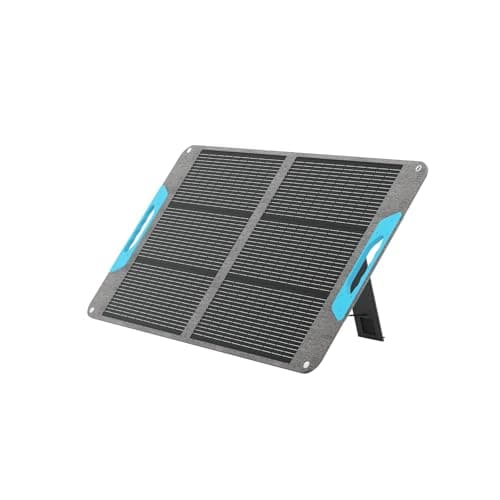
100 W rated output at 23% bifacial cell efficiency, with USB-C and USB-A on the panel itself, IP68 rated, for 7.1 lb.
Jackery publishes 100 W under Standard Test Conditions and 110 W bifacial, 23% bifacial cell conversion efficiency from dual-sided PERC cells with a bifaciality coefficient above 65%, an IP68 water and dust rating, a 7.1 lb (3.2 kg) weight, unfolded dimensions of 65.67 by 16.65 by 0.67 in, folded of 17.05 by 16.65 by 1.85 in, an integrated aluminum stand with 10 mm stake holes, and USB-C and USB-A ports on the panel.
Twenty-three percent is at the upper end of what mass-produced monocrystalline achieves, and efficiency matters more on a camping panel than on a roof because the limit here is area, not money: you can only unfold so much panel beside a picnic table. The bifacial rear face only adds to that where there is a bright surface under the panel to bounce light back, so count it as a bonus on sand or pale rock rather than a figure you will see on grass.
The on-panel USB ports are the feature that makes it useful without a power station. Prop it against the car in the morning, plug two phones in, and the panel is doing something even if you have no battery to charge. Jackery does not publish what either port delivers, so treat them as a convenience rather than something to plan a charging budget around.
The drawback
It unfolds to 65.67 in long, so it wants a clear strip of ground rather than a patch. Jackery does not publish the output of either USB port, so you cannot plan charging rates from the spec sheet.
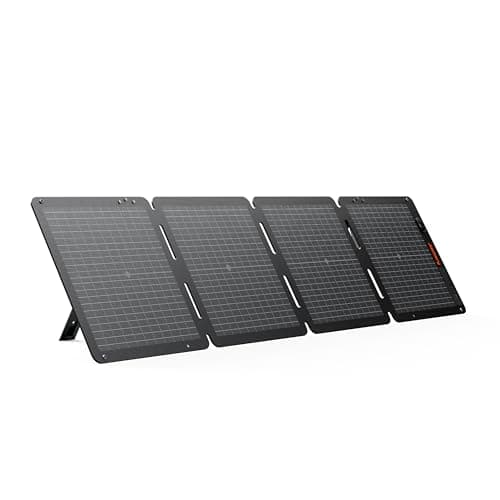
100 W from 25%-efficient N-Type cells, with a 45 W USB-C PD port and two USB-A ports at published wattages, for 8.86 lb.
Renogy publishes 100 W from N-Type 16BB cells at 25% conversion efficiency, one USB-C PD port rated to 45 W and two USB-A ports at 18 W and 15 W, a weight of 8.86 lb, a folded size of 20.6 by 24.6 by 1.6 in, built-in kickstands, IP67 weatherproofing with a hail-resistant ETFE coating rated from -40 F to 185 F, parallel wiring so a single shadow does not drag the whole panel down, and a 3-year warranty on output, material and workmanship. It quotes 320 Wh a day, sunlight depending.
The ports are the reason this earns its place. Both other panels here are built to feed a power station: Jackery does not publish a per-port output for the SolarSaga and the EcoFlow has no USB ports at all. This one publishes a number for every port, and 45 W over USB-C PD is enough to charge a laptop or to fast-charge a large power bank directly, which the 5 V ports on cheap panels cannot do.
That makes it the panel to buy if you want sun-to-device with nothing in between. For anything that has to run after dark you still want storage — pair it with a power station and the panel becomes a genuine off-grid supply rather than a daytime trickle.
The parallel wiring claim is worth noting against the shade problem below. Most folding panels wire their cells in series, where one shadowed cell throttles the whole string; Renogy states this one is wired in parallel so individual shadows do not. It is the only panel here that publishes anything at all about shade behavior.
The drawback
Renogy publishes no unfolded size, no cable length and no Voc, Vmpp or Imp figures, so you cannot check how much space it needs or how it pairs with a specific charge controller before it arrives.
Published specs
Rated output
100 W
Cells
N-Type, 16BB, 25% conversion efficiency
Ports
USB-C PD 45 W max, plus 2x USB-A at 18 W and 15 W
Weight
8.86 lb
Folded size
20.6 x 24.6 x 1.6 in
Stand
built-in kickstands
Weather
IP67, hail-resistant ETFE coating, -40 F to 185 F
Shading
parallel wiring, so one shadow does not drag the whole panel
Maker's daily figure
320 Wh per day, sunlight-dependent; Renogy's number, not a measured one
Warranty
3 years on output, material and workmanship
Note
Renogy publishes no unfolded size, no cable length and no Voc/Vmpp/Imp figures for this panel
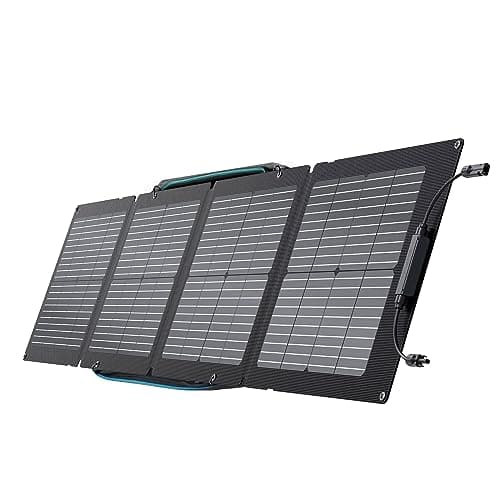
110 W nominal at 22-23% efficiency in an IP68-rated composite case, with a stand built into the carry bag, for 8.8 lb.
EcoFlow publishes 110 W nominal output, 22 to 23% solar conversion efficiency, an 8.8 lb (4 kg) weight, unfolded dimensions of 20.2 by 62.5 by 0.8 in and folded of 20.2 by 16.5 by 0.8 in, an IP68-rated waterproof composite construction tested to IEC 60529, and a stand built into the carry case.
IP68 is a meaningfully higher rating than IP65 — EcoFlow states testing to a maximum water depth of 1 m for up to 72 hours — and on a camping panel that is a practical feature rather than a specification-sheet flex. Panels get left out through an afternoon shower because bringing one in every time it clouds over is how they end up unused.
The integrated stand is the other quietly good decision. Panels that need a separate stand get laid flat, and flat is the worst orientation for output at any time of year outside midsummer noon. The lack of USB ports is a genuine limitation: this one wants a power station on the end of it.
The drawback
No USB ports on the panel itself — it is designed to feed a power station rather than a phone, so it is the one panel here that does nothing on its own.
QHow much power does a 100W camping solar panel produce in a day?
Multiply the rating by peak sun hours - typically 3 to 6 - then take 20 to 30% off for angle, heat and cable losses. On a clear summer day with 5 peak sun hours that is roughly 350 to 400 Wh. Overcast or shaded, expect a fraction of it.
QWhat size solar panel do I need for camping?
Less than you think for phones and lights. A phone charge is roughly 15 to 20 Wh, so four people charging daily is under 100 Wh - a fraction of one clear day on a 100 W panel. Running a 12V fridge is a different project needing a much larger battery as well.
QDoes panel angle really matter?
A lot. Output falls with the cosine of the angle between the panel and the sun, so 30 degrees off costs about 13% and 60 degrees off costs about half. Repositioning a panel twice a day beats buying a bigger one and leaving it flat.
QWhy does shade hurt solar panels so much?
Because a shadowed cell limits the current through its entire series string. A branch shadow across one corner costs far more output than the fraction of area it covers, which is why a long cable to put the panel in sun beats keeping it beside camp. The Renogy is the one panel here that publishes anything about this, stating parallel wiring so a single shadow does not drag the whole panel down.
QWhat happened to the BioLite SolarPanel 100?
It is no longer sold. BioLite has no portable solar panel listed on the marketplace at all as of October 2026 - the SolarPanel 5+ and the SolarHome 625 both come back as currently unavailable - so we replaced it on this page rather than leave a buy link that goes nowhere. The Renogy 100W Portable is our pick in its place: it matches the feature that made the BioLite worth listing, a 45 W USB-C PD port for charging devices straight off the panel, and adds published wattages for its USB-A ports too.
How we picked
Everyone else in this category will tell you they tested twenty of these. We have not tested any of them, and we would rather say so than pretend. There is no gear closet here and no test lab.
What we did instead: pulled the published specifications from each manufacturer's own spec sheet or manual, named the standard behind every rating so you can check what it actually promises, did the arithmetic that turns a spec into a decision, and pulled today's real retail price rather than quoting one from memory. Every pick states a drawback, because a list where nothing is wrong with anything is an advert.
The limits of that method, stated plainly: published specs do not capture zipper quality, seam durability, or how a tent behaves at 2am in a storm. Where that matters, we say so on the pick. The full method is here.