Jackery vs EcoFlow for Camping: Capacity, Recharge Speed and One Compatibility Trap
The two brands split cleanly: Jackery publishes more capacity and a longer-rated cell life, EcoFlow publishes a one-hour recharge. The thing that should actually decide it is which panel plugs into which box, and that is where Jackery has a problem of its own making.
Buy the Jackery Explorer 300 if you want the most stored energy and the longest-rated cells: 292 Wh against EcoFlow's 243 Wh, and cells rated past 4,000 cycles. Buy the EcoFlow River 2 240 if recharge speed matters more than capacity — it publishes a 60-minute refill and Jackery publishes no AC recharge time for the Explorer 300 at all. For panels, buy the EcoFlow, because Jackery states its own SolarSaga 100 Air is not compatible with the Explorer 300.
This is a brand comparison rather than a model comparison, so the honest framing is that each brand publishes a different number loudly and stays quiet about the other one. That pattern is the comparison.
Power stations, on published numbers
Jackery Explorer 300
EcoFlow River 2 240
Capacity
292 Wh
243 Wh
AC output
300 W, 600 W peak surge
300 W, 600 W surge
Cells
LiFePO4, over 4,000 cycles to 70%
LiFePO4, 3,000 cycles to 80%
Weight
7.5 lb
7.7 lb
AC recharge
not published
60 minutes to full
Solar recharge
to 80% in about 2.8 h on a 100 W panel
not published for this model
Ports
2x AC, USB-C PD 100 W, 2x USB-A, 120 W car
not published on the listing
Figures as published by each maker on 2026-10-21. The blanks are real: each brand omits exactly the figure the other one leads with.
Read the bottom three rows together, because they are the whole decision. Jackery tells you how fast the sun fills it and not how fast the wall does. EcoFlow tells you how fast the wall fills it and not how fast the sun does. Neither is hiding a bad number necessarily — but you cannot compare them on the axis the other brand chose, and any page that claims to has made the figure up.
The cycle-life figures are not comparable, and here is why
Both brands publish a cycle rating and the numbers look directly comparable. They are not. Jackery publishes over 4,000 cycles to 70% capacity; EcoFlow publishes 3,000 cycles to 80%. The percentage is the end-point — the state of degradation at which the count stops — and Jackery has chosen a deeper one, which naturally yields a bigger number.
A cell that is allowed to decay to 70% will always survive more cycles than the same cell measured to 80%. So the correct reading is: both are LiFePO4 cells, both will outlast the camping life of the product, and neither figure should move your decision. For context on what the chemistry buys you, see best portable power stations.
Solar panels, on published numbers
Jackery SolarSaga 100 Air
EcoFlow 110W
Rated output
100 W (STC), 110 W bifacial
110 W nominal
Cells
dual-sided PERC, bifacial, 23%
22-23%
Weight
7 lb
8.8 lb
Weather
IP68 in the specs, IP65 in the title
IP68 to IEC 60529
Stand
integrated aluminum, 60-second setup
built into the carry case, adjustable
USB ports
yes, wattage unclear on the listing
none
Compatibility
NOT compatible with Explorer 300 / 300 v2
most stations with solar connectors
Figures as published by each maker on 2026-10-21. The Jackery listing states IP65 in its title and IP68 in its feature list; that contradiction is the maker's, not ours.
The Jackery panel will not run the Jackery station on this page
Jackery prints this on the SolarSaga 100 Air listing itself: the panel is not compatible with the Explorer 300 or 300 v2 series, and using them together may trigger an F7 input voltage error from a voltage mismatch. If you are buying into Jackery expecting the obvious pairing to work, it does not. Either buy a different Jackery panel that matches your station's input voltage window, or buy a station from the same current generation as the panel — and check the input voltage range on the station before you order either.
Why voltage mismatch happens at all
A power station's solar input accepts a voltage window, not any panel. Feed it below the minimum and the charge controller never starts; feed it above the maximum and the station refuses the input to protect itself, which is what an error code like F7 is doing. Panel wattage has nothing to do with it — a 100 W panel can be outside the window while a 200 W panel is inside it.
That is why the real compatibility spec is the panel's open-circuit voltage against the station's published input range, and why “same brand” is not a substitute for checking. The practical rule: before pairing anything, find the station's solar input voltage range in its manual and the panel's Voc on its spec sheet, and confirm the second sits inside the first. The sizing arithmetic that follows is in what size power station do I need.
What each brand is actually good at
Jackery: capacity per dollar and per pound. 292 Wh at 7.5 lb is more energy in a lighter box than EcoFlow's 243 Wh at 7.7 lb. For a family weekend of phones, lights and a tablet, more stored energy is worth more than faster refilling.
EcoFlow: turnaround. A published 60-minute full recharge changes how you use the thing. If your camping is a series of short trips with the station living in the house between them, this is the one that is always ready.
Jackery: USB-first charging. A 100 W USB-C port covers a laptop without going through the inverter, which is the efficient path out of the battery.
EcoFlow: panel compatibility. Its panel is sold as working with most stations that have solar connectors. Jackery's current 100 W panel is sold with an explicit warning against its own 300-class station.
Which to buy
For most campers reading this site, buy the Jackery Explorer 300. Capacity is the spec that runs out at a campsite, 292 Wh is 20% more of it, and it weighs less. The missing AC recharge figure is an irritation rather than a problem if the station lives in the house and gets charged overnight.
Buy the EcoFlow River 2 240 if you camp in short bursts — a night here, a weekend there, with little warning. An hour from empty to full is the difference between taking it and leaving it behind.
For a panel, buy the EcoFlow 110W unless you have confirmed compatibility. It is heavier and has no USB ports, but it is sold as working with most stations and Jackery's is sold with a warning about the station in this very comparison. If you want the lighter bifacial Jackery panel, pair it with a Jackery station from the matching generation and check the input voltage window first.
And before either brand: work out whether you need a power station at all. A large power bank covers phones and headlamps for a weekend at a fraction of the weight and price, and power banks vs power stations draws the line at the point an AC outlet starts to matter.
The picks in full
1. The Jackery
Jackery Explorer 300
Jackery
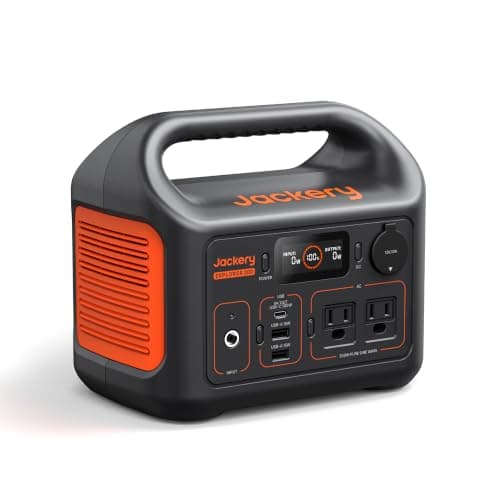
292 Wh and 300 W AC on LiFePO4 cells rated past 4,000 cycles to 70%, at 7.5 lb, with a 100 W USB-C port.
Jackery publishes 292 Wh of capacity, 300 W of rated AC output with a 600 W peak surge, LiFePO4 chemistry rated to over 4,000 charge cycles before falling to 70% capacity, a 7.5 lb weight, and a port set of two AC outlets, a 100 W USB-C PD port, two USB-A ports and a 120 W car port. For solar it publishes 80% in about 2.8 hours from a 100 W panel, or 7.5 hours from a 40 W panel.
Two of those numbers are genuinely better than EcoFlow's. 292 Wh against 243 Wh is 20% more stored energy, which at this size is most of an extra phone-and-lights day. And 4,000 cycles to 70% against 3,000 to 80% is a longer service life, though the two brands have chosen different end-points so the figures are not directly comparable — Jackery is measuring to a deeper state of degradation.
The 100 W USB-C port is the quiet win for camping. Most of what you charge at a campsite is USB, and a 100 W port runs a laptop without touching the AC inverter, which is the least efficient way to move power out of a battery.
The drawback
Jackery publishes no AC recharge time for this model at all, only a solar figure, so you cannot plan a mains top-up between trips from the spec sheet. And its own current 100 W panel does not work with it.
Published specs
Capacity
292 Wh
Output
300 W AC (600 W peak surge)
Battery
LiFePO4, over 4,000 cycles to 70%
Weight
7.5 lb
Ports
2 AC outlets, USB-C PD 100 W, 2x USB-A, 120 W car port
Solar recharge
to 80% in about 2.8 h on a 100 W panel, or 7.5 h on a 40 W panel
Note
the listing publishes no AC recharge time; the solar figures above are what it does publish
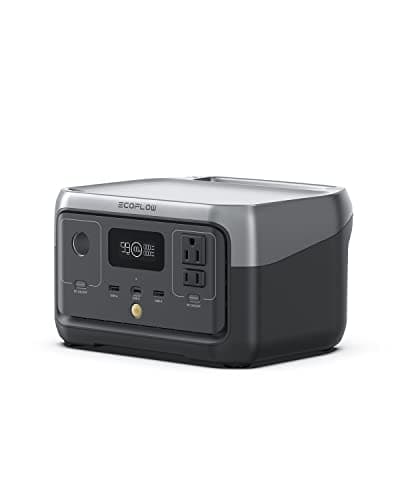
243 Wh and 300 W with a 600 W surge, on LiFePO4 rated to 3,000 cycles to 80%, at 7.7 lb, with a published 60-minute recharge to full.
EcoFlow publishes 243 Wh, 300 W of output with a 600 W surge, LiFePO4 cells rated to 3,000 cycles to 80% capacity, a 7.7 lb weight, and a full AC recharge in 60 minutes.
That recharge figure is the brand's whole argument and it is a real one for the way most people camp. A station that refills in an hour can be topped up at a trailhead cafe, in a motel room on a multi-stop trip, or in the twenty minutes you are packing the car. A station that takes an unspecified number of hours has to be remembered the night before.
Note what EcoFlow does publish that Jackery does not: an actual AC recharge time. Note also what it costs — 243 Wh is the smallest battery here, and it weighs more than the Jackery that holds 20% more. You are paying weight and capacity for speed.
The drawback
The smallest capacity in this comparison by 49 Wh, and heavier than the Jackery despite holding less. A one-hour recharge is partly a function of having less to fill.
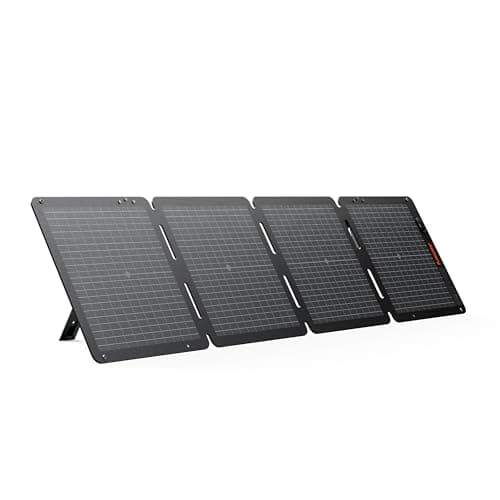
100 W bifacial at 23% efficiency in a 7 lb package with an integrated aluminum stand and a sun indicator.
Jackery publishes 100 W from dual-sided PERC cells at 23% efficiency, a 7 lb weight it describes as 27% lighter than a standard 100 W panel, a W-fold design it says packs smaller than A2 paper, an integrated aluminum stand with a 60-second setup, a sun indicator for alignment, an operating range of -4 F to 149 F, and IEC TS 63163 certification backed by 18 tests including 4,000 fold cycles.
Bifacial is the interesting part: the panel generates from both faces, so light bouncing off the ground or a light-colored tarp contributes. Jackery claims the benefit shows up most at dawn, dusk and under cloud, which is exactly when a camp panel is otherwise useless.
Then there is the compatibility notice, printed by Jackery on its own listing: this panel is not compatible with the Explorer 300 or 300 v2 series, and pairing them may trigger an F7 input voltage error. The brand's current 100 W panel does not run the brand's 300-class power station. That is the single most important fact on this page.
The drawback
Jackery states on this listing that it is NOT compatible with the Explorer 300 or 300 v2 series and will throw an F7 input-voltage error. The listing also contradicts itself on weatherproofing, with IP65 in the title and IP68 in the specifications.
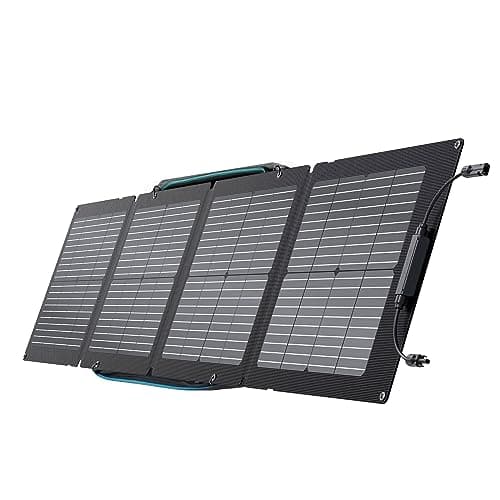
110 W at 23% efficiency, IP68-rated, in a carry case that doubles as an adjustable kickstand.
EcoFlow publishes 110 W nominal output, 22 to 23% cell efficiency, an IP68 water and dust rating tested to IEC 60529, an 8.8 lb weight, an unfolded size of 20.2 by 62.5 by 0.8 in and a folded size of 20.2 by 16.5 by 0.8 in, and a carry case that doubles as an adjustable kickstand.
The compatibility language is the opposite of Jackery's: EcoFlow says it plugs into most power stations with solar connectors. That is a meaningfully different promise from a brand that has to warn you off its own hardware, and it is why the EcoFlow panel is the safer buy if you do not already own a matching station.
The kickstand-in-the-case design is also quietly good. Panels that need a separate stand end up lying flat on the ground, and a panel lying flat loses a large fraction of its output — see the angle arithmetic in best solar panels for camping.
The drawback
8.8 lb, the heaviest item in this comparison, and EcoFlow publishes no per-port USB output because it has no USB ports at all. It is a panel for feeding a power station, not for charging a phone directly.
Jackery for capacity, EcoFlow for recharge speed. The Jackery Explorer 300 publishes 292 Wh against the EcoFlow River 2 240's 243 Wh, and weighs slightly less at 7.5 lb versus 7.7 lb. The EcoFlow publishes a 60-minute full AC recharge; Jackery publishes no AC recharge time for the Explorer 300 at all.
QCan you use a Jackery solar panel with a Jackery power station?
Not always, and this is a real trap. Jackery states on the SolarSaga 100 Air listing that it is not compatible with the Explorer 300 or 300 v2 series, and that pairing them may trigger an F7 input voltage error. Check the station's solar input voltage range against the panel's open-circuit voltage before buying, even within one brand.
QWhat does an F7 error mean on a Jackery power station?
It is an input voltage error. A power station's solar input accepts a voltage window, and a panel outside that window is refused rather than accepted at reduced output. Jackery names the F7 code specifically when warning that the SolarSaga 100 Air should not be paired with the Explorer 300 series.
QJackery says 4,000 cycles and EcoFlow says 3,000 - is Jackery's battery better?
Not necessarily, because the end-points differ. Jackery counts over 4,000 cycles to 70% of original capacity; EcoFlow counts 3,000 to 80%. A cell measured to a deeper state of degradation always records more cycles. Both are LiFePO4 and both will outlast the camping life of the product, so this should not decide your purchase.
QWhich brand's solar panel is better for camping?
The EcoFlow 110W is the safer buy because it is sold as compatible with most power stations that have solar connectors. The Jackery SolarSaga 100 Air is lighter at 7 lb versus 8.8 lb and is bifacial, generating from both faces, but it carries an explicit incompatibility warning for Jackery's own 300-class stations.
QDo you need a power station for camping at all?
Usually not for a weekend. Phones, headlamps and a camera are a power bank's job, at a fraction of the weight and cost. A power station earns its place when you need an AC outlet, are out longer than a couple of nights, or are running something continuous like a 12V fridge or a CPAP.
How we picked
Everyone else in this category will tell you they tested twenty of these. We have not tested any of them, and we would rather say so than pretend. There is no gear closet here and no test lab.
What we did instead: pulled the published specifications from each manufacturer's own spec sheet or manual, named the standard behind every rating so you can check what it actually promises, did the arithmetic that turns a spec into a decision, and pulled today's real retail price rather than quoting one from memory. Every pick states a drawback, because a list where nothing is wrong with anything is an advert.
The limits of that method, stated plainly: published specs do not capture zipper quality, seam durability, or how a tent behaves at 2am in a storm. Where that matters, we say so on the pick. The full method is here.