A headlamp wins for anything you do with your hands: cooking, pitching a tent, reading, walking. A flashlight wins for three jobs — throwing light a long way, handing light to someone else, and lighting something from an angle so you can see its shape. Most campers should own a headlamp first and a flashlight second.
The angle point is the one people have not thought about. A headlamp puts the beam along your line of sight, which flattens everything and removes the shadows that show texture. Looking for a dropped tent stake in grass, or checking whether a pole section is cracked, is much easier with a light held to one side.
Handing light to someone is the second. You cannot lend a headlamp to a person helping you without taking it off your head, and holding a headlamp in your hand is awkward because the strap gets in the way. The general case for the headlamp is in best headlamps for camping.
Compared on published numbers
Flashlight
Max output
Beam distance
Runtime high
Water rating
Weight
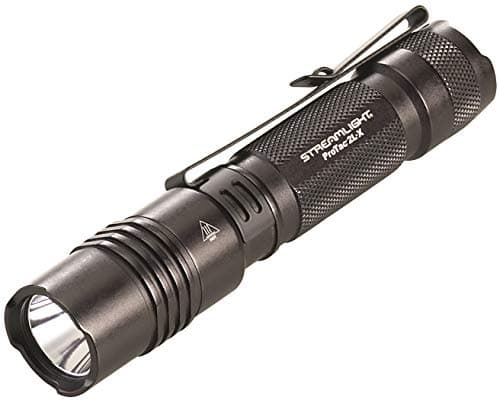
Streamlight ProTac 2L-X
500 lm
165 m
2.67 h on CR123A
IPX7
3.9 oz
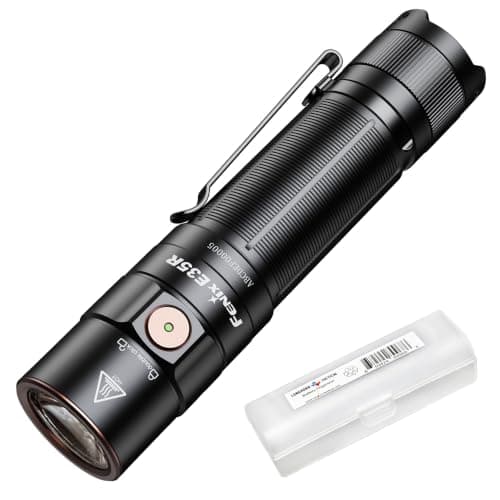
Fenix E35R
3,100 lm
284 yd
not compared here
IP68, 2 m for 30 min
5.22 oz
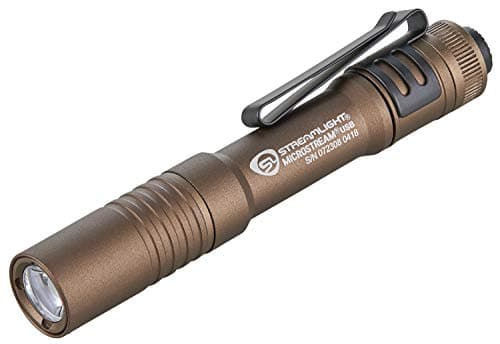
Streamlight MicroStream USB
250 lm
68 m
1.5 h
IPX4
1.2 oz
Figures as published by each manufacturer. Streamlight figures are tested to ANSI/PLATO FL1.
Lumens are not brightness where you are pointing
Lumens measure total light output in every direction. Candela measures intensity in the direction the light is pointed, and beam distance is derived from candela. Two lights can be much closer in reach than their lumen figures suggest, or much further apart: the ProTac 2L-X publishes 500 lumens and throws 165 m, while the MicroStream USB publishes 250 lumens and throws 68 m. Half the lumens but well under half the reach, because the ProTac also concentrates its light into a tighter beam. Lumens set the total output; candela sets how far any of it actually gets.
For camp use, a wide flood at moderate output is more useful than a tight beam at high output, because you are lighting things a few feet away and a hotspot just ruins your night vision. For finding something at distance, the reverse. The full explanation is in lumens explained for camping lights.
ANSI FL1 is what makes these numbers comparable
ANSI/PLATO FL1 is the standard that defines how output, runtime, beam distance, impact resistance and water resistance are measured on a portable light. Crucially, it defines runtime as the time until output falls to 10 percent of the initial figure, which is why a published runtime is longer than the time the light stays genuinely bright.
A light that publishes FL1 figures has been measured against a defined procedure. A light that publishes a lumen number with no standard beside it has been measured however the seller chose. On budget flashlights that difference is frequently a factor of two or more.
Read the IP rating before a wet trip
IP ratings are not a scale of general toughness. IPX4 is splash resistance from any direction. IPX7 is immersion to 1 m for 30 minutes. IP68 adds dust protection and immersion beyond 1 m to a depth the maker states. The MicroStream USB at IPX4 is fine in rain and not fine in a creek; the ProTac at IPX7 and the E35R at IP68 both survive being dropped in water. If your camping involves boats, rivers or genuinely heavy weather, this is the specification to read first.
Batteries decide whether the light works on day four
Rechargeable only — lightest and cheapest to run, and completely dependent on you having power. Fine for weekends, a liability on a week-long trip without a power station or a solar panel.
Disposable only — works forever if you carry spares, and CR123A cells are expensive and not stocked in every small-town store.
Both — the ProTac 2L-X takes either. This is the configuration worth paying for, and the reason it is the pick here.
None of the flashlights here has a red mode, and that is a real limitation at a campsite. Red light preserves night vision and does not blind the person you are talking to, which is why every serious headlamp has it. If you are buying one light for a campsite, that is an argument for a headlamp; if you are buying a flashlight, it is an argument for owning both.
Buy the Streamlight ProTac 2L-X if you want one flashlight that cannot be stopped by a flat battery. Buy the Fenix E35R if you have a genuine need to see several hundred yards. Buy the MicroStream USB if what you want is a light that lives in a pack lid and you forget you have.
And buy a headlamp first if you do not already own one. It is the more useful light for almost everything a campsite involves.
The picks in full
1. Best overall
Streamlight ProTac 2L-X
Streamlight
500 lumens and 165 m of beam distance at 3.9 oz, IPX7, running on CR123A cells or a rechargeable SL-B26.
Streamlight publishes 500 lumens on high and 40 on low to ANSI/PLATO FL1, runtimes of 2.67 hours high and 30 hours low on two CR123A cells or 3.25 hours high and 30 hours low on the rechargeable SL-B26, a beam distance of 165 m high and 49 m low, IPX7 water resistance, and a weight of 3.9 oz / 111 g with two CR123A cells.
The dual power option is what makes this the pick. A light that takes both a rechargeable cell and a disposable one cannot be stranded by a flat battery on day four, which is the failure mode that matters on a trip rather than in a garage.
The drawback
CR123A cells are expensive and not stocked everywhere, and the rechargeable battery is an extra purchase rather than included.
3,100 lumens and 284 yards of throw at 5.22 oz, IP68 rated to 2 m for 30 minutes, USB-C rechargeable.
Fenix publishes a maximum output of 3,100 lumens, a peak beam distance of 284 yd, a peak intensity of 15,103 cd, a weight of 5.22 oz / 148 g with the battery, a length of 4.7 in, IP68 water resistance rated to 2 m for 30 minutes, 1.5 m impact resistance, and a USB-C rechargeable 21700 lithium-ion cell.
Buy this one for a specific reason rather than as a general camp light. Fifteen thousand candela of peak intensity is what lets you identify something several hundred yards away, which matters if you are looking for a person, a dog or a route and matters not at all if you are looking for the toilet block.
The drawback
3,100 lumens is far more light than a campsite needs, and using it near other people at night is antisocial. It also runs on a single 21700 cell, so there is no disposable backup.
250 lumens and 68 m of throw from a 1.2 oz body under 4 inches long, USB rechargeable.
Streamlight publishes 250 lumens on high and 50 on low, a 1.5 hour runtime on high and 3.5 hours on low, a peak intensity of 1,150 cd, a beam distance of 68 m on high and 31 m on low, IPX4 water resistance tested to 1 m impact, a weight of 1.2 oz / 34 g, a length of 3.87 in, and a lithium-ion battery that charges in-product in about 4 hours.
At 1.2 oz this is under a third the weight of the ProTac and under a quarter of the E35R, and 250 lumens is the price of that. What it buys is a light you genuinely always have, because it is small enough to live in a pack lid or a jacket pocket permanently. At camp that is worth more than peak output you need once a year.
Read the 1,150 cd figure next to the Fenix at 15,103. Candela rather than lumens sets how far a beam reaches, which is why this throws 68 m and the E35R throws several hundred. For finding a dropped peg, a tent zip or something in the bottom of a bag, a short wide beam is the better tool; for picking out a trail junction in the dark it is not.
The drawback
At 250 lumens it is much the dimmest light here, and IPX4 is splash resistance rather than immersion. Drop it in a stream and it is a different conversation from the IPX7 and IP68 lights here.
For most camping, a headlamp covers it. A flashlight is better at three jobs: throwing light a long way, handing light to someone else, and lighting something from an angle so shadows reveal its shape. Own the headlamp first.
QHow many lumens does a camping flashlight need?
Around 300 to 500 lumens covers everything a campsite involves. Higher output is for searching at distance, and it is beam intensity in candela rather than lumens that determines throw. Two 500-lumen lights here differ by 75 m of beam distance.
QWhat does ANSI FL1 mean on a flashlight?
It is the standard defining how output, runtime, beam distance, impact resistance and water resistance are measured. It sets runtime as the time until output drops to 10 percent of initial. A lumen figure with no standard beside it has been measured however the seller chose.
QWhat IP rating do I need for a camping flashlight?
IPX4 is splash resistance and is enough for rain. IPX7 is immersion to 1 m for 30 minutes and is what you want near water. IP68 adds dust protection and deeper immersion. Choose from where the light will actually be, not from the general toughness of the light.
How we picked
Everyone else in this category will tell you they tested twenty of these. We have not tested any of them, and we would rather say so than pretend. There is no gear closet here and no test lab.
What we did instead: pulled the published specifications from each manufacturer's own spec sheet or manual, named the standard behind every rating so you can check what it actually promises, did the arithmetic that turns a spec into a decision, and pulled today's real retail price rather than quoting one from memory. Every pick states a drawback, because a list where nothing is wrong with anything is an advert.
The limits of that method, stated plainly: published specs do not capture zipper quality, seam durability, or how a tent behaves at 2am in a storm. Where that matters, we say so on the pick. The full method is here.