The first number is magnification and the second is the diameter of the front lens in millimeters. 8x42 means eight times closer, through a 42 mm objective. Higher magnification is not better: above about 10x, your hand shake is magnified too, and the image becomes unusable without a tripod. For camping, 8x42 is the answer often enough that the other options need a reason.
The objective diameter controls how much light gets in. Divide it by the magnification and you get the exit pupil in millimeters — 42 divided by 8 is 5.25 mm, which Vortex publishes directly. A human pupil opens to roughly 5 to 7 mm in low light, so a 5.25 mm exit pupil fills your eye at dawn and dusk. That is precisely when wildlife is out, and it is why 42 mm keeps winning over smaller compacts.
A 10x42 pair gives you a 4.2 mm exit pupil, a narrower field of view and more visible shake. A 8x25 compact is pocketable and gives you a 3.1 mm exit pupil, which is fine at noon and poor at the hour you actually want them.
Compared on published numbers
Binocular
Weight
Field of view
Eye relief
Close focus
Waterproof
Nikon PROSTAFF P3 8x42
20.3 oz
377 ft at 1,000 yd
20.2 mm
not published
1 m for 10 min, nitrogen filled
Vortex Crossfire HD 8x42
23.8 oz
393 ft at 1,000 yd
17 mm
6 ft
waterproof, fogproof and shockproof
Celestron Nature DX 8x42
22.2 oz
388 ft at 1,000 yd
17.5 mm
6.5 ft
not published on the listing we read
Figures as published by each manufacturer or its listing.
Note how close these three are on the optics. Sixteen feet of field of view separates the widest from the narrowest, and half a foot of close focus separates the shortest from the longest. Weight is the one spec that genuinely spreads: three and a half ounces between the Nikon and the Vortex. This is a category where the optical specifications converge, which means the deciding factor is usually eye relief, sealing and what feels right in your hands.
Eye relief is the spec that decides it for half of readers
Eye relief is the distance behind the eyepiece where the full image forms. Your eye has to sit there. Glasses push your eye back by roughly 10 to 15 mm, so a pair with 14 mm of eye relief simply cannot deliver the whole image to someone wearing them — you get a dark tunnel with the edges cut off.
If you wear glasses, treat anything under about 16 mm as unusable and buy toward 18 to 20 mm. That single filter removes most of the market and makes this decision easy. Twist-down eyecups, which all three of these have, are what let a non-glasses user get their eye to the right depth instead.
Close focus is the spec nobody tells beginners about
Every pair has a minimum distance below which it will not focus. The Vortex publishes 6 ft and the Celestron 6.5 ft, which sounds academic until you are at a campsite trying to look at a lizard on a rock eight feet away. Short close focus turns binoculars from a look-at-the-mountain object into something you use around camp all day, and it is the reason birders care about it far more than magnification.
Roof prism, porro prism and what you are paying for
All three here are roof-prism designs: the straight-barrel shape, more compact and more durable, and more expensive to make well. Porro prisms are the old zig-zag shape, which gives better depth perception and more light for the money but is bulkier and more fragile.
For camping, roof prisms win on packability and on sealing. What you are paying for as price rises within roof prisms is coating quality and glass type — phase coatings, and “HD” or “ED” glass that reduces the color fringing you see on a branch against a bright sky. It is a real difference, and it is the last thing a first-time buyer should spend on.
What binoculars are actually for at a campsite
Three things, in order of how often they get used:
Wildlife you would otherwise miss. Most animals at a campground are seen at a distance, at dawn or dusk, and 8x is the difference between “a bird” and a species.
Route reading. Checking whether that is the trail junction, whether the creek is crossable, whether the ridge goes. This pairs with a map rather than replacing one — see how to read a topographic map.
Keeping children occupied. Unreasonably effective, and the reason a cheap second pair is often a better buy than upgrading the first.
Stargazing is a fourth, and 8x42 is genuinely good at it: wide field, bright exit pupil, and the Moon and the Pleiades both look transformed. Steady your elbows on a table or the roof of the car.
What the specifications do not tell you
Waterproofing is inconsistently published. Nikon states a depth and a duration — 1 m for 10 minutes, nitrogen filled — which is the most specific claim here. Vortex states waterproof, fogproof and shockproof without a depth or duration. The Celestron listing we read states no equivalent figure at all, so we have left that cell blank rather than assume. For camping, assume you will be caught in rain and treat sealing as a feature worth confirming before you buy.
Nobody publishes a meaningful optical-quality number. There is no standardized sharpness or contrast rating, which is why reviews in this category rely on subjective comparison. We have not handled these three side by side, so we are comparing them on what the makers publish and nothing else.
What to buy with them
The neck strap supplied with almost every pair is too thin, and binoculars hanging on it swing into your chest all day. A binocular harness moves the weight onto your shoulders and stops the swing, and it costs a fraction of the binoculars. A microfiber cloth in the case is the other thing you will want on day one.
Which to buy
Buy the Nikon PROSTAFF P3 if you wear glasses, or if you want the pair that publishes an actual immersion depth. Buy the Vortex Crossfire HD if wildlife is the point and you want the widest view, the closest focus and sealing against knocks as well as rain — it is the heaviest of the three, and that is the trade. Buy the Celestron Nature DX if you want a capable first pair to live in the car and you would rather spend the difference on something else.
Any of the three is enough for a lifetime of camping. The upgrade that actually changes what you see is not a better pair, it is getting up at dawn — which is also when the compass and the map come out.
The picks in full
1. Best overall
Nikon PROSTAFF P3 8x42
Nikon
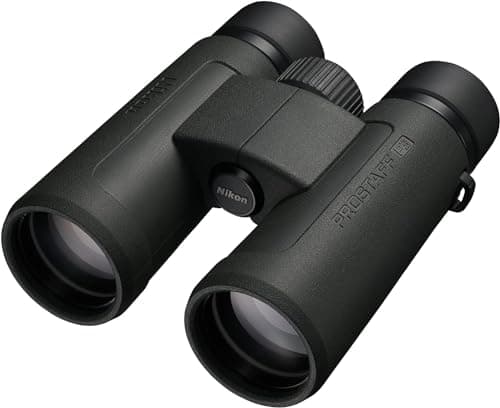
20.2 mm of eye relief and a 377 ft field of view at 20.3 oz, waterproof to 1 m and nitrogen filled.
Nikon publishes 8x magnification with a 42 mm objective, a 20.3 oz weight, a 377 ft field of view at 1,000 yd, 20.2 mm of eye relief, waterproofing to 1 m for 10 minutes, nitrogen filling against fogging, and a multicoated roof-prism design.
The 20.2 mm eye relief is why this is the pick. If you wear glasses, eye relief is the single specification that decides whether binoculars work for you at all: below roughly 15 mm you see a black ring instead of the full image unless you take the glasses off. Twenty millimeters is generous, and it is the difference between a pair you use and a pair that lives in the glovebox.
Nitrogen filling is the other quiet feature. Camping means taking optics from a cold night into a warm morning, and a nitrogen-purged body does not fog internally when you do.
The drawback
377 ft is the narrowest field of view of the three here. Nikon does not publish a close-focus figure on the page we read, which matters if you want to look at insects rather than elk.
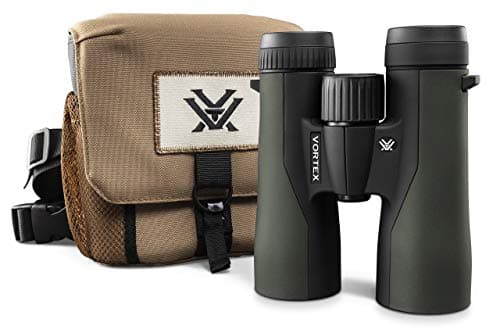
393 ft of field of view and a 6 ft close focus, with 17 mm of eye relief and full waterproof, fogproof and shockproof sealing.
Vortex publishes 8x42, a 23.8 oz weight, a 393 ft field of view at 1,000 yd (7.5 degrees), 17 mm of eye relief, a 6 ft close focus, a 5.25 mm exit pupil, dimensions of 6.3 by 5.2 in, an interpupillary range of 57 to 74 mm, and waterproof, fogproof and shockproof construction.
Two numbers make this the wildlife pick. The 393 ft field of view is the widest here, which is what lets you find a moving bird without losing it; and the 6 ft close focus is the shortest of the three, close enough to watch a dragonfly on the far side of a picnic table.
Field of view is the specification beginners ignore and experienced users choose on. A wider view means less hunting around, and hunting around is why people give up on binoculars.
The drawback
17 mm of eye relief is usable with glasses but noticeably tighter than the Nikon's 20.2 mm, and at 23.8 oz it is the heaviest of the three for no extra brightness.
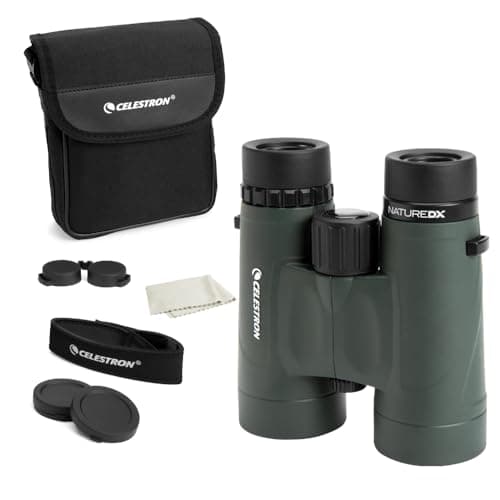
388 ft of view and a 6.5 ft close focus at 22.2 oz, in a compact 5.3 by 4.9 in body.
Celestron publishes 8x42, a 22.2 oz weight, a 388 ft field of view at 1,000 yd, a 6.5 ft close focus, 17.5 mm of eye relief and a body measuring 5.3 by 4.9 by 2 in.
On paper this sits between the other two on every axis, which is exactly why it is the value pick: nothing about it is compromised, and the specification you give up is a fraction of an ounce and a millimeter of eye relief.
The short body is worth noting for a car-camping kit. These are the easiest of the three to leave in a door pocket, which correlates strongly with actually using them.
The drawback
The heaviest here at 22.2 oz, and 17.5 mm of eye relief puts it behind the Nikon for glasses wearers.
QWhat magnification binoculars are best for camping?
8x, with a 42 mm objective. Above about 10x your hand shake is magnified enough to blur the image without a tripod, and the field of view narrows so much that finding a moving animal becomes difficult. 8x42 also gives a 5.25 mm exit pupil, which suits dawn and dusk when wildlife is active.
QWhat does 8x42 mean on binoculars?
Eight times magnification through a 42 mm front lens. Dividing the objective by the magnification gives the exit pupil, 5.25 mm here, which is roughly how wide your own pupil opens in low light. That match is why 42 mm objectives stay bright at dawn and dusk while small compacts do not.
QDo binoculars work if you wear glasses?
Only if the eye relief is long enough. Glasses hold your eye 10 to 15 mm further back, so anything under about 16 mm of eye relief will show a dark ring instead of the full image. The Nikon PROSTAFF P3 publishes 20.2 mm, the Celestron Nature DX 17.5 mm and the Vortex Crossfire HD 17 mm.
QAre expensive binoculars worth it for camping?
Past a point, no. Within roof-prism designs the money buys better coatings and glass that reduces color fringing, which is real but subtle. For camping, eye relief, field of view and whether they are sealed against rain matter far more than price.
How we picked
Everyone else in this category will tell you they tested twenty of these. We have not tested any of them, and we would rather say so than pretend. There is no gear closet here and no test lab.
What we did instead: pulled the published specifications from each manufacturer's own spec sheet or manual, named the standard behind every rating so you can check what it actually promises, did the arithmetic that turns a spec into a decision, and pulled today's real retail price rather than quoting one from memory. Every pick states a drawback, because a list where nothing is wrong with anything is an advert.
The limits of that method, stated plainly: published specs do not capture zipper quality, seam durability, or how a tent behaves at 2am in a storm. Where that matters, we say so on the pick. The full method is here.