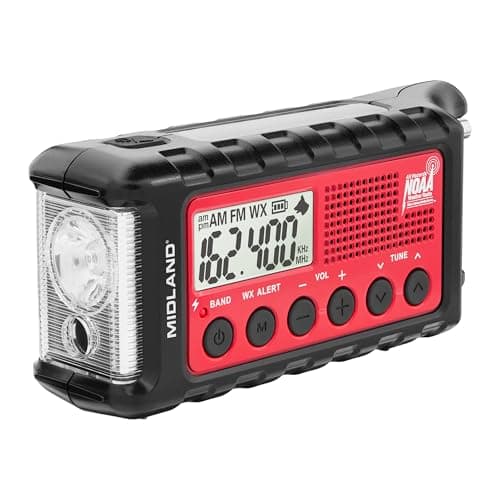
A weather radio does one thing no phone can do at a campsite with no signal: tell you what the sky is about to do. It cannot call anyone, and confusing the two is dangerous.
A NOAA weather radio receives. It cannot transmit, it cannot call for help, and it will not tell anyone where you are. It exists to give you warning of what is coming — severe thunderstorms, flash floods, tornadoes, winter storms — in places where your phone has no signal. For calling for help, you need a satellite messenger, and the two are not interchangeable.
This distinction matters because the products look similar and are sold beside each other. The site's comparison of the transmitting options is in satellite messenger vs PLB vs two-way radio. A weather radio is the cheap half of a complete kit, not a substitute for the expensive half.
What it is genuinely excellent at: knowing at 4pm that a severe thunderstorm warning covers your valley, so you can strike the tarp, move off the ridge or get out of the wash before it arrives. Flash floods in particular kill campers who never saw the rain, because it fell twenty miles upstream.
Compared on published numbers
Radio
NOAA channels
Power sources
Battery life
Flashlight
Notable
Midland ER310
7, with alert
solar, crank, Li-ion, 6 x AA
up to 32 h
130 lumens
AA fallback, USB out, SOS beacon
Midland ER210
7, scans 10 WX
solar, crank, 2,200 mAh Li-ion
up to 32 h
130 lumens, high and low
5.5 h recharge, USB out
Figures as published by Midland.
Two radios from one maker is not laziness. Midland dominates this category in the US and publishes real specifications; most competing crank radios list neither battery capacity nor runtime, and a radio whose runtime is unstated is not one we can compare.
The four power sources, ranked by how much you should rely on them
Disposable AA batteries. The most reliable by a wide margin, and only the ER310 takes them. Keep a fresh set in the bin.
The internal lithium cell, charged before you leave. 32 hours is genuinely plenty for a weekend, provided you charged it. Lithium cells self-discharge in storage.
The hand crank. A real backstop: one minute gives roughly 10 to 20 minutes of playback on the ER310. Fine for checking a forecast, useless for running a light all evening.
Solar. Midland describes the panel as a trickle charge to maintain battery life. Treat it as maintenance, not charging, and do not plan around it.
Check your alert area before you trust the alarm
NOAA weather alerts are broadcast by county or marine zone. A radio set to scan and lock the strongest channel will alert you to warnings for that transmitter's whole coverage, which can be several counties wide — so some alerts will not apply to you, and one valley over may be served by a different transmitter you are not receiving. Scan for the strongest signal once you arrive at a new site rather than assuming the channel you used last trip still applies.
Where the radio fits in a camping kit
Realistically it lives in the bin with the first aid kit and comes out when the forecast is uncertain or the sky changes. It is not an every-trip item for a sheltered campground with a phone signal, and it is close to essential for dispersed camping, desert washes, exposed ridges and anywhere storms build fast in the afternoon.
Two habits make it worth carrying. Check the forecast before you leave the signal, and check the radio again when the sky changes rather than after the rain starts. The trip-level planning is in dispersed camping for beginners.
What the specifications do not tell you
Neither listing we read publishes a weight or dimensions, which is the figure you most want when deciding whether it goes in a pack. We have left it out rather than estimate.
Reception quality is also unpublished and depends almost entirely on terrain. A valley can block a transmitter completely, and no specification predicts that. Extend the antenna fully and try several positions before concluding there is no coverage.
Which to buy
Buy the ER310 if the radio lives in the car or a bin, which is most people. The AA fallback is the specification that makes it dependable a year after you bought it and forgot about it.
Buy the ER210 if it is going in a pack and size decides what comes.
Buy neither instead of a way to call for help. A satellite messenger is the item that gets someone to you; the weather radio is the item that keeps you from needing one.
The picks in full
1. Best overall
Midland ER310
Midland
7 NOAA channels with alert, up to 32 hours of runtime, four power sources including 6 AA, and a 130-lumen light.
Midland publishes 7 NOAA weather channels with weather alert, power from a solar panel, a hand crank, a rechargeable lithium-ion battery or six AA batteries, up to 32 hours of continuous use, roughly 10 to 20 minutes of playback per minute of cranking, a 130-lumen Cree LED flashlight, an SOS beacon and USB device charging.
The AA fallback is why this is the pick. Solar is slow, cranking is tedious, and a lithium cell that has sat in a box since last summer is often flat. A radio that will also run on six AAs bought at any gas station has a failure mode you can actually recover from at 9pm.
The weather alert function is the part worth understanding: left on, it monitors the channel and sounds when the National Weather Service issues a warning for the area, rather than requiring you to listen.
The drawback
Larger and heavier than it needs to be for one person, and the ultrasonic dog whistle is a novelty rather than a feature. Midland does not publish a weight on the page we read.
The same 7 NOAA channels and 130-lumen light in a smaller body, with a 2,200 mAh cell good for 32 hours.
Midland publishes 7 NOAA weather channels with a scan across 10 WX band channels, three power sources (solar, hand crank and a 3.7 V 2,200 mAh lithium-ion battery), up to 32 hours of continuous operation, a charge time of about 5.5 hours, a 130-lumen Cree LED flashlight with high and low modes and an SOS Morse beacon, and a USB output for charging a phone.
Same core capability, smaller package. If the radio is going in a pack rather than a bin, this is the sensible version, and the specification you give up is the one you hope never to need.
Treat the USB charging output on both of these as an emergency trickle rather than a power source. A 2,200 mAh cell is a fraction of a phone battery, and cranking a phone back to life is a genuinely miserable way to spend an hour — carry a power bank instead.
The drawback
No AA fallback. When the internal 2,200 mAh cell is flat you are cranking or waiting on solar, and a full recharge takes about 5.5 hours.
It matters most where your phone has no signal and the weather builds fast: dispersed sites, desert washes, exposed ridges and river corridors. At a developed campground with coverage, your phone does the same job. The case for one is flash floods and severe thunderstorms, which arrive with little visible warning.
QCan a NOAA weather radio call for help?
No. It only receives. It cannot transmit, cannot contact anyone and does not report your location. For calling for help outside cell coverage you need a satellite messenger or a personal locator beacon, which are different devices with a different cost.
QHow long does an emergency crank radio last on one charge?
Midland publishes up to 32 hours of continuous use for both the ER310 and ER210. The hand crank adds roughly 10 to 20 minutes of playback per minute of cranking, and the solar panel is a trickle charge that maintains the battery rather than charging it from empty.
QCan you charge a phone from a crank weather radio?
Slowly, and only as a last resort. Both radios have a USB output, but a 2,200 mAh internal cell is a fraction of a modern phone battery, and cranking one back to life takes a long time for very little charge. Carry a proper power bank for charging.
How we picked
Everyone else in this category will tell you they tested twenty of these. We have not tested any of them, and we would rather say so than pretend. There is no gear closet here and no test lab.
What we did instead: pulled the published specifications from each manufacturer's own spec sheet or manual, named the standard behind every rating so you can check what it actually promises, did the arithmetic that turns a spec into a decision, and pulled today's real retail price rather than quoting one from memory. Every pick states a drawback, because a list where nothing is wrong with anything is an advert.
The limits of that method, stated plainly: published specs do not capture zipper quality, seam durability, or how a tent behaves at 2am in a storm. Where that matters, we say so on the pick. The full method is here.