Published range figures are measured line of sight with nothing in between — effectively two hilltops on a clear day. In forest, in a valley, or between a campsite and a trail, expect 1 to 3 miles from a consumer radio and 2 to 8 from a 5-watt one. These are VHF and UHF signals: they travel in straight lines and do not bend around terrain.
This is not a scandal, it is physics, and every manufacturer quotes the same way. The useful move is to read the second number where one is published: Rocky Talkie publishes 2 to 8 miles in backcountry terrain, Midland publishes an average of 1/2 to 2 miles in normal conditions, and Motorola publishes 2 miles in neighborhoods and 6 on open water.
Power helps but less than height does. Moving fifty feet up a slope will do more for your signal than doubling wattage, which is worth knowing when you cannot reach someone.
Compared on published numbers
Radio
Power
Realistic range as published
Battery
Water rating
Weight
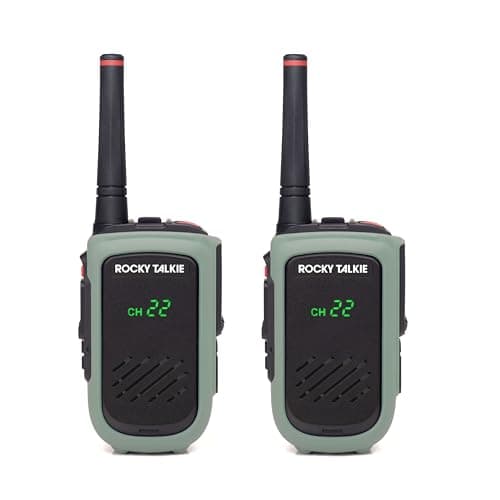
Rocky Talkie 5 Watt
5 W
2 to 8 mi backcountry
1,800 mAh, 4 to 6 days
IP67
9.1 oz
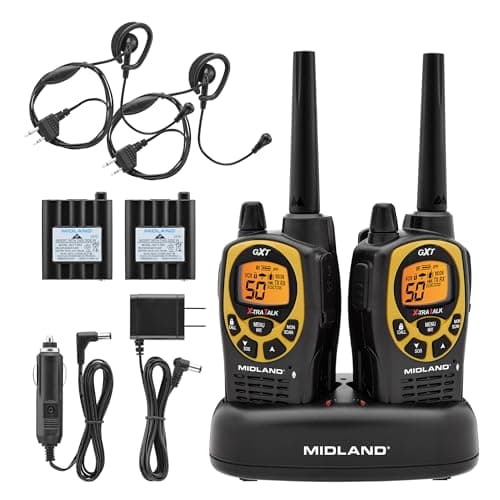
Midland GXT1030VP4
not published
1/2 to 2 mi normal conditions
NiMH pack or 4x AA
JIS4 splash
not published
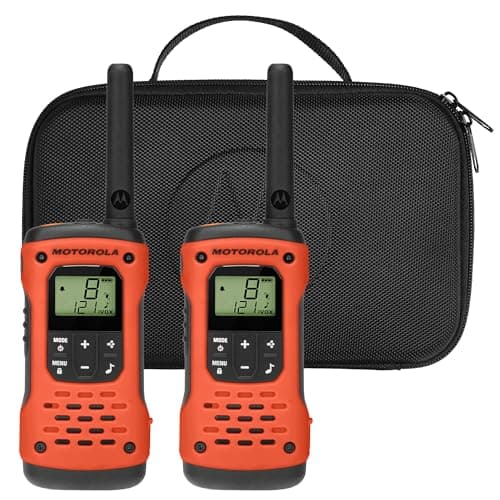
Motorola Talkabout T605 H2O
not published
2 mi neighborhoods, 6 mi open water
800 mAh, about 9 h, or 3x AA
IP67, floats
not published
Figures as published by each manufacturer, including their own realistic-terrain figures where given.
FRS, GMRS and the license question
These radios use two overlapping US services and the distinction has legal weight.
FRS is license-free, capped at 2 watts on most channels, and fixed-antenna only. Every consumer walkie-talkie sold in a blister pack operates here.
GMRS allows higher power and repeater access, and requires an FCC license. As of writing that license covers your whole immediate family, lasts ten years, and involves no exam — but it is not optional if you transmit on GMRS channels or at GMRS power levels.
A 5-watt radio is a GMRS radio. If you buy one, get the license; the FCC publishes the current fee and process, and it is a form rather than a test.
A radio is not an emergency device
Two-way radios talk to other radios on the same channel, within a few miles, if someone is listening. They do not reach emergency services, they do not work where nobody else is, and the SOS siren on a consumer radio is a loud noise rather than a distress signal anyone monitors. If the scenario you are planning for is a genuine emergency in the backcountry, the device for that is a satellite messenger or a personal locator beacon — the difference is laid out in satellite messenger vs PLB vs two-way radio.
Where radios genuinely earn their place
The strongest case is a family campground with no cell signal and children who range further than you can see. A radio each turns a constant low-level worry into a check-in, and that is worth the money on its own.
The second is any group that splits up: two cars on a forest road, one party going to the trailhead early, someone staying at camp. The third is convoy driving, where cell coverage drops out and the person in front needs to say they are turning.
What radios are not for is replacing navigation. Talking to someone who is also lost is not progress — see how to navigate without a phone.
Set them up before you leave
Agree a channel and privacy code and write it on tape on the back of each radio. The single most common failure with these is two people on different codes, both convinced the other radio is broken, because a mismatched privacy code silences the receiver without any indication.
Charge everything at home, carry spare AAs for the radios that take them, and turn theIP rating into a habit rather than a spec: clip the radio to a strap rather than dropping it in a pocket, and a chest harness or holster makes that automatic.
Which to buy
Buy the Rocky Talkie 5 Watt if you camp in real terrain and want a radio that lasts a long trip on one charge. Buy the Midland GXT1030VP4 for family campground use, weather alerting and AA fallback at a fraction of the price. Buy the Motorola T605 H2O if water is part of the trip.
And if what you are really worried about is getting help rather than getting a message to someone fifty yards away, buy neither — the options are in best satellite messengers for camping.
The picks in full
1. Best overall
Rocky Talkie 5 Watt Radio
Rocky Talkie
5 watts, IP67, and a published 4 to 6 days of use per charge, with the maker quoting 2 to 8 miles in real backcountry terrain.
Rocky Talkie publishes 5 W of power, a 9.1 oz weight, an 1,800 mAh li-ion battery giving 4 to 6 days of use, IP67 water and dust protection with submersion to 1 m, a size of 10.3 by 6.2 by 3.4 cm, GMRS operation with repeater capability, and a range claim of up to 35 mi line of sight against 2 to 8 mi in backcountry terrain.
That second range figure is the reason this is the pick. It is the only maker here that publishes what its radio does in trees and terrain alongside the marketing number, and 2 to 8 miles is an honest, useful answer.
The drawback
9.1 oz each and the most expensive option here by a wide margin. It is also a GMRS radio, so the higher-power channels legally require an FCC license.
Published specs
Power
5 W
Weight
9.1 oz
Battery
1,800 mAh li-ion, 4 to 6 days of use
Water and dust
IP67, submersible to 1 m
Range claim
up to 35 mi line of sight; 2 to 8 mi in backcountry terrain
50 GMRS channels with 142 privacy codes, 10 NOAA weather channels with alerting, and AA fallback when the pack dies.
Midland publishes a range claim of up to 36 mi line of sight against an average of 1/2 to 2 mi in normal conditions, 50 GMRS channels with 142 privacy codes, 10 NOAA weather channels with Weather Scan and Alert, a rechargeable NiMH pack with 4x AA fallback, JIS4 splash resistance, high/medium/low power settings and an SOS siren.
The AA fallback is worth more than it sounds. A rechargeable-only radio on day four of a trip is a paperweight; one that takes AAs from the camp store keeps working. The weather alerting is the other genuinely useful feature, especially in summer thunderstorm country.
The drawback
JIS4 splash resistance only. That handles rain and will not survive a drop in a creek, which is the most common way a camping radio dies.
Published specs
Range claim
up to 36 mi line of sight; averages 1/2 to 2 mi in normal conditions
IP67 rated, floats face up, with a water-activated flashlight and USB-C charging.
Motorola publishes a range claim of up to 35 mi line of sight against up to 6 mi on open water and 2 mi in neighborhoods, 22 channels with 121 privacy codes, IP67 with submersion to 1 m for 30 minutes, a design that floats face up, an 800 mAh NiMH battery giving about 9 hours with 3x AA fallback, USB-C charging, a water-activated flashlight and NOAA weather alerts.
Floating face up is not a gimmick. A radio that sinks is gone; one that floats with the screen up and a light flashing is recoverable, and that single design decision is why this is the one to take on a canoe trip.
The drawback
About 9 hours of battery against 4 to 6 days on the Rocky Talkie, and 22 channels rather than 50. This is an FRS-class consumer radio, not a backcountry tool.
Published specs
Range claim
up to 35 mi line of sight; up to 6 mi open water, 2 mi neighborhoods
One to three miles for a consumer radio in forest or valleys, and 2 to 8 miles for a 5-watt radio in backcountry terrain, which is what Rocky Talkie publishes. The 35-mile figures on the box are line of sight with nothing in between.
QDo I need a license for a camping two-way radio?
For FRS, no; those are license-free and capped at about 2 watts. For GMRS, which covers higher power and repeater access, yes: an FCC license is required. It covers your immediate family, lasts ten years and involves no exam, but it is not optional.
QCan a two-way radio call for help in an emergency?
No. It talks to other radios on the same channel within a few miles, if someone is listening. It does not reach emergency services. For genuine backcountry emergencies you need a satellite messenger or a personal locator beacon.
QWhy can't my radios hear each other?
Usually a mismatched privacy code, which silences the receiver with no indication that anything is wrong. Agree a channel and code before you leave and write it on tape on the back of each radio.
How we picked
Everyone else in this category will tell you they tested twenty of these. We have not tested any of them, and we would rather say so than pretend. There is no gear closet here and no test lab.
What we did instead: pulled the published specifications from each manufacturer's own spec sheet or manual, named the standard behind every rating so you can check what it actually promises, did the arithmetic that turns a spec into a decision, and pulled today's real retail price rather than quoting one from memory. Every pick states a drawback, because a list where nothing is wrong with anything is an advert.
The limits of that method, stated plainly: published specs do not capture zipper quality, seam durability, or how a tent behaves at 2am in a storm. Where that matters, we say so on the pick. The full method is here.