The Best Hiking Boots for Beginners, and When You Do Not Need Them
A boot is the only piece of camping gear you lift several thousand times a day. Every ounce is charged to you with interest, so start by asking whether you need the ankle.
For campground walking and maintained trails in dry weather, a trail shoe or trainer is usually enough. A mid-height boot earns its extra weight in three situations: carrying a loaded pack, walking rough or uneven ground, and cold or wet conditions where a higher cuff keeps water and grit out. If none of those describes your camping, the money is better spent on a rain shell.
The received wisdom that everyone needs ankle support does not survive contact with the research or with what experienced walkers actually wear. A mid cuff limits some ankle movement, but it does not prevent a rolled ankle on its own; strong ankles and looking where you put your feet do more. What the cuff reliably does is keep grit, water, snow and small stones out of the boot, which is a real and underrated benefit.
The four numbers worth reading
Boot
Weight
Drop
Lug depth
Membrane
Merrell Moab 3 Mid Waterproof
1 lb 1.45 oz per shoe
11.5 mm
5 mm
M Select DRY
Columbia Newton Ridge Plus II
15.9 oz per shoe (size 9)
Not published
4.7 mm
Omni-Tech
Salomon X Ultra 5 Mid GTX
1 lb 10.9 oz per pair
11 mm
not published
GORE-TEX
All figures as published by the manufacturers. Note that Merrell and Columbia publish per shoe and Salomon publishes per pair.
Weight is the one that changes your day, and it compounds: a boot is lifted thousands of times, so an extra few ounces on your feet costs far more energy than the same weight in your pack. Lug depth is grip on soft ground; 4 to 5 mm is the useful range for general hiking, and deeper lugs feel clumsy on hard surfaces. Drop is the heel-to-toe height difference and mostly matters for comfort continuity — if your everyday shoes have a high drop, a very low-drop boot will feel strange at first. The membrane is a trade, not an upgrade.
The waterproofing trade nobody explains at the till
A waterproof membrane keeps out dew, puddles and rain, and it also slows drying to a crawl once water gets in over the cuff — which it will, in a stream crossing or heavy rain running down your legs. A soaked non-waterproof shoe can be wearable again in a few hours; a soaked membrane boot can still be damp the next morning. Waterproof is right for spring, autumn, dewy grass and cold. Non-waterproof is often right for hot, dry summer camping, and it always breathes better.
Sizing, which matters more than the model
Buy roughly half a size up from your street shoe. Feet swell over a day of walking, and on descents your foot slides forward — if your toes touch the end when you kick a step down, you will lose toenails on a long descent. There should be roughly a thumb's width in front of your longest toe with the boot laced.
Try boots at the end of the day, wearing the socks you will actually hike in, and walk a slope if the shop has one. A heel that lifts more than a few millimeters when you walk uphill is a blister on trip one, and no amount of lacing technique reliably fixes it. Lace the ankle hooks tightly and the forefoot loosely to hold the heel down without crushing the toes.
Socks are half the purchase
A good boot with cotton socks is a blister machine. Cotton holds water against the skin, soft skin abrades, and abrasion is what a blister is. Wool or synthetic hiking socks, with no seam across the toes, solve most blister problems on their own and cost a fraction of the boots. Carry a dry spare pair on every walk; changing socks at lunch is the single most effective blister prevention there is.
If you do get one, that is what the first aid kit is for — blister treatment is the most-used item in every camping kit by a wide margin.
Break them in, briefly
Modern boots need far less breaking in than leather boots did, and the Merrell is specifically sold on not needing any. Still, wear them for a few normal days and one short walk before the trip. It costs nothing and it is how you find out that the left one rubs before you are five miles from the car. More on what to wear over them in how to layer for camping.
The picks in full
1. Best first boot for most people
Merrell Moab 3 Mid Waterproof
Merrell
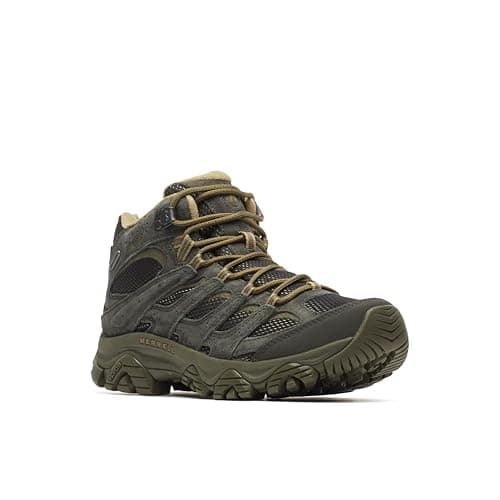
5 mm Vibram TC5+ lugs and an M Select DRY membrane on a wide-fitting last, at 1 lb 1.45 oz per shoe.
Merrell publishes 1 lb 1.45 oz (495 g) per shoe for the men's version and 410 g for the women's, an 11.5 mm drop, 5 mm lugs, a Vibram TC5+ outsole, the M Select DRY waterproof membrane, a pig suede and mesh upper and an air cushion in the heel.
The Moab's reputation is built on one thing that does not appear in any spec sheet: it fits a wide range of feet without a break-in period. Most first-time buyers do not know their foot volume, do not know whether they pronate, and are buying a boot two weeks before a trip. A boot that is comfortable on day one removes the single most common way a first hiking trip goes wrong, which is blisters at mile three.
The 5 mm lug depth is genuinely deep for a boot in this class, and it is the reason it works on wet grass and loose gravel where a trainer skates. Merrell also sells this in a non-waterproof version and in wide widths; if you camp in summer heat and cross no streams, the non-waterproof one breathes considerably better.
The drawback
Heavier than a trail shoe by a distance, and the membrane makes it warm in summer and slow to dry once water gets in over the cuff.
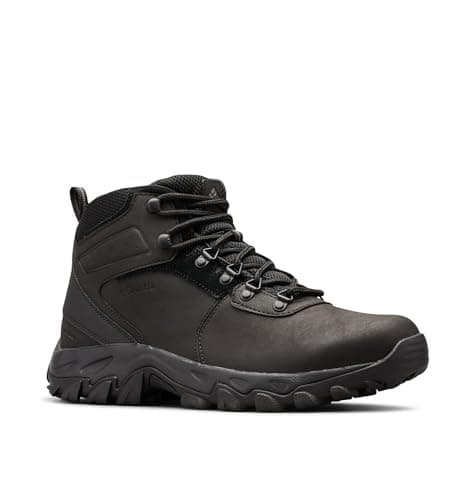
15.9 oz per shoe with a seam-sealed Omni-Tech bootie and 4.7 mm Omni-Grip lugs, on a leather and suede upper.
Columbia publishes 15.9 oz per shoe at size 9, a PU-coated leather, suede and mesh upper, an Omni-Tech seam-sealed waterproof bootie construction, a Techlite EVA midsole, an Omni-Grip rubber outsole with 4.7 mm lugs, and metal hook eyelets at the ankle.
This is the lightest boot here by several ounces, and that is exactly what a campground-based camper wants. If your walking is a mile of gravel track to a viewpoint and back, a full-weight backpacking boot is dead weight you will resent, while a trainer leaves you slipping on the one wet slope.
The honest caveat is durability and sealing. A seam-sealed bootie keeps water out of the seams; it does not stop water entering over the tongue in deep wet grass, and that is the failure mode reviewers report most often for this model. Treat it as a fair-weather boot with the ability to cope with a shower, not a wet-season boot.
The drawback
The lightest construction here, and reviewers consistently report the tongue as the weak point for water. Not a boot for carrying a loaded pack over rough ground.
A GORE-TEX membrane over a Contagrip outsole, at 1 lb 10.9 oz per pair.
Salomon publishes 1 lb 10.9 oz per pair, an 11 mm drop, a 33 mm heel and 22 mm forefoot stack, a GORE-TEX membrane, an EnergyCell EVA midsole, a Matryx textile upper reinforced with Kevlar yarn, and a Contagrip outsole. Salomon does not publish a lug depth for this model, so we are not quoting one.
The stack height numbers are the interesting ones. Over 30 mm under the heel is a lot of cushioning for a mid boot, and cushioning is what stops a long day on rock feeling like a long day on rock. Combined with the stiffer chassis, this is the pick if your walking involves loose stone, roots, or the extra 30 lb of a loaded backpack.
Fit is the constraint. Salomon lasts run narrow and this one is no exception, so anyone with a wide forefoot should try the Merrell instead. This is also the boot in this group where trying before buying pays for itself.
The drawback
A narrow last that does not suit wide feet, and the most complex lacing here. GORE-TEX is warm in summer and takes a long time to dry once flooded.
Not for campground walking and maintained trails in dry weather, where a trail shoe is usually enough. Mid-height boots earn their weight when you carry a loaded pack, walk rough ground, or camp in cold and wet conditions where a higher cuff keeps water and grit out.
QShould hiking boots be waterproof?
It is a trade rather than an upgrade. A membrane keeps out dew and rain but slows drying dramatically once water enters over the cuff. Waterproof suits spring, autumn and wet grass. Non-waterproof breathes better and dries faster in hot, dry summer conditions.
QWhat size hiking boots should I buy?
Usually about half a size up from your street shoe, with roughly a thumb's width in front of your longest toe when laced. Try them at the end of the day in the socks you will hike in, because feet swell and your foot slides forward on descents.
QHow deep should hiking boot lugs be?
Between about 4 and 5 mm covers general hiking. Merrell publishes 5 mm for the Moab 3 and Columbia 4.7 mm for the Newton Ridge Plus II; Salomon does not publish a lug depth for the X Ultra 5. Deeper lugs grip soft ground better but feel clumsy on hard surfaces.
How we picked
Everyone else in this category will tell you they tested twenty of these. We have not tested any of them, and we would rather say so than pretend. There is no gear closet here and no test lab.
What we did instead: pulled the published specifications from each manufacturer's own spec sheet or manual, named the standard behind every rating so you can check what it actually promises, did the arithmetic that turns a spec into a decision, and pulled today's real retail price rather than quoting one from memory. Every pick states a drawback, because a list where nothing is wrong with anything is an advert.
The limits of that method, stated plainly: published specs do not capture zipper quality, seam durability, or how a tent behaves at 2am in a storm. Where that matters, we say so on the pick. The full method is here.