Seam sealing, a hood that adjusts, and the ability to vent. In that order. The fabric's waterproof rating is the specification everybody shops on and the one least likely to be your problem. On a camping trip you get wet from trapped sweat far more often than from rain coming through the fabric, and a jacket that does not let you dump heat feels exactly like a jacket that leaks.
Jacket
Weight
Waterproof
Breathability
Vents
Columbia Watertight II
13.7 oz
Omni-Tech, seam sealed (no mm published)
Not published
None
Marmot PreCip Eco
10.1 oz
10,000 mm
17,000 g/m2/24hr
Pit zips
Frogg Toggs Ultra-Lite2
12.8 oz for jacket and pants
ASTM F1670 certified
Not published
None
All figures as published by the manufacturers. Blank cells mean the maker does not publish a figure, not that the jacket lacks the property.
What the millimeter rating means
A waterproof rating is a hydrostatic head measurement, the same test used on tent fabric: water pressure is raised against the material until it penetrates, and the height of the water column in millimeters is recorded. Marmot's 10,000 mm figure means the PreCip Eco's face fabric resists a ten-meter column of water before it wets through.
That is comfortably beyond anything rain does, which is the point: for practical camping, anything above roughly 5,000 mm is waterproof enough, and the difference between 10,000 and 20,000 mm is felt mostly by people kneeling in wet ground or carrying a pack whose straps press the fabric against them. Pressure is what defeats a rating, and pack straps are the pressure you actually apply.
The rating that never appears on the label
Breathability, quoted as g/m2/24hr, is how much water vapor a square meter of fabric passes in a day. It is the number that decides whether you arrive dry or steamed, and most brands simply do not publish it. When you cannot find one, look for pit zips instead — mechanical venting beats any membrane when you are working hard, and it never degrades.
DWR: the thing that stops working and makes you think the jacket failed
The outer face of a shell carries a durable water repellent finish that makes rain bead and roll off. When it wears out, the face fabric soaks up water instead. The membrane underneath is usually still perfectly waterproof, but a saturated face fabric cannot pass vapor outward, so you get clammy inside and conclude the jacket has failed.
It has not. Wash the jacket with a technical cleaner rather than detergent, then reproof it with a wash-in or spray-on product and tumble dry warm if the label allows — the heat is what reactivates it. Doing this once a season roughly doubles the useful life of a shell, and it is the single most valuable maintenance job in this category.
Fit for camping, not for a mountain
Buy a shell with room for a fleece underneath. A trim alpine cut looks better and is useless the first cold evening, because the layer that actually keeps you warm will not fit under it. Check that the hood turns with your head rather than leaving you looking at the inside of it, and that the sleeves do not ride up your forearms when you reach forward to peg out a tent.
Then keep it where you will actually have it. A jacket that packs into its own pocket, as two of these do, is one you leave in a daypack permanently, and the jacket you have with you beats the better jacket at home every single time.
What we did not include
We have not listed a 3-layer hardshell. They are more durable, more breathable and dramatically more expensive, and for the trips this site is written for — car camping, family camping, a first backpacking trip — they solve a problem you do not have. We have also not tested any of these jackets or stood in the rain in them; every figure above is the manufacturer's published one, with the source linked. See how we research.
The picks in full
1. Best all-round camping shell
Columbia Watertight II Jacket
Columbia
2-layer Omni-Tech, fully seam sealed, at 13.7 oz, and it packs into its own hand pocket.
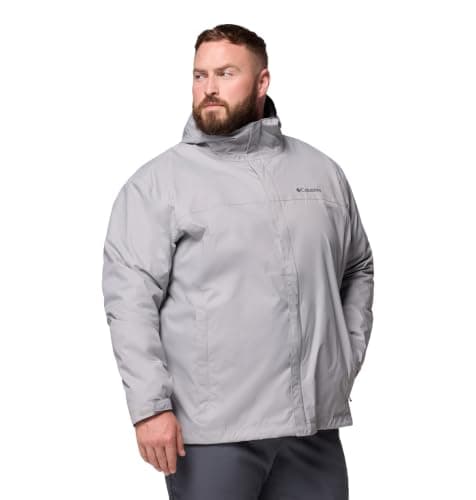
Columbia publishes a 13.7 oz weight for a men's medium, 2-layer Omni-Tech waterproof-breathable fabric, full seam sealing, a breathable mesh lining, an adjustable hood, a drawcord hem, zippered hand pockets, and self-packing into one of those pockets.
Full seam sealing is the specification that matters and the one cheap jackets skip. A waterproof fabric with unsealed seams leaks along every stitch line, which is why a budget shell soaks through at the shoulders first — that is where the seams are and where the rain lands.
The mesh lining is what makes this the one that gets worn. A 2.5-layer ultralight shell has a printed inner surface that sticks to bare arms unpleasantly. This has a real lining, so it functions as an ordinary jacket around the campsite rather than something you put on only when it is already raining.
The drawback
The heaviest here and Columbia publishes no hydrostatic head figure for it, so you are trusting the construction rather than a number. No pit zips.
2. Best published numbers, and best for walking in
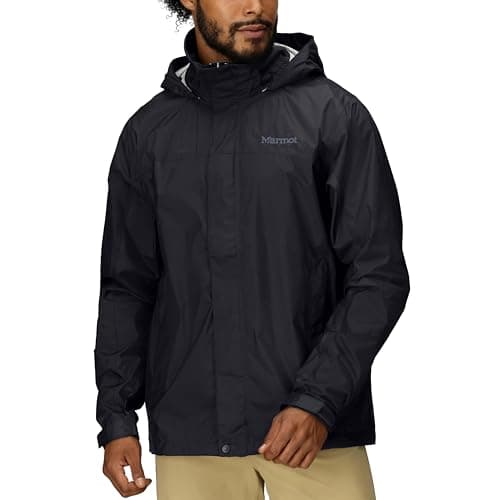
Marmot PreCip Eco Jacket
Marmot
10,000 mm waterproof and 17,000 g/m2/24hr breathability with pit zips, at 10.1 oz in recycled nylon.
Marmot publishes 10.1 oz for the men's version and 8.7 oz for the women's, a 2.5-layer NanoPro Eco construction on 100% recycled nylon ripstop, a PFC-free coating, a 10,000 mm waterproof rating, 17,000 g/m2/24hr breathability, pit zips, an adjustable hood and self-packing into a pocket.
This is the only jacket here that publishes both numbers, which is worth rewarding. The breathability figure is the more useful of the two: 17,000 g/m2/24hr is genuinely high, and breathability is what determines whether you arrive at camp dry or merely dry on the outside.
Pit zips are the other reason it is the walking pick. No membrane keeps up with a human working hard uphill in warm rain; being able to dump heat directly is the only thing that does. If your camping involves walking rather than sitting, this is the one.
The drawback
2.5-layer construction means a printed inner face that feels clammy on bare skin, and the ultralight face fabric needs its DWR refreshed to keep performing.
A full jacket and pants at 12.8 oz for the suit, in welded-seam non-woven polypropylene certified to ASTM F1670.
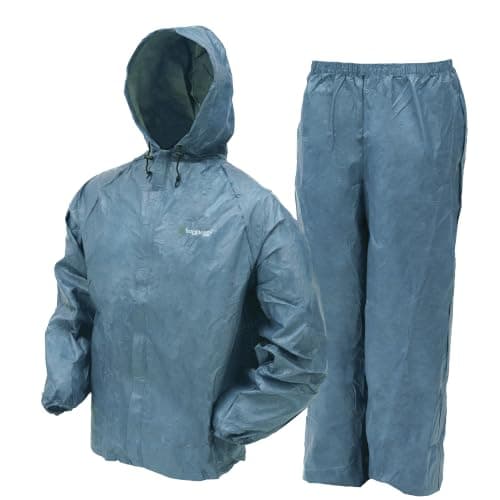
Frogg Toggs publishes a 12.8 oz net weight for the complete suit, 5.5 oz for a men's small jacket alone, an ultralight non-woven polypropylene bi-laminate fabric, welded rather than stitched seams, certification to ASTM F1670 / F1670M-17a, an adjustable hood with cord locks, a storm flap and an elasticated-waist pant with wide cuffs.
Welded seams are why it works. There are no stitch holes to leak through, which is a more absolute solution than taping and part of why this fabric performs far above its price. The breathability comes from the non-woven structure itself rather than a membrane.
The reason it is third is not performance, it is durability. Non-woven polypropylene has very low tear strength: catch a sleeve on a bramble and it opens up. Treat it as an excellent spare that lives permanently in the camp bin for the day someone forgets theirs, and as a genuinely good buy for children who will outgrow anything better.
The drawback
Non-woven fabric tears on brambles and barbed wire and will not survive rough use. There is no adjustment to speak of, and the fit is a sack.
QWhat waterproof rating do I need for a camping rain jacket?
Anything above roughly 5,000 mm hydrostatic head handles rain. Marmot publishes 10,000 mm for the PreCip Eco. Higher ratings mainly help where pressure is applied, such as under pack straps or when kneeling, rather than in ordinary rain.
QWhy does my rain jacket feel wet inside?
Usually trapped sweat rather than a leak. When the outer DWR finish wears out the face fabric soaks up water and can no longer pass vapor outward, so you feel damp. Wash with a technical cleaner, reproof, and tumble dry warm if the label allows.
QAre cheap rain jackets waterproof?
Some are. The determining factor is whether the seams are sealed or welded, not the fabric. The Frogg Toggs Ultra-Lite2 uses welded seams and is certified to ASTM F1670, which is why it performs well. Cheap jackets with unsealed seams leak along every stitch line.
QDo I need pit zips on a rain jacket?
If you walk in your shell, yes. No membrane keeps up with hard uphill effort in warm rain, and mechanical venting is the only thing that does. If your shell is mostly for sitting around a campsite, pit zips matter much less.
How we picked
Everyone else in this category will tell you they tested twenty of these. We have not tested any of them, and we would rather say so than pretend. There is no gear closet here and no test lab.
What we did instead: pulled the published specifications from each manufacturer's own spec sheet or manual, named the standard behind every rating so you can check what it actually promises, did the arithmetic that turns a spec into a decision, and pulled today's real retail price rather than quoting one from memory. Every pick states a drawback, because a list where nothing is wrong with anything is an advert.
The limits of that method, stated plainly: published specs do not capture zipper quality, seam durability, or how a tent behaves at 2am in a storm. Where that matters, we say so on the pick. The full method is here.