Cotton absorbs a large fraction of its own weight in water, holds it against your skin, and dries very slowly. Wet fabric moves heat away from you far faster than dry fabric, which is why wet jeans in wind are genuinely dangerous rather than merely uncomfortable. Nylon absorbs almost nothing and dries in an hour.
That is the entire argument, and it applies to rain, river crossings and your own sweat equally. Both pants here are 95 to 97 percent nylon for exactly this reason, and the small percentage of elastane or spandex is what provides the stretch.
The same logic runs through the whole clothing system from the skin outward, and it is why base layers are merino or synthetic rather than cotton — see how to layer for camping.
Compared on published numbers
Pants
Fabric
Weight
UPF
Finish
Stretch
prAna Stretch Zion
97 percent nylon, 3 percent elastane
14.3 oz, size 34/34
UPF 50+
DWR
two-way
KUHL Renegade Cargo Convertible
95 percent nylon, 5 percent spandex DURALUX
about 15 oz; 170 gsm fabric
UPF 50
DWR
yes
Figures as published by each manufacturer.
Features that earn their place
A gusseted crotch. The single most useful construction detail. Without it, a high step pulls the whole garment and eventually splits a seam.
An integrated belt or a proper waist adjuster. Because a pack hipbelt sits exactly where a normal belt buckle does, and the two together are a pressure point over several hours.
Articulated knees. Panels shaped for a bent leg rather than a straight one. Less critical than the gusset and noticeable on steep ground.
Zippered thigh pockets. Reachable with a hipbelt on, unlike hand pockets, which a pack covers completely.
UPF rating. Both here publish UPF 50 or better, which covers the largest area of skin you can protect without applying anything — see best sun protection for camping.
DWR is not waterproof, and it wears off
A durable water repellent finish makes water bead and roll off, which handles drizzle and brief showers. It is a surface treatment, not a membrane, and it wears off with abrasion and washing — usually first at the thighs and seat, where a pack and sitting down abrade it. It is also restorable: a wash-in or spray-on treatment brings it back, and heat from a tumble dryer or a warm iron reactivates an existing finish. The routine is the same one in how to wash and reproof a rain jacket. For actual rain you want a separate shell layer.
Convertible, roll-up or plain
Convertibles win when the temperature range in a single day is large and you would otherwise carry shorts. They cost you a zipper across the knee that can chafe under a pack-weighted stride, and a legitimate failure point.
Roll-up pants with a button tab are the middle option: no zipper, no separate garment, and they do not become actual shorts. For most three-season hiking this is the version people end up preferring.
Plain pants are lighter, more comfortable and cheaper, and they are the right answer if your trips are cool or if you genuinely do not mind carrying shorts.
What these are not
They are not rain pants. A DWR softshell in sustained rain wets through and then takes hours to dry, and no amount of reproofing changes that. If the forecast is real rain, a separate waterproof shell over the top is the system, and the fabric side of that is in best rain jackets for camping.
They are also not winter pants. Nylon softshell over a bare leg is fine to around freezing while moving and cold once you stop, which is what a base layer underneath is for.
Fit, and the thing to check in the shop
Try them with a pack hipbelt on if you can, or at least fastened at the waist with something pressing there. A waistband that sits comfortably unloaded can dig in badly under a belt carrying 25 lb, and that is a six-hour problem you cannot fix on the trail.
Then do a high step onto a chair. If the crotch binds or the waistband drops at the back, the gusset is inadequate or the rise is wrong for you. A low-profile webbing belt with a flat buckle solves the hipbelt conflict where the pants do not have an integrated one.
Which to buy
Buy the prAna Stretch Zion if you want one pair for three-season hiking that also passes in a restaurant, and accept the DWR as showerproofing rather than waterproofing. Buy the KUHL Renegade Cargo Convertible if your days swing from cold starts to hot afternoons and you would rather not carry shorts.
Whichever you pick, the fabric rule is the part that matters. Anything predominantly nylon with a gusseted crotch will outperform anything cotton, at any price.
The picks in full
1. Best overall
prAna Stretch Zion Pant
prAna
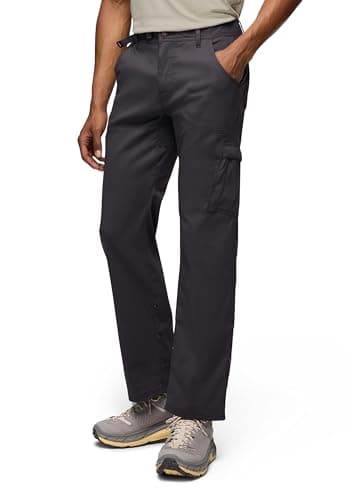
97 percent nylon with 3 percent elastane at 14.3 oz, UPF 50+, with a DWR finish, a gusseted crotch and ventilation ports.
prAna publishes 97 percent nylon and 3 percent elastane Stretch Zion twill, a garment weight of 14.3 oz in size 34/34, UPF 50+, a durable water repellent finish, two-way stretch, a gusseted crotch, ventilation ports and abrasion-resistant construction.
The gusseted crotch is the feature that separates hiking pants from ordinary trousers. A diamond of fabric set into the crotch seam removes the four-seam junction that otherwise binds when you lift a leg onto a rock, and it is why these can be scrambled in without thinking about it.
The drawback
The DWR is modest water repellency rather than waterproofing. In sustained rain these wet through like any softshell, and they take a while to dry once fully soaked.
Published specs
Fabric
97 percent nylon, 3 percent elastane Stretch Zion twill
95 percent nylon and 5 percent spandex DURALUX at 170 gsm, UPF 50, with zip-off legs and a DWR finish.
KUHL publishes 95 percent nylon and 5 percent spandex DURALUX fabric, a fabric weight of 5.0 oz per square yard / 170 gsm, a garment weight of about 15 oz, UPF 50, a durable water repellent finish and zip-off legs.
Convertibles are unfashionable and genuinely useful for one specific pattern: an early start in cold air and a hot afternoon, where the alternative is carrying a second garment. If your trips are not that, a plain pant is lighter, more comfortable and cheaper.
The drawback
About 15 oz, and zip-off legs put a hard zipper across the knee that can chafe and that adds a failure point no plain pant has.
Predominantly nylon, usually 95 to 97 percent with elastane or spandex for stretch. Nylon absorbs almost no water and dries in about an hour. Cotton absorbs a large fraction of its weight, holds it against your skin and dries very slowly.
QAre convertible hiking pants worth it?
Only if your days swing from cold mornings to hot afternoons and you would otherwise carry shorts. The cost is a zipper across the knee that can chafe under a loaded stride, plus an extra failure point. Roll-up pants are the middle option.
QAre hiking pants waterproof?
No. Both pairs here publish a DWR finish, which makes water bead and roll off in drizzle and brief showers. It is a surface treatment rather than a membrane, it wears off at the thighs and seat, and it is restorable with a wash-in or spray-on product.
QWhat is a gusseted crotch and does it matter?
It is a diamond of fabric set into the crotch seam that removes the four-seam junction found in ordinary trousers. It matters a great deal: without it a high step onto a rock pulls the whole garment and eventually splits a seam.
How we picked
Everyone else in this category will tell you they tested twenty of these. We have not tested any of them, and we would rather say so than pretend. There is no gear closet here and no test lab.
What we did instead: pulled the published specifications from each manufacturer's own spec sheet or manual, named the standard behind every rating so you can check what it actually promises, did the arithmetic that turns a spec into a decision, and pulled today's real retail price rather than quoting one from memory. Every pick states a drawback, because a list where nothing is wrong with anything is an advert.
The limits of that method, stated plainly: published specs do not capture zipper quality, seam durability, or how a tent behaves at 2am in a storm. Where that matters, we say so on the pick. The full method is here.