Clothing beats sunscreen on every practical measure
The short answer
A UPF-rated garment protects at a constant level all day, cannot be applied too thinly, does not need reapplying every two hours, does not wash off in water and does not run into your eyes. Sunscreen is what you use on the parts fabric cannot cover. That ordering is the single most useful thing in this category.
The reason sunscreen underperforms in real use is dosage. The SPF on the bottle is measured at an application thickness that almost nobody achieves, and the practical protection people get is routinely a fraction of the labelled figure. A shirt delivers its rated protection whether or not you were thorough.
UPF and SPF are also different scales. UPF measures how much UV a fabric transmits: UPF 50 passes about one fiftieth. SPF measures how much longer treated skin takes to burn. Do not compare the numbers directly.
Compared on published numbers
Item
Rating
Active or fabric
Duration
Reapply
Outdoor Research Echo Hoodie
UPF 15, UPF 20 in dark colors
ultralight stretch, AirVent
all day
never
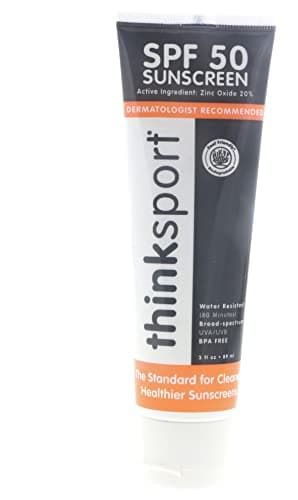
Thinksport SPF 50+
SPF 50+ broad spectrum
23.4 percent non-nano zinc oxide
80 min water resistance
every 2 h, and after swimming
Figures as published by each manufacturer. UPF and SPF are different scales and are not comparable.
Where people actually burn
Ears and the back of the neck. Missed by every hat that is not wide brimmed, and by most sunscreen applications. A hood solves both.
The backs of the hands. Exposed on trekking poles and paddles all day, and washed clean at every stream crossing. Thumb holes solve this.
The tops of the feet, in sandals. Entirely a sunscreen job, and the one people forget — see best camp shoes and sandals.
Under the chin and the nose. Reflected UV off water, sand and snow comes from below, which is why sunburn on the water is worse than the sky suggests.
The scalp along a parting, if you are not wearing a hat.
Altitude and reflection change the exposure, not the forecast
UV intensity rises with elevation, and snow and water reflect a large share of it straight back at you. A cool, breezy day at altitude or on a lake produces far more UV exposure than it feels like, and the absence of heat is exactly why people do not reapply. Sunburn at a high alpine lake in a windbreaker is one of the most common ways a good trip becomes a miserable one. Treat elevation and water as the trigger for more protection rather than temperature.
The rest of the system
A wide-brimmed hat rather than a cap, because a cap leaves the ears and neck exposed, which is where the damage accumulates over years. Sunglasses with genuine UV400 protection, because the eye surface burns too and snow blindness is a real outcome at altitude.
Lip balm with an SPF rating, which is the item that gets forgotten every time and the one whose absence you feel most immediately. A wide-brimmed UPF hat and an SPF lip balm together weigh a couple of ounces and cover the two gaps a hoodie leaves.
Sunscreen that actually gets used
Two practical habits. Apply the first coat at the campsite before you set off, not at the trailhead in a hurry, because the twenty minutes chemical sunscreens need to bind happens while you are packing. Mineral zinc works immediately, which is one reason to prefer it.
And carry a small tube in a hip belt pocket rather than the main compartment. Sunscreen in the bottom of a pack gets applied once. The same logic applies to the whole day-hiking kit — see best hip packs for hiking.
Which to buy
Buy a sun hoodie first, and treat the Echo as a breathable all-day layer rather than maximum-UPF armor: if you camp in high desert or on water, look for a UPF 50 garment instead. Buy Thinksport SPF 50+ for face, hands and feet, and reapply it at the two-hour mark whether or not it feels necessary.
UPF 15, rising to UPF 20 in darker colors, in an ultralight breathable fabric with thumb holes and a hood.
Outdoor Research publishes UPF 15, rising to UPF 20 in darker colors, a bluesign-approved ultralight stretch fabric, ActiveFresh odor control, AirVent construction for airflow, flat-seam construction, thumb holes at the cuffs and a ponytail hole in the hood.
The thumb holes and the hood are the parts doing the work. They cover the back of the hands and the ears and neck, which are the three places people reliably burn because sunscreen there is applied once in the morning and never again.
The drawback
UPF 15 is modest. Dedicated sun shirts reach UPF 50+, and this one is prioritizing breathability, so on a high-UV day it is a base layer rather than complete protection.
SPF 50+ broad spectrum from 23.4 percent non-nano zinc oxide, with 80 minutes of water resistance.
Thinksport publishes SPF 50+ broad spectrum UVA/UVB protection, 23.4 percent non-nano zinc oxide as the active ingredient, 80 minutes of water resistance, a formula free of PABA, parabens, phthalates, BPA, oxybenzone and avobenzone, and 3 and 6 fl oz sizes.
Zinc oxide is a physical blocker rather than a chemical absorber, which means it works the moment it is on rather than after twenty minutes and does not degrade in sunlight the way some chemical filters do. It is also the chemistry that reef-protection rules in Hawaii and elsewhere are written around.
The drawback
Eighty minutes is the published limit, which in practice means reapplying roughly every hour and a half of swimming or heavy sweat, and a mineral formula leaves more visible residue than a chemical one.
QIs sunscreen or sun-protective clothing better for camping?
Clothing, for everything it covers. A UPF garment protects at a constant level all day, cannot be applied too thinly, does not wash off and never needs reapplying. Sunscreen is for face, hands, feet and anywhere fabric cannot reach.
QWhat is the difference between UPF and SPF?
They are different scales. UPF measures how much UV a fabric transmits, so UPF 50 passes about one fiftieth. SPF measures how much longer treated skin takes to burn. The numbers are not comparable, so do not read UPF 15 as weaker than SPF 15.
QHow often should I reapply sunscreen when camping?
Every two hours, and immediately after swimming or heavy sweating. Thinksport publishes 80 minutes of water resistance, which is the limit rather than a target. Carry a small tube where you can reach it, because sunscreen in the bottom of a pack gets applied once.
QWhy do I burn worse at altitude or on the water?
UV intensity rises with elevation, and water, snow and sand reflect a large share of it back at you from below. The day feels cool and breezy, so nobody reapplies. Treat elevation and water as the trigger for more protection rather than temperature.
How we picked
Everyone else in this category will tell you they tested twenty of these. We have not tested any of them, and we would rather say so than pretend. There is no gear closet here and no test lab.
What we did instead: pulled the published specifications from each manufacturer's own spec sheet or manual, named the standard behind every rating so you can check what it actually promises, did the arithmetic that turns a spec into a decision, and pulled today's real retail price rather than quoting one from memory. Every pick states a drawback, because a list where nothing is wrong with anything is an advert.
The limits of that method, stated plainly: published specs do not capture zipper quality, seam durability, or how a tent behaves at 2am in a storm. Where that matters, we say so on the pick. The full method is here.