The Best Shade Canopies for Camping, Compared on Covered Square Feet
A tent is where you sleep. A canopy is where the trip actually happens: the shade at noon, the dry table in a shower, and the only place a family can sit together.
An open pop-up canopy solves sun and rain. A screen shelter solves insects. Neither solves both perfectly, and buying the wrong one is the main way people end up with two. If your camping is hot and dry, buy the open canopy. If your evenings are ruined by mosquitoes, buy the screen room. If it is both, buy the screen room with a waterproof roof.
Shelter
Covered area
Height
Weight
Setup
Walls
E-Z UP Ambassador 10x10
100 sq ft
9 ft 6 in peak, 6 ft 6 in valance
not published on this page
Two people, minutes
Open
Clam Quick-Set Escape
94 sq ft
90 in peak, 72 in walls
37 lb
About 60 seconds
No-see-um mesh
Gazelle G6
92 sq ft
86 in center
34 lb
Under 60 seconds
TriTech mesh
Published figures from each manufacturer. Where a maker does not publish a figure we have left it blank rather than estimating one.
Covered area is not the same as usable area
A 10 by 10 canopy does not give you 100 sq ft of usable space, because the sun moves. At noon a flat roof puts its shadow directly underneath; by four in the afternoon that shadow has walked several feet sideways and a chunk of your table is in full sun. Anything with walls keeps its shade all day.
Two practical consequences. First, orient an open canopy for the afternoon rather than for noon, because the afternoon is when the heat is worst. Second, a canopy with one side wall — sold separately for most models, or improvised with a tarp — is dramatically more useful than one without, both for shade and for the wind that always arrives at dinner time.
Wind is what breaks canopies
Every shelter here is a large, light, rigid object with a roof, which is a description of a sail. Canopies are the single most commonly destroyed item in a campground, and it is almost always because nobody staked or guyed them.
The Clam ships with 7 stakes and 5 tie-down ropes; the Gazelle ships with all-terrain stakes and guy lines; the E-Z UP ships with a spike kit. Use all of them, every time, even on a still afternoon — the gust that flips a canopy into somebody else's tent does not announce itself. Weight the legs as well as staking them, and drop the canopy overnight or before you leave the site for the day. The staking technique that applies here is the same one in how to pitch a tent in wind.
Check the campground rules before you buy
A meaningful number of campgrounds cap the number of structures per site, restrict freestanding shelters, or require everything to sit on the pad. Some state and national park campgrounds are stricter still. Two minutes on the campground's own page before you spend money on a 37 lb screen room is worth it, and it is the same call that tells you the current fire ban status covered in campfire safety basics.
What a canopy replaces
For a family, a canopy is not an accessory to the tent — it is a second room, and it changes what a wet or hot weekend feels like more than almost any other purchase. It is where the stove lives so nobody cooks in a doorway, where the table goes, and where people sit when the tent is too hot to be inside.
That is why it belongs next to the table and chair decisions rather than in the tent budget. A camp table under a canopy is a kitchen; the same table in the sun is a place to put things down. The full campsite layout argument is in how to set up a comfortable campsite.
What we did not test
None of it. Every figure above is the manufacturer's published specification with a link to where it was read, and we have deliberately left the E-Z UP weight blank rather than quoting a retailer figure the maker does not publish on its own product page. Our judgments are about covered area, height, wall type and setup, which spec sheets support. See how we research.
The picks in full
1. Best all-round shade canopy
E-Z UP Ambassador 10 x 10 Instant Shelter
E-Z UP
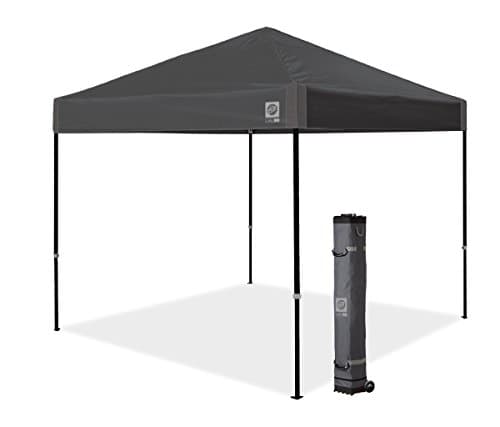
100 sq ft of cover at a 9 ft 6 in peak with 6 ft 6 in of valance clearance, on a powder-coated steel straight-leg frame that meets CPAI-84.
E-Z UP publishes 100 sq ft of shade, a 9 ft 6 in peak height, 6 ft 6 in of valance clearance, a powder-coated steel straight-leg frame with high-strength end caps, two height settings via toggle leg adjustment, compliance with CPAI-84 fire resistant requirements, an included roller bag and spike kit, and a 1 year warranty.
The specification that matters most is the one nobody reads: valance clearance, at 6 ft 6 in. That is the height of the lowest edge, and it is what decides whether adults walk under the edge or duck around it. Cheap canopies save money by dropping this figure, and you spend the weekend hitting your head.
Straight legs rather than slant legs is the other quiet decision. A slant-leg 10 by 10 has a 10 ft footprint and covers considerably less than 100 sq ft, because the roof is smaller than the base. Straight legs give you the area you paid for, and let you butt two canopies together or put one hard against a hedge.
The drawback
Open on all four sides, so it does nothing about insects, and a steel-framed 10 by 10 is a genuinely two-person job to raise in any wind.
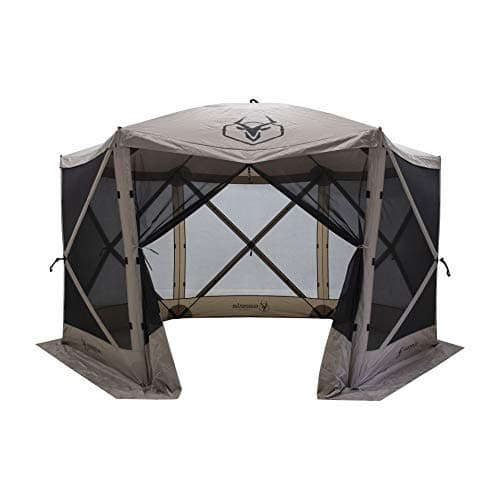
94 sq ft under a 90 in peak with 72 in walls of no-see-um mesh, up in about 60 seconds, for 37 lb.
Clam publishes an 11.5 by 11.5 ft set-up size giving a 94 sq ft footprint, a 90 in peak height with 72 in walls, a 37 lb weight, a 75 by 14 by 14 in carry bag, setup in about 60 seconds with no assembly, extra-large 11 mm flex-tested fiberglass poles in a six-sided hub design, capacity for up to 6 people, tear-resistant no-see-um mesh, a water-resistant seam-taped roof panel, and 7 stakes with 5 tie-down ropes.
This is the shelter for anywhere with a mosquito season, and it changes a trip more than its price suggests. The alternative to a screen room in a bad bug week is everybody retreating into the tent at eight in the evening, which is not what anybody came for. Bites also stop being a gear problem and start being a chemistry problem — see bug protection for the repellents that go with this.
The hub design is what makes 60-second setup credible for something this size: the poles stay attached and the hubs lock. It is still 37 lb, and it still wants two people to lift comfortably.
The drawback
37 lb in a 75 in carry bag is a large object to store and to lift, and mesh walls block insects rather than weather.
92 sq ft under an 86 in center height for 34 lb, in waterproof 210D Oxford polyester rated UV50+, up in under a minute.
Gazelle publishes a 124 by 124 in footprint giving 92 sq ft, an 86 in center height, a 34 lb weight, a collapsed size of 8 by 8 by 74.5 in, setup in under 60 seconds, a waterproof 210D Oxford polyester shell rated UV50+, single-filament TriTech mesh, capacity for 8 people, and included all-terrain stakes and guy lines.
Three pounds lighter than the Clam with a slightly smaller footprint and a lower peak, the practical difference is the fabric specification: a waterproof 210D Oxford roof with a UV50+ rating is a real weather claim rather than a water-resistant one, which makes this the version that works as a rain shelter as well as a bug room.
Six-sided hub shelters cover more usable floor per unit of perimeter than a square does, which is why 92 sq ft here feels larger than 100 sq ft under a square canopy. The catch is that you need a flat 11 by 11 ft patch to put it on, and plenty of campground pitches do not have one.
The drawback
Six sides means a footprint that needs a genuinely large, level pitch, and the collapsed bag is 74.5 in long.
A 10 by 10 ft canopy covers a standard picnic table with room to stand around it, which suits most family campsites. Screen shelters at 11.5 by 11.5 ft cover a table plus chairs for six. Anything smaller than 10 by 10 covers the table and not the people.
QIs a screen shelter better than a canopy for camping?
It depends on the problem. A screen shelter stops insects and keeps its shade all day because it has walls. An open canopy is lighter, cheaper, simpler and better in wind. If mosquitoes are what ends your evenings, the screen shelter is the one that changes the trip.
QHow do I stop my canopy blowing away?
Stake every leg and use every guy line supplied, every time, even on a calm afternoon. Weight the legs as well. Drop the canopy overnight or whenever you leave the site, because a gust that flips it will destroy the frame and possibly a neighboring tent.
QWhat is valance clearance on a canopy?
The height of the lowest edge of the roof, measured to the bottom of the fabric valance. The E-Z UP Ambassador publishes 6 ft 6 in. It matters more than peak height day to day, because it decides whether adults walk under the edge or duck.
How we picked
Everyone else in this category will tell you they tested twenty of these. We have not tested any of them, and we would rather say so than pretend. There is no gear closet here and no test lab.
What we did instead: pulled the published specifications from each manufacturer's own spec sheet or manual, named the standard behind every rating so you can check what it actually promises, did the arithmetic that turns a spec into a decision, and pulled today's real retail price rather than quoting one from memory. Every pick states a drawback, because a list where nothing is wrong with anything is an advert.
The limits of that method, stated plainly: published specs do not capture zipper quality, seam durability, or how a tent behaves at 2am in a storm. Where that matters, we say so on the pick. The full method is here.