Why a mat is the highest-value cheap purchase at a campsite
The short answer
Nearly all the dirt that ends up inside a tent arrives on the soles of feet in the thirty seconds between taking boots off and getting in. A mat at the door gives people somewhere clean to stand while they do that, and it is the only intervention that reliably works.
Everything else people try — a rule about shoes, a towel, sweeping the tent out — fails because it depends on discipline at the exact moment everyone is tired and it is getting dark. A mat works because it requires no decision.
The secondary benefits are real too. Grit inside a tent abrades the floor coating from the inside, which is one of the quieter ways tents die, and it works into sleeping pad valves and zippers. Keeping it out is cheaper than replacing any of that — the rest of the tent care routine is in how to clean and store a tent.
Three types, and what each is for
Type
What it is
Best at
Limitation
Sand-free mesh mat
dual-layer one-way weave
sand, grit, beach and desert sites
bulky, and overkill on grass
Reversible polypropylene mat
woven plastic, awning-style
general campsite floor, easy to hose off
does not shed sand, holds it on the surface
Foam interlocking tiles
closed-cell puzzle tiles
cold or hard ground, inside an awning
traps grit underneath, and blows around
Category characteristics rather than specific models, other than the sand-free mat above.
For most campground camping on grass or gravel, a simple reversible woven mat does the job at a fraction of the price, and you hose it down at home. The sand-free construction earns its premium specifically where there is loose sand, which is beaches, dunes, dry washes and desert sites.
Where to put it, which matters more than which you buy
Directly outside the tent door, overlapping the vestibule edge, so nobody has to step on ground between the mat and the tent.
Under the awning or canopy if you have one, so the living area has a floor and chairs do not sink.
Not under the tent itself. A mat under a tent traps water between the mat and the floor and can pool it, which is the opposite of what a footprint does.
Staked at the corners in any wind. The D-rings exist for this and an unstaked mat becomes a sail.
Do not leave a mat down on grass for a week
A solid mat left in place kills the grass underneath it in a few days, and on a site that hundreds of people use each season that damage accumulates. Most campgrounds that allow mats expect them to be lifted daily or at least shaken and moved; some prohibit solid mats on vegetation entirely. Mesh mats let light and water through and do far less harm, which is a genuine argument for the type beyond the sand. Check the site rules before a long stay.
Sizing it to the site
Six by six feet covers a tent door and gives two people somewhere to stand and change shoes. Eight by eight is a living area under a canopy, sized for chairs and a small table. Ten by ten matches a standard pop-up canopy footprint exactly, which is the reason that size exists.
Bigger is not automatically better here, because the constraint is trunk space and a rolled mat does not compress. If you are already at capacity, measure what the canopy or the tent door actually needs rather than buying the largest — the packing problem is in how to pack a car for camping.
What to pair it with
A boot brush or a stiff broom head, because the mat gives people somewhere to stand and a brush gives them a reason to stop. A small boot scraper mat at the tent door in addition to the main mat is the two-stage version and it is noticeably more effective.
Beyond that, the mat is one element of a site layout rather than a standalone item, and the order everything goes in is in how to set up a comfortable campsite.
Which to buy
Buy the CGEAR Original Sand-Free Mat if you camp on sand or in the desert, where the one-way weave is doing something no cheaper mat does. For grass and gravel campgrounds, a plain reversible woven mat at a quarter of the price does the job, and the money is better spent on the chair you will sit in on top of it.
The picks in full
1. Best overall
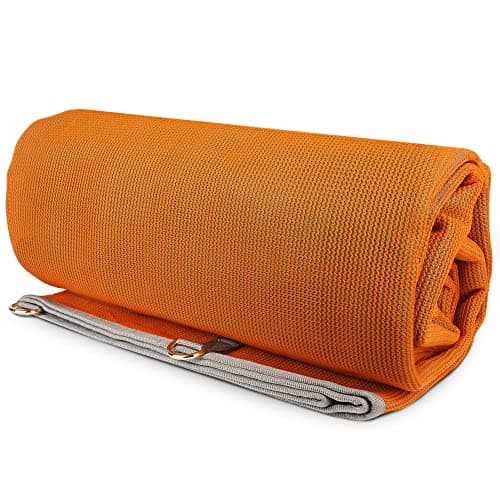
CGEAR Original Sand-Free Mat
CGEAR
A dual-layer high-density weave that lets sand fall through and not come back up, in UV-stabilized polyethylene at 6 by 6 ft up to 10 by 10 ft.
CGEAR publishes sizes of 6 by 6 ft rated for 3 persons, 8 by 8 ft rated for 6, and a 10 by 10 ft option; a dual-layer high-density mesh weave through which sand falls and cannot return; ultra-tough UV-stabilized polyethylene; reinforced seams with double-reinforced corner D-rings; and fast-drying, water and mold resistant construction.
The one-way weave is the whole product and it genuinely works. Sand shaken onto the surface drops through the layers and stays under the mat, which means the mat does not need shaking out and the sand does not migrate to your tent door.
The drawback
CGEAR does not publish a weight for the Original, and a mat this size in heavy polyethylene is a bulky roll that competes with a camp chair for trunk space.
Published specs
Sizes
6 x 6 ft, 8 x 8 ft and 10 x 10 ft
Rated for
3 persons at 6 x 6 ft; 6 persons at 8 x 8 ft
Weave
dual-layer high-density mesh; sand falls through and cannot come back up
Yes, for one specific reason: nearly all the dirt in a tent arrives on feet in the seconds between removing boots and getting in. A mat gives people somewhere clean to stand, which no rule about shoes reliably achieves.
QWhat size camping mat do I need?
Six by six feet covers a tent door and gives two people room to change shoes. Eight by eight is a living area for chairs and a small table. Ten by ten matches a standard pop-up canopy footprint, which is why that size exists.
QDo sand-free camping mats actually work?
The mesh ones do. A dual-layer high-density weave lets sand fall through and prevents it coming back up, so the mat does not need shaking out. It is worth the premium on beaches, dunes and desert sites, and is overkill on grass.
QCan I put a camping mat under my tent?
Do not. A mat under a tent traps water between the mat and the floor and can pool it, which is the opposite of what a footprint does. Put the mat outside the door, overlapping the vestibule edge.
How we picked
Everyone else in this category will tell you they tested twenty of these. We have not tested any of them, and we would rather say so than pretend. There is no gear closet here and no test lab.
What we did instead: pulled the published specifications from each manufacturer's own spec sheet or manual, named the standard behind every rating so you can check what it actually promises, did the arithmetic that turns a spec into a decision, and pulled today's real retail price rather than quoting one from memory. Every pick states a drawback, because a list where nothing is wrong with anything is an advert.
The limits of that method, stated plainly: published specs do not capture zipper quality, seam durability, or how a tent behaves at 2am in a storm. Where that matters, we say so on the pick. The full method is here.