The Best Bug Protection for Camping, in Three Layers That Do Different Jobs
There is no single best insect repellent, because clothing, skin and the air around a picnic table are three separate problems with three separate answers.
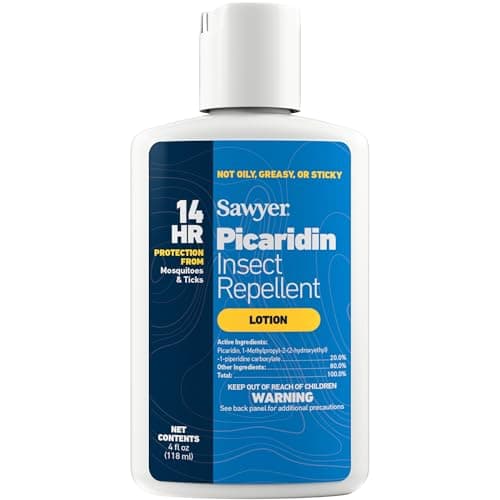
Sawyer 20% Picaridin Insect Repellent Lotion, 4 oz
20% picaridin, published at up to 14 hours against mosquitoes and ticks in the lotion, non-greasy and fragrance-free, and it does not damage plastics or synthetic coatings.
Hands, face, neck and anything the clothing layer does not cover
Treat clothing with permethrin at home, put an EPA-registered repellent such as picaridin on exposed skin, and run an area repeller or a screen shelter where you sit still. Each layer covers what the others cannot. Skin repellent alone leaves your ankles exposed through socks; clothing treatment alone leaves your hands and face; an area repeller alone stops working the moment you walk away from the table.
Layer
Product type
Active
Duration
Covers
Clothing
Permethrin fabric treatment
Permethrin
6 weeks or 6 washings
Anything the fabric touches
Skin
Picaridin lotion or spray
20% picaridin
Up to 14 hours (lotion)
Exposed skin only
Area
Rechargeable repeller
Metofluthrin
5.5 h per charge, 12 h refill
About a 20 ft zone
All figures as published by the manufacturers.
Why ticks change the calculation
Mosquitoes are a comfort problem for most campers in most places. Ticks are a disease vector, and the CDC's prevention guidance leads with treating clothing and gear with 0.5% permethrin and using EPA-registered repellents on skin — which is exactly the two-layer approach above, in that order.
The practical version at a campsite: treat socks, trousers and boots rather than only your shirt, because ticks climb from ground vegetation upward. Tuck trousers into socks in long grass, however it looks. And do a tick check every evening, particularly on children, behind knees, along the hairline and at the waistband. The CDC page linked below is the authority here; we do not publish medical guidance.
What we are not qualified to tell you
Nothing on this page is medical or public health advice, and we do not publish concentrations, dosages, application rates for children, or guidance on what to do after a bite. Follow the label on the product and the CDC and EPA pages linked at the bottom. What this page does is compare what each product publishes about its own coverage and duration, which is the part a gear site can actually help with. See how we research.
Gear beats chemistry for the hours you sit still
The single most effective bug measure at a family campsite is not a repellent at all. It is a mesh shelter over the table, because it works continuously, needs no reapplication, and covers children who should not be doused in anything.
A screen room such as the Clam Quick-Set Escape publishes 94 sq ft under no-see-um mesh, which is a finer weave than standard insect mesh and the specification that actually stops midges rather than just mosquitoes. Combined with an area repeller for the gap between the shelter and the fire, it removes the problem rather than managing it.
The tent itself is the other piece of gear that matters. Check the mesh, check the zips close completely, and get in the habit of closing the door behind you rather than leaving it while you fetch something — almost every mosquito in a tent walked in through an open door at dusk.
Site choice, which is free
Mosquitoes breed in standing water and are weak fliers. Two consequences worth acting on: pitch away from ponds, ditches and marshy ground, and choose a site with some breeze rather than a still hollow. A pitch fifty yards further from the water can be a different evening entirely.
Timing helps too. Most mosquito species are worst at dusk and dawn, so plan cooking and eating either side of that window rather than through it. The layering that covers skin without chemicals — long sleeves, long trousers, tucked in — is in how to layer for camping, and the permethrin layer above is applied to exactly those garments.
What we deliberately left out
Citronella candles, ultrasonic devices and wearable clip-on bracelets. The EPA and CDC recommend registered repellents applied to skin and clothing, and we are not going to recommend products whose published claims we cannot check against a registered active ingredient and a stated duration. That is the same rule this site applies to everything else — if a maker will not publish a number, we do not invent one.
The picks in full
1. Best for clothing and gear, and the one people skip
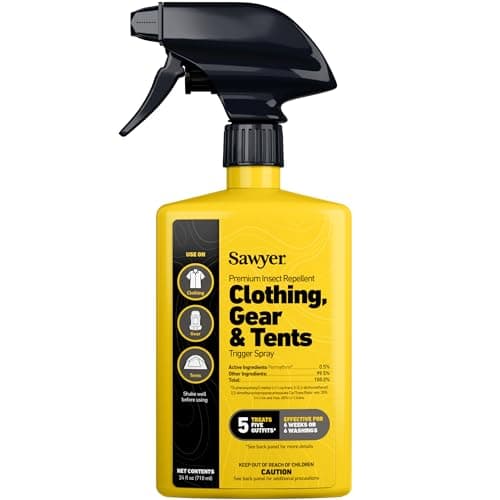
Sawyer Permethrin Clothing and Gear Insect Repellent, 24 oz
Sawyer
Bonds to fabric for up to 6 weeks or 6 washings, treats about 5 outfits per 24 oz bottle at the EPA-recommended 4.5 oz each, and is odorless once dry.
Sawyer publishes that permethrin bonds to fabric fibers for up to 6 weeks or 6 washings, that the EPA recommends 4.5 oz per outfit of shirt, trousers and socks so a 24 oz bottle treats about 5 outfits, that it kills or repels ticks, mosquitoes, chiggers, mites and more than 50 other insects, that it does not stain or damage synthetics or waterproof membranes, and that it is odorless once dry.
This is the layer that beginners do not know exists, and it is the one that does the most for ticks specifically. Treated socks and boots protect the ankles and lower legs, which is where ticks arrive from, and unlike a skin repellent it keeps working while you sleep, sweat and swim.
Two hard rules. It goes on fabric, never on skin, and never on clothing while it is being worn. And it is toxic to cats until it has completely dried — if you have a cat, treat clothing outdoors and let it dry outdoors. Once dry it is inert to mammals and safe against skin.
The drawback
Fabric only, never skin, and it has to be applied at home and left to dry — there is no way to do this at a trailhead.
Published specs
Use
fabric treatment only, never on skin
Bonded life
up to 6 weeks or 6 washings
Coverage
EPA guidance 4.5 oz per outfit; 24 oz treats about 5 outfits
Targets
ticks, mosquitoes, chiggers, mites and 50 more
Fabric safety
does not stain or damage synthetics or waterproof membranes
Sawyer 20% Picaridin Insect Repellent Lotion, 4 oz
Sawyer
20% picaridin, published at up to 14 hours against mosquitoes and ticks in the lotion, non-greasy and fragrance-free, and it does not damage plastics or synthetic coatings.
Sawyer publishes a 20% picaridin active ingredient, up to 14 hours of protection against mosquitoes and ticks for the lotion (up to 12 for the spray), up to 8 hours against biting flies, gnats, chiggers and sand flies, a non-greasy fragrance-free formula that dries quickly, and no damage to plastics or synthetic coatings.
That last point is the practical reason to prefer picaridin over DEET for camping. DEET dissolves plastics, and a camp is full of them: watch straps, sunglasses frames, tent fabric, headlamp housings, the coating on a rain jacket. Picaridin does not, which means you can put it on your hands and then touch your gear.
The CDC lists picaridin alongside DEET, IR3535, oil of lemon eucalyptus and 2-undecanone as EPA-registered active ingredients, so this is a mainstream choice rather than an alternative one. Fourteen hours also means one application in the morning covers a full day, which is not true of most concentrations of anything else.
The drawback
It is still a chemical you reapply to skin, and 8 hours against biting flies and gnats is well short of the mosquito figure.
3. Best for the table, the chairs and the space around them
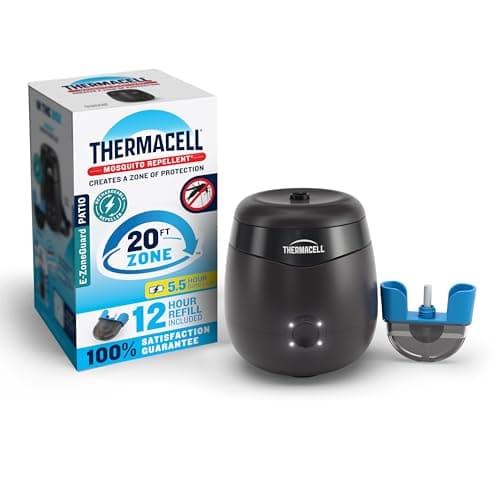
Thermacell E55 Rechargeable Mosquito Repeller
Thermacell
A 20 ft protection zone from a rechargeable unit, at full effect in about 15 minutes, running 5.5 hours per charge and charging while it runs.
Thermacell publishes a 20 ft zone of mosquito protection, a rechargeable lithium-ion battery giving 5.5 hours of consistent protection that can be charged while operating, maximum protection within about 15 minutes of activation, metofluthrin as the active ingredient, an included 12-hour refill with 40-hour refills sold separately, and scent-free flameless operation.
This solves the problem the other two do not: sitting still outdoors in the evening. Skin repellent works but has to go on everybody including children; an area repeller treats the space and nobody has to put anything on. For a family sitting around a table at dusk that is a meaningful difference.
The limitations are honest and worth stating. It needs about fifteen minutes to build the zone, so switch it on before you need it rather than when the first bite lands. Wind disperses the vapor, so it works best in still air and behind some sort of break. And it is a zone, not a shield — walking to the toilet block takes you out of it.
The drawback
It protects a zone, not a person: walk out of the 20 ft circle and you are unprotected, and moving air degrades it.
There is no single one, because clothing, skin and the area around your chair are three problems. Treat clothing with permethrin at home, use an EPA-registered skin repellent such as 20% picaridin on exposed skin, and run an area repeller or a mesh shelter where you sit still.
QCan you put permethrin on your skin?
No. Permethrin is a fabric treatment only and must not be applied to skin, or to clothing while it is being worn. It also stays toxic to cats until it has completely dried, so treat clothing outdoors and let it dry there.
QIs picaridin better than DEET for camping?
For camping specifically it has one clear practical advantage: it does not damage plastics or synthetic coatings, so it will not harm watch straps, sunglasses, tent fabric or a rain jacket. The CDC lists both as EPA-registered active ingredients.
QDo area mosquito repellers actually work?
Within their stated zone and in still air, yes. Thermacell publishes a 20 ft protection zone that reaches full effect about 15 minutes after switching on. Wind disperses the vapor, and stepping outside the zone leaves you unprotected, so it complements rather than replaces skin repellent.
How we picked
Everyone else in this category will tell you they tested twenty of these. We have not tested any of them, and we would rather say so than pretend. There is no gear closet here and no test lab.
What we did instead: pulled the published specifications from each manufacturer's own spec sheet or manual, named the standard behind every rating so you can check what it actually promises, did the arithmetic that turns a spec into a decision, and pulled today's real retail price rather than quoting one from memory. Every pick states a drawback, because a list where nothing is wrong with anything is an advert.
The limits of that method, stated plainly: published specs do not capture zipper quality, seam durability, or how a tent behaves at 2am in a storm. Where that matters, we say so on the pick. The full method is here.