The Best Hip Packs for Hiking, and Why Your Shoulders Want One
A daypack puts a few pounds on your shoulders for six hours. A hip pack puts the same load on the strongest joint in your body and stops your back sweating.
The hips are the strongest load-bearing structure in the body and carrying weight there costs almost nothing. Shoulders are not built for static load, which is why five pounds on a daypack strap aches after four hours and the same five pounds on a belt does not. A hip pack also leaves your back uncovered, which in heat is worth more than the capacity you give up.
That second point is underrated. A daypack against your spine traps heat and sweat across the largest surface on your body, and no amount of mesh back panel fully solves it. On a hot day a hip pack is the difference between a soaked shirt and a dry one.
The limits are real too. Five to seven liters is one layer, water, food and small items. Once you need a rain shell, a fleece, a first aid kit and a headlamp for a full day in the mountains, you have outgrown the category — that is best daypacks for hiking.
Compared on published numbers
Pack
Capacity
Empty weight
Dimensions
Belt fit
Bottles
Osprey Savu 5
5 L
376 g / 0.83 lb
7 x 9 x 4 in
not published
two rigid, tuck-away
Mountainsmith Tour
7 L
1 lb 12 oz
11.5 x 10 x 5 in
28 to 48 in
1 L each side
Figures as published by each manufacturer.
Wearing it so it does not slide
The single most common complaint about hip packs is that they ride up and end up around the waist, and it is almost always a position problem rather than a product fault.
Sit the belt on the iliac crest, the shelf of bone at the top of your hips, not around your natural waist. That ledge is what stops it climbing.
Tighten it more than feels natural. A loose hip belt bounces, and bouncing is what works it upward over a few miles.
Wear it where you can reach it. Many people run a hip pack rotated to the front for the bulk of a hike and swing it back when scrambling.
Balance the bottles. One full bottle on one side and nothing on the other will twist the belt all day.
A hip pack does not replace the ten essentials
Five liters is a real constraint and it is where people quietly stop carrying a headlamp, a first aid kit and an extra layer. Those are the items that turn a twisted ankle two miles out into an inconvenience rather than a night outside. If your hip pack cannot fit them, either carry a daypack or shorten the objective — do not simply leave them behind because the bag is small. The list is in best camping first aid kits and best headlamps for camping.
Hip pack, lumbar pack, fanny pack
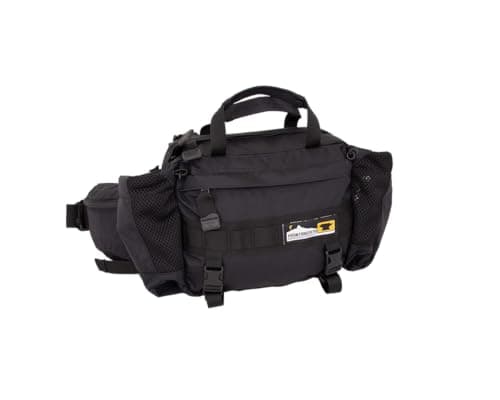
The terms get used interchangeably and there is a rough distinction worth knowing. A fanny pack is a small pouch on a webbing strap with no structure. A hip pack adds padding and a shaped belt. A lumbar pack, which is what the Mountainsmith is, adds a padded panel across the lower back and is designed to carry more weight further.
For hiking specifically you want the second or third of those. An unpadded webbing strap under five pounds becomes a pressure line across your hip bones inside an hour.
Water is the deciding constraint
Two liters of water weighs about 4.4 lb, which is most of what a hip pack should carry and most of its volume if it is inside the main compartment. That is why both packs here put bottles in external pockets: it keeps the weight low and against your body and leaves the compartment for everything else.
Buy the Osprey Savu 5 for short hikes, trail runs and hot days where the whole point is carrying as little as possible as comfortably as possible. Buy the Mountainsmith Tour if you want a hip pack that genuinely replaces a small daypack, you carry a camera, or a 28 to 48 in belt range is what makes a pack fit you at all.
The picks in full
1. Best overall
Osprey Savu 5
Osprey
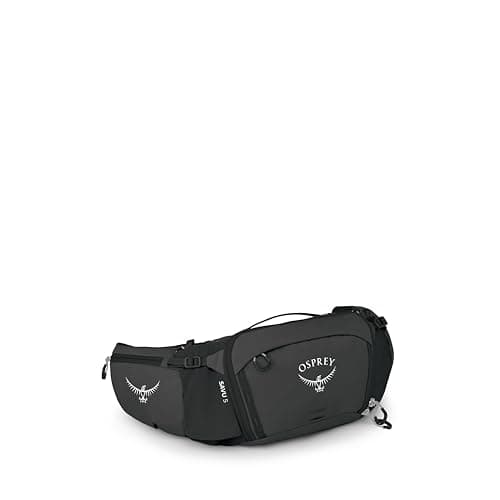
5 L at 376 g with two rigid bottle pockets that tuck away, on recycled 600D PET with a PFC-free finish.
Osprey publishes a 5 L capacity, a weight of 376 g / 0.83 lb, dimensions of 7 by 9 by 4 in, two rigid bottle pockets that tuck away when not needed, a bluesign-approved recycled 600D PET polyester main fabric with a PFC-free DWR, and an angled hipbelt with compression straps.
The tuck-away bottle pockets are the detail that makes this work as a hiking pack rather than a bike bag. Out, they carry water where you can reach it without stopping; tucked, the pack is a slim profile that does not catch on anything.
The drawback
Five liters is genuinely small. Two bottles, a shell, snacks and a phone fills it, and there is no room for the extra layer you should be carrying in shoulder season.
Published specs
Capacity
5 L
Weight
376 g / 0.83 lb
Dimensions
7 x 9 x 4 in
Bottles
two rigid bottle pockets that tuck away
Fabric
bluesign-approved recycled 600D PET polyester, PFC-free DWR
7 L with a 1 L bottle pocket on each side, a 28 to 48 in belt range and a removable waistbelt that converts it to a shoulder bag.
Mountainsmith publishes a 7 L capacity, dimensions of 11.5 by 10 by 5 in, an empty weight of 1 lb 12 oz, a suggested load of 8 to 10 lb, a 28 to 48 in waist fit, nylon dobby fabric, 1 L bottle pockets on each side, a padded shoulder strap and a removable waistbelt that converts the pack into a shoulder bag.
The 28 to 48 in belt range is the widest here and the reason this pack fits people that others do not. Hip packs are far more fit-sensitive than daypacks, because there is no second contact point to take up the slack.
The drawback
1 lb 12 oz empty, which is more than twice the Osprey before anything goes in it. Mountainsmith rates it for 8 to 10 lb, and at the top of that range it will sag.
Published specs
Capacity
7 L
Dimensions
11.5 x 10 x 5 in
Empty weight
1 lb 12 oz
Suggested load
8 to 10 lb
Waist fit
28 to 48 in
Fabric
nylon dobby
Extras
1 L bottle pocket each side, padded shoulder strap, removable waistbelt
For short days, yes. The hips are the strongest load-bearing structure in the body, so weight there costs far less than the same weight on shoulder straps. A hip pack also leaves your back uncovered, which matters more than capacity in heat.
QHow big should a hiking hip pack be?
Five liters carries water, a layer, snacks and a phone. Seven liters starts to replace a small daypack. Beyond that you want an actual daypack, because a hip pack loaded past about 10 lb sags and works its way up to your waist.
QWhy does my hip pack ride up?
It is sitting too high. The belt should sit on the iliac crest, the shelf of bone at the top of your hips, not around your natural waist, and it needs to be tighter than feels natural. A loose belt bounces, and bouncing is what walks it upward.
QHip pack or daypack for hiking?
Hip pack for short hikes, hot weather and minimal kit. Daypack once you need a rain shell, an insulating layer, a first aid kit and a headlamp for a full day. Do not solve the capacity problem by leaving the safety items behind.
How we picked
Everyone else in this category will tell you they tested twenty of these. We have not tested any of them, and we would rather say so than pretend. There is no gear closet here and no test lab.
What we did instead: pulled the published specifications from each manufacturer's own spec sheet or manual, named the standard behind every rating so you can check what it actually promises, did the arithmetic that turns a spec into a decision, and pulled today's real retail price rather than quoting one from memory. Every pick states a drawback, because a list where nothing is wrong with anything is an advert.
The limits of that method, stated plainly: published specs do not capture zipper quality, seam durability, or how a tent behaves at 2am in a storm. Where that matters, we say so on the pick. The full method is here.