Standing upright on flat ground with a pole planted beside your foot, your elbow should sit at about 90 degrees. Shorten the poles by 5 to 10 cm for a sustained climb and lengthen them by the same for a sustained descent. On fixed-length folding poles, buy for flat ground and accept the compromise on hills.
As a starting figure, most people between 5 ft 8 in and 6 ft land somewhere near 120 cm, and the adjustable poles here cover roughly 26 to 55 inches, which spans everyone. The reason adjustability matters is not fitting the person; it is fitting the terrain.
The lock is the specification that matters
There are two mechanisms, and they fail differently.
External lever locks (FlickLock, quick-lock) clamp the outer tube onto the inner one. They work with gloves on, they work when wet or muddy, and when they start to slip you tighten a screw. This is what every pole here uses.
Internal twist locks expand a plug inside the tube. They are cheaper and they are the reason trekking poles have a bad reputation: they slip once grit gets in, they seize when over-tightened, and they cannot be adjusted with cold hands.
If a pole you are considering uses a twist lock, that is the single strongest reason to choose something else, regardless of what the shaft is made of.
Compared on published numbers
Poles
Weight
Length
Shaft
Lock
Grip
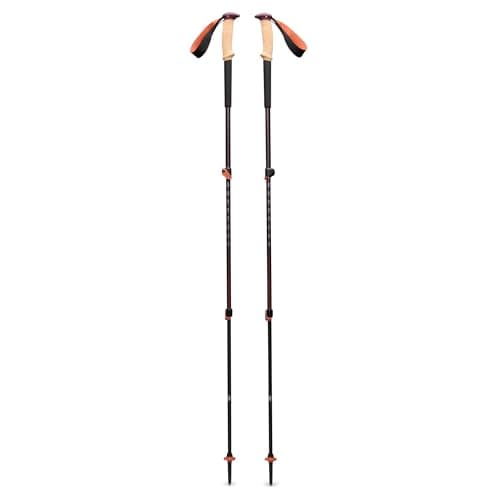
Black Diamond Trail Ergo Cork
1 lb 2 oz per pair
29-55 in adjustable
7075 aluminum
dual FlickLock levers
natural cork, angled
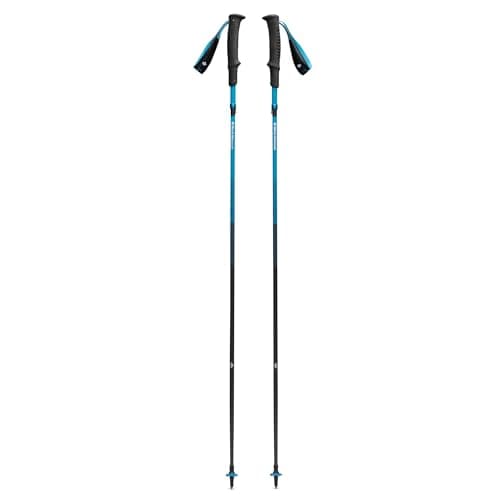
Black Diamond Distance Carbon Z
from 9 oz per pair
110-130 cm fixed
100 percent carbon
none, folding Z-pole
foam
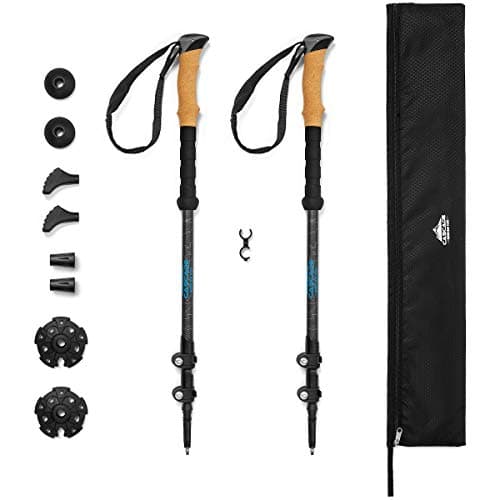
Cascade Mountain Tech Carbon Quick Lock
7.35 oz per pole
about 26-54 in adjustable
carbon fiber
external quick-lock levers
cork-style with EVA extension
Figures as published by each manufacturer.
Carbon or aluminum
Carbon is lighter and stiffer per gram. Aluminum is heavier and tougher. The difference that actually matters is the failure mode: an aluminum shaft that takes a hard sideways load bends, and a bent pole still walks you out. A carbon shaft under the same load can crack or shatter, and a shattered pole is done.
Where poles get pinned between rocks, in talus, in scree, or under a falling body, aluminum is the sensible choice. Where every gram is being counted on maintained trail, carbon is. Neither is wrong; they are answers to different questions.
Use the strap correctly or take it off
The strap is meant to carry your weight so your hand does not have to grip. Come up through the loop from underneath, then lay your palm over the top of the strap and hold the grip lightly. Done that way, the strap takes the load on your wrist and your hand stays relaxed all day. Done the intuitive way — hand down through the loop — the strap does nothing and you grip the handle for eight hours, which is where sore forearms come from. On steep, exposed or icy ground, take your hands out of the straps entirely so a fall does not trap them.
What poles are actually for
The clearest case is descent. Poles let your arms take a share of the load that would otherwise go through the knees, and that is where most people notice the difference, particularly with a loaded pack. The second case is balance: stream crossings, loose ground, snow patches, anything where a third and fourth point of contact matters.
There is a third use worth knowing about. A lot of ultralight shelters pitch with trekking poles instead of dedicated tent poles, which means the poles you are already carrying replace weight in the tent bag. Whether that is worth building a system around is discussed in best backpacking tents for beginners.
Tips, baskets and the parts that wear out
Tungsten carbide tips are standard and they last for years on rock and dirt. Rubber tip protectors go over them for pavement, for rock where a metal tip skates, and for protecting the inside of a car. They are the part everyone loses first.
Baskets stop the pole sinking. Small trekking baskets are for dirt and mud; wide snow baskets are for snow and soft ground, and Black Diamond includes both with the Trail Ergo Cork. A packet of replacement rubber tips and carbide tips is a few dollars and extends the life of an otherwise good pair indefinitely.
Which to buy
Buy the Black Diamond Trail Ergo Cork if you want one pair that handles everything and survives being treated badly. Buy the Distance Carbon Z if the poles will spend most of the day strapped to a pack and weight is the argument. Buy the Cascade Mountain Tech pair if the budget is the constraint, and tighten the locks before each trip.
The load they are taking off your knees is largely a function of what is on your back — fitting that properly is in how to fit a backpack.
The picks in full
1. Best overall
Black Diamond Trail Ergo Cork
Black Diamond
7075 aluminum shafts with dual FlickLock lever locks, a natural cork grip, and a 29 to 55 in range at 1 lb 2 oz per pair.
Black Diamond publishes a weight of 1 lb 2 oz / 510 g per pair, a usable length of 29 to 55 in, a 29 in collapsed length, three telescoping sections, 7075 aluminum shafts containing 30 percent pre-consumer recycled aluminum, dual FlickLock lever locks, a natural cork grip angled forward with an EVA foam extension, and four-season flex tips with both trekking and snow baskets.
Aluminum and lever locks is the combination that lasts. Aluminum bends before it breaks and can be straightened enough to finish a hike; a FlickLock can be tightened with a screwdriver or a coin when it starts to slip. Neither of those is true of a carbon shaft or an internal twist lock.
The drawback
1 lb 2 oz per pair is nearly twice the weight of the carbon folding option, and 29 in collapsed will not fit inside most daypacks.
Published specs
Weight per pair
1 lb 2 oz / 510 g
Usable length
29-55 in / 74-140 cm
Collapsed length
29 in / 74 cm
Sections
3, telescoping
Shaft
7075 aluminum with 30 percent pre-consumer recycled content
Locks
dual FlickLock lever locks
Grip
natural cork, angled forward, with EVA foam extension
Tips
4-season flex tips; trekking and snow baskets included
From 9 oz per pair in 100 percent carbon, folding to 13 to 17 inches with no adjustment mechanism to fail.
Black Diamond publishes a weight from 9 oz per pair depending on length, sizes from 110 to 130 cm in 5 cm increments with a womens range of 100 to 120 cm, a three-section foldable Z-pole design, a folded length of 13 to 17 in, and 100 percent carbon fiber shafts.
Removing the adjustment mechanism is what makes these so light and so short when folded. It also removes the thing that usually breaks. The trade is that you cannot adapt the length to the terrain, which matters more on steep ground than on rolling trail.
The drawback
Fixed length, so you buy one size and cannot shorten them for a climb or lengthen them for a descent. Carbon also snaps rather than bends when it fails.
Cascade Mountain Tech Carbon Fiber Quick Lock Poles
Cascade Mountain Tech
Carbon shafts at 7.35 oz per pole with external quick-lock levers, cork-style grips and tungsten carbide tips.
Cascade Mountain Tech publishes a weight of 7.35 oz per pole, an adjustable range of about 26 to 54 in, three telescoping sections, carbon fiber shafts, external quick-lock levers, cork-style grips with EVA foam extensions and adjustable straps, and tungsten carbide tips.
This is a lot of specification for the money, and the reason to know about the lock reputation is not to avoid the poles but to maintain them. The tension screw on a lever lock is adjustable by design; tightening it a quarter turn when slipping starts is a 30-second fix that most owners never make.
The drawback
The lever locks have a reputation for slipping under load, which on a descent means a pole collapsing under your weight. Check and retighten them before every trip.
Published specs
Weight per pole
7.35 oz
Adjustable range
about 26-54 in
Sections
3, telescoping
Shaft
carbon fiber
Locks
external quick-lock levers
Grip
cork-style with EVA foam extension and adjustable strap
Plant a pole beside your foot on flat ground standing upright; your elbow should be at about 90 degrees. Most people between 5 ft 8 in and 6 ft land near 120 cm. Shorten by 5 to 10 cm for sustained climbs and lengthen by the same for descents.
QAre carbon or aluminum trekking poles better?
It depends on the failure mode you can live with. Aluminum is heavier and bends when overloaded, so a damaged pole still walks you out. Carbon is lighter and stiffer but can crack or shatter. Choose aluminum for rocky, technical ground and carbon for maintained trail where weight matters.
QWhat kind of trekking pole lock is best?
External lever locks such as FlickLock or quick-lock. They work with gloves, work when muddy, and can be retightened with a screwdriver when they start slipping. Internal twist locks slip once grit gets in and cannot be adjusted with cold hands.
QHow do you use trekking pole straps?
Come up through the loop from underneath, then lay your palm over the top of the strap and hold the grip lightly. The strap carries the load through your wrist so your hand stays relaxed. On steep, exposed or icy ground, take your hands out of the straps entirely.
How we picked
Everyone else in this category will tell you they tested twenty of these. We have not tested any of them, and we would rather say so than pretend. There is no gear closet here and no test lab.
What we did instead: pulled the published specifications from each manufacturer's own spec sheet or manual, named the standard behind every rating so you can check what it actually promises, did the arithmetic that turns a spec into a decision, and pulled today's real retail price rather than quoting one from memory. Every pick states a drawback, because a list where nothing is wrong with anything is an advert.
The limits of that method, stated plainly: published specs do not capture zipper quality, seam durability, or how a tent behaves at 2am in a storm. Where that matters, we say so on the pick. The full method is here.