The Best Hydration Packs for Hiking, and the Cleaning Problem
A reservoir makes you drink more, because drinking stops being a decision. It also has to be cleaned, and that is where most of them end up in a cupboard.
A hose on your shoulder strap removes every step between deciding to drink and drinking. A bottle in a side pocket requires stopping, or twisting, or asking someone. People with reservoirs drink more, and dehydration is the most common reason a day hike goes badly.
The cost is that you cannot see how much is left. A bottle tells you at a glance; a reservoir tells you when it starts sucking air, which is usually a mile after you would have wanted to know. That is the single strongest argument for carrying one bottle alongside a reservoir rather than relying on it alone.
How much you need in the first place is a function of heat, effort and how far apart the water sources are — the arithmetic is in how much water do you need camping.
Compared on published numbers
Pack
Total volume
Cargo
Reservoir
Empty weight
Frame
Osprey Skarab 18
18 L
18 L
2.5 L included
1.10 lb
framesheet with AirScape panel
CamelBak M.U.L.E.
12 L
9 L
3 L included
30 oz
frameless, XV back panel
Gregory Nano 22 H2O
22 L
22 L
hydration sleeve
not published
not published
Figures as published by each manufacturer.
Note the weight of the water itself, because it dwarfs the pack differences: 2.5 L is about 5.5 lb and 3 L is about 6.6 lb. Choosing a pack that is four ounces lighter and then filling it with an extra half liter is a net gain of a pound.
The cleaning problem
This is why hydration packs end up unused. A reservoir put away damp with a trace of sugar in it grows mold along the hose and inside the bite valve, and once it is established it is very hard to remove because the hose interior cannot be scrubbed by hand.
The routine that prevents it:
Water only, if you can. Sports drink, electrolyte tablets and anything with sugar are what feed the growth. If you use them, clean the same day.
Empty and rinse after every trip, including the hose, by lifting the reservoir and letting clean water run all the way through and out of the bite valve.
Dry it fully open. Prop the reservoir wide with a whisk, a clothes peg or a paper towel roll so the walls do not touch, and hang the hose downward.
Freeze it if you cannot dry it. A rinsed reservoir in the freezer will not grow anything until you next need it. This is the practical answer for most people.
Filling a reservoir from a stream puts untreated water directly into a container you cannot easily scrub and then into your mouth. Treat the water first, then fill. Some filters thread directly onto a reservoir hose as an inline setup, which is convenient and still requires you to keep the filter clean. What treats what is in water filter vs purifier vs tablets and the hardware is in best water filters for camping.
Where the reservoir sits matters
Most packs put the reservoir in a sleeve against your back, which is the right place for weight distribution and the wrong place for access: refilling means unpacking. A few designs use an external sleeve you can reach without emptying the pack, which is worth looking for if you expect to refill several times in a day.
Whatever the layout, the hose routing decides whether you use it. Clip it high on the shoulder strap where you can reach the bite valve with your mouth without using a hand, and use the magnetic attachment if the pack has one. A hose that swings loose gets tucked away and then forgotten, which returns you to not drinking.
Cold weather, and the mistake that ends the day
A hose freezes long before the reservoir does, because it is thin and exposed. Once the hose is blocked, all the water you are carrying is unreachable. Two fixes: blow the water back into the reservoir after every drink so the hose sits empty, and route the hose inside your jacket rather than outside it.
Below about 20 F, an insulated bottle is simply the more reliable choice, which is one of the reasons winter kit lists differ — see winter camping checklist.
Which to buy
Buy the Osprey Skarab 18 for a general-purpose day hiking pack with real suspension. Buy the CamelBak M.U.L.E. if the days are long and hot and 3 liters is the specification that decides it. Buy the Gregory Nano 22 H2O if you carry a lot of things besides water.
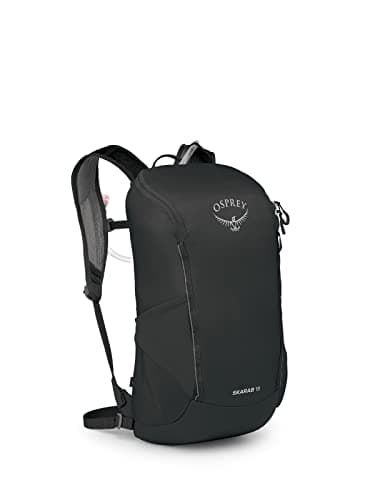
18 L of pack with a 2.5 L reservoir included, a framesheet suspension and a 1.10 lb empty weight.
Osprey publishes an 18 L volume, dimensions of 20.1 H by 9.8 W by 8.3 D in, an included Hydraulics LT 2.5 L reservoir, a 1.10 lb pack weight, a rated load of up to 25 lb, an AirScape back panel over a framesheet, a magnetic bite valve attachment on the sternum strap and dual side compression straps.
The framesheet is what separates this from a soft daypack with a bladder in it. Two and a half liters of water is 5.5 lb sitting against your spine, and a pack with no structure lets that weight sag into your lower back over a day.
The drawback
Rated to carry up to 25 lb, which is fine for a day pack and means it is not a candidate for an overnight load.
Published specs
Volume
18 L
Reservoir
Hydraulics LT 2.5 L, included
Pack weight
1.10 lb
Rated load
up to 25 lb
Dimensions
20.1 H x 9.8 W x 8.3 D in
Suspension
AirScape back panel over a framesheet
Extras
magnetic bite valve attachment, dual side compression
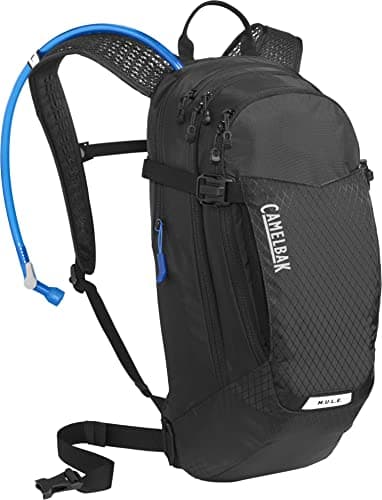
A 3 L reservoir with 9 L of cargo alongside it, in a frameless 12 L pack at 30 oz.
CamelBak publishes a 12 L total capacity split as 9 L of cargo and a 3 L / 100 oz Crux reservoir, a 30 oz weight, dimensions of 17 by 9.8 by 8.5 in, coated ripstop nylon fabric, and a frameless build with an XV back panel.
Three liters is the reason to choose it. On a summer ridge with no water source, the difference between 2.5 and 3 liters is about an hour of walking, and running out is a genuinely serious problem rather than an inconvenience.
The drawback
Frameless, and 30 oz empty is heavier than the Osprey with more structure. Three liters of water is 6.6 lb hanging off an unsupported back panel.
22 L of cargo volume with a hydration sleeve, in a simple lightweight body.
Gregory publishes a 22 L volume for the Nano 22 H2O with a hydration sleeve. It is the largest cargo volume here by four liters, which is the difference between carrying a jacket and carrying a jacket, a fleece, lunch and a camera.
Buy this if the water is one of several things you are carrying rather than the main one. The rest of the daypack category, including options without hydration compatibility, is in best daypacks for hiking.
The drawback
At 22 L this is a daypack that takes a reservoir rather than a purpose-built hydration pack, so the water sits in a sleeve rather than a dedicated compartment.
For drinking enough, yes: a hose on your shoulder strap removes every step between deciding to drink and drinking. The drawback is that you cannot see how much is left, which is why carrying one bottle alongside a reservoir is the common answer.
QHow big a hydration reservoir do I need?
Two liters covers most day hikes in moderate conditions and 3 liters covers long, hot, dry days. Remember that water is the heaviest thing in the pack: 2.5 L is about 5.5 lb and 3 L is about 6.6 lb.
QHow do you clean a hydration bladder?
Empty and rinse it after every trip, running clean water all the way through the hose and out of the bite valve, then dry it propped fully open with the hose hanging down. If you cannot dry it, put the rinsed reservoir in the freezer until next time.
QWhy does my hydration hose freeze in winter?
The hose is thin and exposed, so it freezes long before the reservoir. Blow the water back into the reservoir after every drink so the hose sits empty, and route it inside your jacket. Below about 20 F an insulated bottle is more reliable.
How we picked
Everyone else in this category will tell you they tested twenty of these. We have not tested any of them, and we would rather say so than pretend. There is no gear closet here and no test lab.
What we did instead: pulled the published specifications from each manufacturer's own spec sheet or manual, named the standard behind every rating so you can check what it actually promises, did the arithmetic that turns a spec into a decision, and pulled today's real retail price rather than quoting one from memory. Every pick states a drawback, because a list where nothing is wrong with anything is an advert.
The limits of that method, stated plainly: published specs do not capture zipper quality, seam durability, or how a tent behaves at 2am in a storm. Where that matters, we say so on the pick. The full method is here.