Water Filter vs Purifier vs Tablets: Which Pathogen Are You Removing?
These three words describe three different levels of protection against three different classes of pathogen. Only one of them removes viruses, and most campers do not need it.
Trail & Tarp earns a commission from qualifying purchases made through links on this page, at no extra cost to you. Full disclosure.
The distinction, in one paragraph
The short answer
A filter is a physical barrier with a pore size, and it removes bacteria and protozoa. A purifier also handles viruses, which are too small for most filter pores, usually by chemistry or UV. Tablets are chemical purification: they handle viruses and bacteria reliably, and they need time. The CDC notes that filters alone may not remove viruses, which is exactly why the three words are not interchangeable.
Filter
Purifier
Tablets
Bacteria (E. coli)
Yes
Yes
Yes
Protozoa (giardia, crypto)
Yes
Yes
Varies; crypto needs long contact time
Viruses
No, at typical pore sizes
Yes
Yes
Sediment and cloudiness
Yes
Depends on type
No; pre-filter first
Chemicals and heavy metals
No
No
No
Speed
Immediate
Immediate to minutes
30 minutes to 4 hours
Taste
Unaffected
Varies
Noticeable chemical taste
Weight
3 to 12 oz
Varies
Effectively nothing
What each category does. Individual products vary; always read the maker's own claim.
Pore size, and what the numbers mean
A filter's rating is the size of the largest particle it lets through, in microns. Bacteria are roughly 0.2 to 5 microns and protozoan cysts are considerably larger, so a 0.1 or 0.2 micron filter blocks both physically. Viruses are around 0.02 to 0.3 microns and pass through.
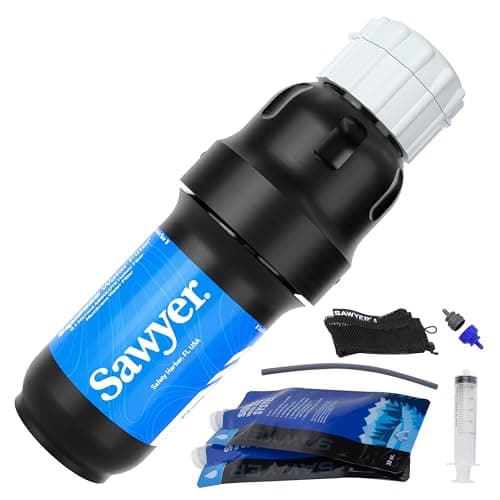
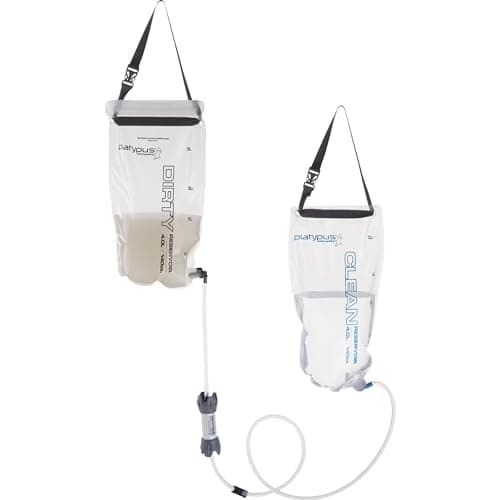
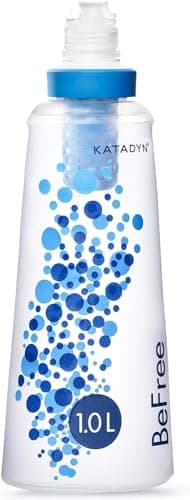
The published figures for the filters on this site: Sawyer Squeeze at 0.1 micron absolute, with removal of 99.99999% of bacteria and 99.9999% of protozoa, at 3 oz. Platypus GravityWorks 4 L at 0.2 micron, up to 1.75 L per minute, 11.5 oz for the system and up to 1,500 L of cartridge life. Katadyn BeFree 1.0 L at 0.1 micron, up to 2 L per minute, 63 g and up to 1,000 L of cartridge life.
Note what none of them claims: virus removal. That is not an omission, it is the category boundary, and it is honest of the manufacturers to state it that way.
Do you actually need virus protection?
For camping in the backcountry of the United States, Canada and most of Western Europe, generally no. The pathogens that make campers ill in these places are bacteria such as E. coli and protozoa such as giardia and cryptosporidium, all of which a 0.1 or 0.2 micron filter removes. Waterborne viruses in these settings are associated with human sewage contamination, which is a developed-water-supply and international-travel problem rather than a mountain stream problem.
Where it flips: international travel to regions with poor sanitation, water downstream of agriculture or settlement, flood water, and anywhere you have specific reason to think sewage is involved. In those cases you want a purifier or chemical treatment, and the CDC page linked below is the authority on which.
Nothing here removes chemicals
Filters, purifiers and tablets all target microorganisms. None of them removes dissolved agricultural runoff, industrial contamination, heavy metals or road salt, and some activated carbon elements improve taste without meaningfully removing contaminants. If you have reason to suspect chemical contamination, the answer is a different water source, not a different filter. We do not publish medical or public health advice; see the CDC and EPA pages below.
Tablets: the backup that weighs nothing
Chemical tablets — chlorine dioxide is the common camping form — are the layer almost everybody should carry and almost nobody does. They weigh essentially nothing, they do not clog, they do not freeze and break, and they work when a filter has failed.
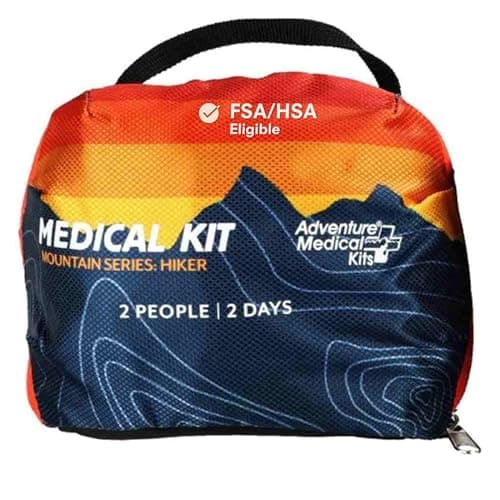
The costs are time and taste. Treatment times are specified on the packet and vary by pathogen and water temperature: typically around 30 minutes for bacteria and viruses, and up to four hours for cryptosporidium, which is unusually resistant. Cold and cloudy water needs longer. Follow the packet rather than a rule of thumb, and keep a strip of tablets in the first aid kit where you will not use them by accident.
Cloudy water needs pre-filtering before chemical treatment, because suspended solids shield pathogens and consume the disinfectant. Coffee filter, bandana, or let it settle — then treat.
Boiling, which is free and always works
The CDC advises bringing water to a rolling boil for one minute, or three minutes above 6,500 ft, as an effective way to kill pathogens. It handles bacteria, protozoa and viruses without exception, needs no equipment you are not already carrying, and cannot be defeated by a clogged cartridge.
The reasons it is not the default are fuel and time. Boiling a day's water for four people uses a serious amount of gas and a lot of stove time, and then you have hot water when you wanted cold. For an emergency, or for the cooking water you were heating anyway, it is the most reliable option available. Fuel arithmetic is in propane vs butane.
Which one, for which trip
Trip
Take
Because
Developed campground, potable taps
Nothing
The tap is treated. A filter is not a safety item here
Campground with an unmarked standpipe
Filter, plus tablets as backup
Unknown supply, small volumes
Day hikes from a campsite
Squeeze or bottle filter
Refill on the move, 3 oz to carry
Group in camp, no potable supply
Gravity system
Volume without standing over it
Backpacking
Filter, plus tablets in the first aid kit
Redundancy for a few grams
International travel, poor sanitation
Purifier or tablets
Viruses are in play
The recommendation follows the water source, not the gear category.
Looking after a filter so it lasts
Two failure modes. Clogging, which is normal and reversible: Sawyer publishes that backwashing restores up to 98.5% of flow, and Katadyn's EZ-Clean membrane is cleaned by shaking or swishing. Do it when flow drops rather than when it stops.
Freezing, which is not reversible. Ice crystals crack the hollow fibers, and a frozen filter can look and feel perfectly normal while passing everything it was supposed to stop. There is no field test for it. If a filter has frozen, retire it — and in cold weather sleep with it in your sleeping bag rather than leaving it in a vestibule.
The product-level comparison of the three filters above is in the water filter roundup, and how much water you need in the first place is in how much water do you need camping. For what a rating does and does not promise elsewhere on this site, the same skepticism applies: read what the maker actually claims, not the category name.
The gear this page points to
Sawyer Squeeze Water Filter (SP129)
Sawyer
0.1 micron absolute at 3 oz, published as removing 99.99999% of bacteria and 99.9999% of protozoa. Backwashing restores up to 98.5% of flow.
QWhat is the difference between a water filter and a purifier?
A filter is a physical barrier with a pore size and removes bacteria and protozoa. A purifier also handles viruses, which are too small to be caught by typical filter pores, usually by chemical or UV treatment. The CDC notes that filters alone may not remove viruses.
QDo I need a water purifier for camping in the US?
Usually not. The pathogens that make campers ill in North America and Western Europe are bacteria and protozoa, both of which a 0.1 or 0.2 micron filter removes. Virus protection matters for international travel to regions with poor sanitation and for water contaminated by sewage.
QHow long do water purification tablets take?
Follow the packet, because it varies by pathogen and water temperature. Chlorine dioxide tablets typically need around 30 minutes for bacteria and viruses and up to four hours for cryptosporidium, which is unusually resistant. Cold or cloudy water needs longer, and cloudy water should be pre-filtered first.
QDoes freezing damage a water filter?
Yes, permanently. Ice crystals crack the hollow fibers, and a frozen filter can look and feel normal while passing what it was meant to stop. There is no field test for it, so retire a filter that has frozen and sleep with it in your bag in cold weather.
Sources
Every figure on this page comes from a published source. We have not tested this gear, so the numbers are the manufacturer's or the standard body's, not ours. How we research.