Propane vs Butane Camp Stoves: Which Fuel Should You Run?
The two fuels behave very differently as the temperature drops, and one of them is stocked at every campground store in America. That mostly settles it.
Propane for anything below about 40 F and for anyone who might need to buy fuel at a campground store; butane for warm-weather convenience and compact storage. The difference is boiling point: propane vaporizes far below freezing, while butane stops producing usable pressure as the canister approaches freezing, which is exactly when you want hot food.
Propane
Butane
Isobutane blend
Cold performance
Best. Works well below freezing
Worst. Struggles near freezing
Good. Blended to fix butane's weakness
Availability in the US
Everywhere, in 16.4 oz cylinders
Limited, often Asian grocers and camping stores
Outdoor retailers, mixed at gas stations
Canister form
Steel, heavy, bulky
Flat cartridge, compact
Threaded canister, compact
Typical use
Two-burner family stoves
Single-burner tabletop stoves
Backpacking systems
Example on this site
Coleman Triton+, 22,000 BTU
Gas One GS-3400P, 8,000 BTU
Jetboil Flash
Fuel characteristics with example stoves and their published outputs.
Why cold kills a butane canister
A gas canister works because liquid fuel inside evaporates and pushes vapor out. How readily it evaporates depends on the fuel and the temperature. Propane boils far below freezing, so it keeps generating pressure in genuinely cold conditions. Butane boils close to freezing, so on a frosty morning the canister goes quiet: it is not empty, it just cannot make vapor.
Isobutane blends exist to split the difference: adding propane to butane raises the pressure and extends the usable range, which is why nearly every backpacking canister is a blend rather than pure butane.
The availability argument decides it for most people
The green 16.4 oz propane cylinder is stocked by campground stores, hardware stores and highway gas stations across the country. Butane cartridges are not. If you have ever run out of fuel on a Saturday evening two hours from anywhere, that single fact outweighs every other consideration on this page.
Cost, and the thing nobody mentions
Per meal, the difference between fuels is small. What is not small is waste: single-use propane cylinders are difficult to recycle and most campgrounds have a bin full of them. Refillable one-pound cylinders and adapter hoses that run a camp stove from a 20 lb tank both exist, cost more up front, and are much cheaper and cleaner over a season. If you camp more than a few times a year, look at a hose adapter before you buy your tenth green cylinder.
The verdict
Run propane. For family camping in the US it wins on availability and on cold performance, and the two-burner stoves that matter mostly run it anyway.
Keep a butane tabletop stove as a second burner if you like: they are cheap, small and quiet, and in summer the fuel difference is invisible. A dual-fuel stove like the Gas One gives you both without a decision.
Use isobutane blends when you are carrying the stove, where the weight of a propane cylinder is unjustifiable. That is the first backpacking trip case, not the campground case.
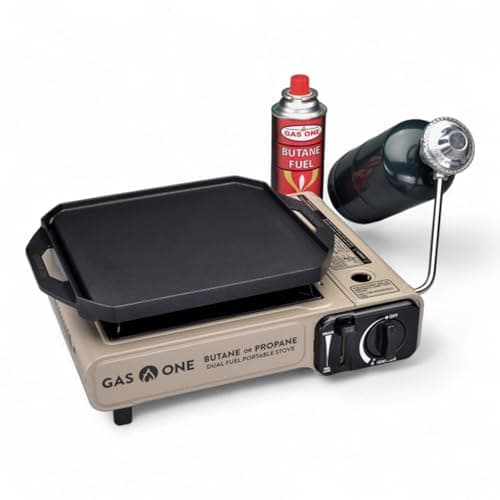
Runs 8,000 BTU on either an 8 oz butane canister or a 16.4 oz propane cylinder, at 3.1 lb.
Gas One publishes dual-fuel operation on butane or propane, 8,000 BTU, 3.1 lb, and a pressure-sensor cartridge ejection system. If you cannot predict your conditions, a dual-fuel stove removes the fuel decision entirely: run butane in summer for convenience, propane when it gets cold.
The drawback
8,000 BTU and a single burner. It is a supporting stove, not a family kitchen, and the adapter approach means carrying whichever fuel you did not use.
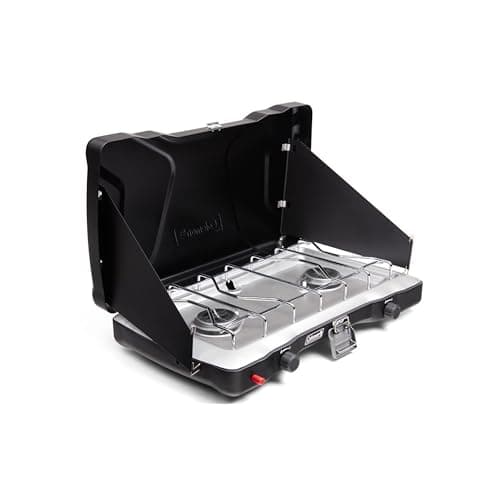
22,000 BTU across two burners on the 16.4 oz propane cylinders sold at every campground store.
Coleman publishes 22,000 BTU total, two adjustable burners, a pressure regulator, and operation from the standard 16.4 oz propane cylinder. Propane's advantage is physical: it keeps producing usable vapor pressure at temperatures well below freezing, where butane has already given up.
The drawback
Those cylinders are heavy, bulky, and awkward to recycle, and each one is single-use unless you buy a refillable adapter setup.
Published specs
Output
22,000 BTU total, 11,000 BTU per burner
Burners
2, independently adjustable
Ignition
push-button InstaStart
Weight
11.9 lb
Fuel
16.4 oz propane cylinder, up to about 1 hour on high
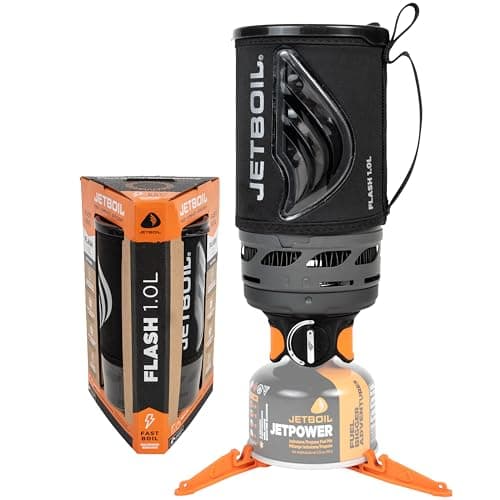
Isobutane-propane blend canisters, two cups boiled in about 100 seconds, 13.1 oz all in.
Jetboil publishes a 100-second boil for two cups on isobutane-propane canisters, in a 13.1 oz system. The blend exists precisely to fix butane's cold-weather problem: adding propane raises the vapor pressure so the canister keeps working further down the thermometer.
The drawback
Blend canisters are the least widely stocked of the three fuels, and they cannot be part-measured, so you carry a spare and guess.
Propane for cold weather and for the ability to buy fuel almost anywhere in the US; butane for compact warm-weather convenience. Butane loses canister pressure as it approaches freezing, so it is a poor choice for shoulder-season and winter camping.
QDoes butane work in cold weather?
Poorly. Butane's boiling point is close to freezing, so in cold conditions the canister cannot generate enough vapor pressure to feed the burner. Isobutane-propane blends are formulated specifically to extend the usable temperature range.
QCan you use propane in a butane stove?
Only if the stove is designed for both. Dual-fuel stoves such as the Gas One GS-3400P accept either an 8 oz butane cartridge or a 16.4 oz propane cylinder. Never improvise an adapter for a stove that is not rated for the fuel.
QWhich camp stove fuel is cheapest?
Per meal the fuels are close. The bigger saving is refilling: an adapter hose that runs a camp stove from a 20 lb propane tank, or refillable one-pound cylinders, both cost less over a season than a stack of single-use cylinders and create less waste.
How we picked
Everyone else in this category will tell you they tested twenty of these. We have not tested any of them, and we would rather say so than pretend. There is no gear closet here and no test lab.
What we did instead: pulled the published specifications from each manufacturer's own spec sheet or manual, named the standard behind every rating so you can check what it actually promises, did the arithmetic that turns a spec into a decision, and pulled today's real retail price rather than quoting one from memory. Every pick states a drawback, because a list where nothing is wrong with anything is an advert.
The limits of that method, stated plainly: published specs do not capture zipper quality, seam durability, or how a tent behaves at 2am in a storm. Where that matters, we say so on the pick. The full method is here.