A stove that lives in a vehicle is judged on three things a campground stove never is: how much counter it eats, how it behaves in wind, and what fuel you can find at 5pm in a small town.
In a van or an overland build the constraints are closed height, counter footprint, wind exposure at a pullout, and whether the fuel is buyable in a small town. Raw BTU, the number every listing leads with, is the least important of the five. A 40,000 BTU stove you cannot store is worse than a 22,000 BTU stove you can.
The difference from campground cooking is that nothing gets unpacked and repacked at a vehicle site. The stove lives somewhere permanently, comes out in seconds, and often gets used in a wind that a campground loop would have blocked. That reshapes the priority order completely.
Compared on published numbers
Stove
Output
Burners
Closed size
Weight
Fuel
Camp Chef Everest 2X
40,000 BTU (2 x 20,000)
2 high pressure
23.5 x 13.5 x 4 in
12 lb
propane
Coleman Triton+
22,000 BTU total
2
not published
11.9 lb
16.4 oz propane
Gas One GS-3400P
8,000 BTU
1
13.5 x 11.2 x 4.4 in
3.1 lb
butane or propane
Figures as published by each manufacturer.
The spread from 8,000 to 40,000 BTU looks decisive and mostly is not. Burner output determines how fast a large pot boils and how well the flame resists wind; it does not determine whether you can cook. What it does determine is fuel consumption, and the Camp Chef will go through cylinders considerably faster than the Coleman.
Fuel is the decision you make once
Every stove here burns propane, and one also takes butane. The practical differences are cold performance and where you can buy it.
Fuel
Where you find it
Cold
Suits
16.4 oz propane cylinder
hardware, grocery, gas stations nationwide
works below freezing
the default for a US vehicle build
20 lb propane tank plus hose
any propane exchange
same
long stays; needs secure outside mounting
8 oz butane cartridge
Asian groceries, camping stores, online
loses pressure near freezing
warm-weather travel and small galleys
Based on the fuel each manufacturer specifies, plus US retail availability.
If the build is staying in the US and you camp in shoulder seasons, propane is the answer and the argument is settled in propane vs butane camp stoves. A 20 lb tank with an adapter hose is dramatically cheaper per meal than disposables, and the reason most long-term vans run one.
Never cook inside the van with the doors shut
A stove burning in an enclosed vehicle consumes oxygen and can produce carbon monoxide, and a van is a far smaller sealed volume than a tent. Cook with the slider open and a window cracked on the opposite side, or cook outside at the tailgate, and fit a battery carbon monoxide alarm at head height. None of these stoves is certified for indoor use. The full reasoning is in carbon monoxide and stove safety when camping.
Wind is the thing that actually ruins vehicle cooking
Campgrounds are usually sheltered by design. The pullouts, gravel bars and desert flats that vehicle camping exists for are not, and an open flame in a 15 mph wind loses most of its heat sideways before it reaches the pot.
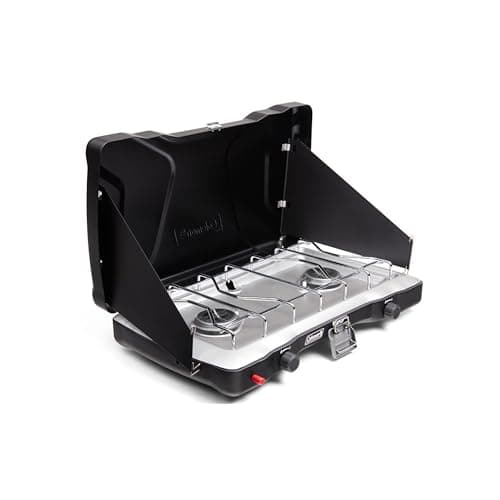
Two features fix it. The first is a physical windscreen — the Camp Chef's folding lid and the Coleman's fold-out panels both work, and the Camp Chef's three-sided arrangement works better. The second is burner pressure, which is why the high-pressure Everest holds a flame where a standard regulator gutters.
Failing both, park the vehicle as the windbreak. It is the largest object you have and it costs nothing.
Counter space is the constraint nobody budgets for
The Everest is 23.5 in wide. In a van galley that is most of the counter, and while it is running there is nowhere to put a chopping board or a plate. This is the single most common regret in a first build.
Three ways around it, in order of cost: cook at the tailgate on a folding table, fit a slide-out stove drawer so the stove sits proud of the counter when in use, or use a single burner and accept one-pan cooking. A drawer slide rated for the weight is the fix most builds converge on.
What the specifications do not tell you
Coleman does not publish a closed size for the Classic on the listing we read, so we have left that cell blank rather than measure a photograph. In a vehicle build that figure is the one you most need, so measure the actual unit before you cut a drawer.
Nobody publishes a wind-performance figure, because there is no standard test. Burner pressure and windscreen geometry are the honest proxies, and both are visible on the spec sheet.
Which to buy
Buy the Camp Chef Everest 2X if the stove is a permanent part of the build, you have 23.5 in of somewhere to put it, and you cook in wind. Buy the Coleman Triton+ if you want the same two-burner capability for less and you value fuel you can buy in any town. Buy the Gas One GS-3400P if the galley is tiny, if you want a backup burner, or if dual fuel solves a supply problem on your route.
Whichever you choose, the rest of the vehicle kitchen matters more than the stove: a 12V fridge changes what you can cook far more than an extra 20,000 BTU, and the layout argument is in camp kitchen setup guide.
The picks in full
1. Best overall
Camp Chef Everest 2X
Camp Chef
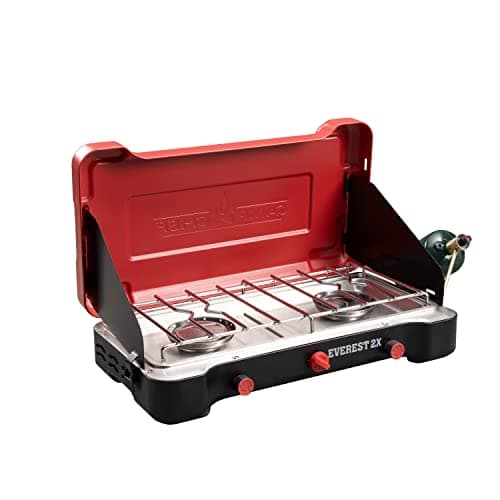
Two 20,000 BTU high-pressure burners in a 4 in tall case, with a folding lid that makes a three-sided windscreen.
Camp Chef publishes two individually controlled 20,000 BTU/hr burners for 40,000 BTU/hr total, a 12 lb weight, dimensions of 23.5 by 13.5 by 4 in, a 215 sq in cooking surface on a 21.5 by 10 in grate, matchless ignition, and a folding lid that forms a three-sided wind screen.
The 4 in closed height is the specification that makes this a vehicle stove. It slides into a drawer or under a bed platform where a taller stove will not go, and it comes out as a full two-burner kitchen.
High-pressure burners are the other reason. A standard camp stove regulator loses noticeable output in wind and cold; these run at a higher pressure and hold their heat better in both, which is the difference between boiling water on a exposed pullout and watching a pot sit lukewarm.
The drawback
23.5 in wide is a lot of counter, and 40,000 BTU is more heat than most van cooking needs. High-pressure burners also empty a 1 lb cylinder fast.
22,000 BTU across two independently adjustable burners at 11.9 lb, fitting a 12 in and a 10 in pan.
Coleman publishes 22,000 BTU total across two independently adjustable burners, an 11.9 lb weight, a 16.4 oz propane cylinder fitting, and room for a 12 in pan plus a 10 in pan.
The argument for this stove in a vehicle is not the specification, it is the supply chain. The 16.4 oz green cylinders it runs on are stocked in every hardware store, grocery store and gas station near a campground in the country, and so are the parts. On a long trip that matters more than burner output.
Two-pan capacity is the practical floor for cooking real meals rather than heating one thing at a time — the reasoning is in best camp stoves.
The drawback
22,000 BTU total is a little over half the Camp Chef, and the wind performance is ordinary. The fold-out side panels help but do not match a high-pressure burner in a breeze.
Published specs
Output
22,000 BTU total, 11,000 BTU per burner
Burners
2, independently adjustable
Ignition
push-button InstaStart
Weight
11.9 lb
Fuel
16.4 oz propane cylinder, up to about 1 hour on high
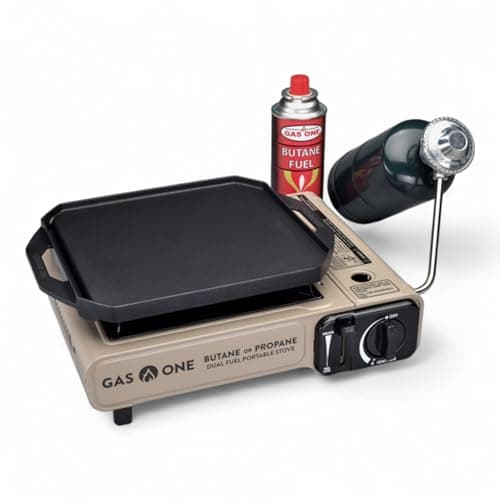
8,000 BTU from either butane or propane at 3.1 lb, in a 13.5 by 11.2 in case.
Gas One publishes 8,000 BTU of output, dual fuel compatibility with either 8 oz butane cartridges or 16.4 oz propane cylinders, a 3.1 lb weight, dimensions of 13.5 by 11.2 by 4.4 in, and a pressure-sensor cartridge ejection safety system.
Dual fuel is the reason this earns a place in a vehicle. Butane is clean, cheap and widely sold in Asian grocery stores; propane works in the cold where butane loses canister pressure. Carrying one stove that takes both removes the single most common supply problem on a long trip.
Read the 8,000 BTU honestly against the others: it is a fifth of the Camp Chef. It is enough for coffee, pasta and a pan of eggs, which for a lot of van cooking is the whole menu.
The drawback
One burner and 8,000 BTU. This boils water and cooks one pan, and it will not run a two-pot meal or heat a large pot quickly.
The Camp Chef Everest 2X for most builds: two 20,000 BTU high-pressure burners in a case only 4 in tall closed, with a folding lid that forms a three-sided windscreen. The closed height is what lets it store in a drawer or under a bed platform, which is the constraint a van imposes and a campground does not.
QCan you use a camp stove inside a van?
Not with the doors shut. Any stove consumes oxygen and can produce carbon monoxide, and a van is a smaller sealed volume than a tent. Cook with the slider open and a window cracked on the opposite side, or cook at the tailgate, and fit a battery carbon monoxide alarm at head height.
QPropane or butane for overlanding?
Propane in the US. The 16.4 oz cylinders are stocked in hardware stores, groceries and gas stations nationwide and work below freezing, while butane loses canister pressure near freezing and is sold in fewer places. A dual-fuel stove like the Gas One GS-3400P takes either, which removes the supply problem on a long route.
QHow many BTU do you need for van cooking?
Less than the listings imply. 8,000 BTU boils water and cooks a pan; 22,000 BTU total across two burners cooks a real meal. Higher output mainly buys faster boiling of large pots and better wind resistance, at the cost of noticeably faster fuel consumption.
How we picked
Everyone else in this category will tell you they tested twenty of these. We have not tested any of them, and we would rather say so than pretend. There is no gear closet here and no test lab.
What we did instead: pulled the published specifications from each manufacturer's own spec sheet or manual, named the standard behind every rating so you can check what it actually promises, did the arithmetic that turns a spec into a decision, and pulled today's real retail price rather than quoting one from memory. Every pick states a drawback, because a list where nothing is wrong with anything is an advert.
The limits of that method, stated plainly: published specs do not capture zipper quality, seam durability, or how a tent behaves at 2am in a storm. Where that matters, we say so on the pick. The full method is here.