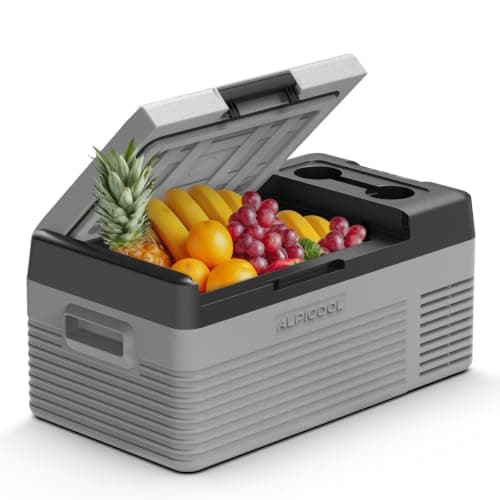
A compressor fridge does not draw its rated wattage continuously. It cycles, and the realistic figure is the duty cycle — commonly 20 to 40 percent in moderate weather once the box is cold. A 45 W fridge cycling at 30 percent averages about 13.5 W, which is roughly 324 watt-hours over 24 hours. That is the number to size a battery against.
Against that, a 292 Wh power station like the Jackery Explorer 300 does not run a fridge for a full day, let alone a weekend. This is the arithmetic people skip, and it is why fridges usually live in vehicles with a second battery or alongside a much larger power station and a solar panel.
Duty cycle rises sharply in heat, in direct sun, and every time the lid is opened. Treat the 30 percent figure as a temperate-weather estimate rather than a promise. The sizing method is in what size power station do I need.
Compared on published numbers
Fridge
Capacity
Weight
Temperature range
Power
Zones
Dometic CFX3 35
36 L, about 50 cans
37.26 lb
-7 F to +50 F
AC, 12/24V DC, solar
single
Alpicool C20
20 L / 21 qt
19.8 lb
-4 F to 68 F
12/24V DC, 110-240V AC
single
Figures as published by each manufacturer. Dometic states a draw of less than a 60 W bulb rather than a rated wattage.
Fridge or cooler?
The honest answer for most people reading this site is a cooler. A fridge costs several times as much, weighs more, needs a power system that costs more again, and solves a problem that block ice and technique solve adequately over a weekend.
One clarification before the four cases below, because the listings blur it: everything on this page is a compressor fridge, which sets an absolute temperature and can freeze. A 12V thermoelectric cooler plugs into the same socket for a fraction of the price and is a different machine — it cools a fixed number of degrees below the surrounding air rather than to a set point, so it cannot freeze and gets warmer as the weather does. If the price here has made you look at cheaper 12V boxes, read best 12V coolers for camping first, so you buy one knowing what it is.
The fridge wins in four specific situations:
Trips longer than about four days, where buying ice becomes a daily errand and the food gets progressively wetter.
Hot climates, where a cooler's published ice figures collapse.
Anywhere ice is not sold, which is most dispersed camping and a lot of remote travel.
When you need a freezer, which no cooler provides at any price.
A vehicle starting battery is designed to deliver a large current for a few seconds, not a small current for two days, and discharging one deeply damages it permanently — sometimes in a single night. A fridge needs either a deep-cycle or lithium auxiliary battery, or a power station. Most 12V fridges include a low-voltage cutoff with selectable levels for exactly this reason; set it to the protective setting rather than the one that runs longest, and you will still have a car that starts.
What compressor fridges do that coolers cannot
They hold a set temperature regardless of ambient. A cooler is always warming toward the air around it; a fridge is thermostatically controlled, so food is at 37 F on day five exactly as it was on day one.
They also keep food dry. Nothing sits in meltwater, packaging does not disintegrate, and you are not re-sorting a swamp every morning. And they freeze: both units here publish sub-zero capability, which means ice cream, frozen meat, and the ability to make your own ice for drinks.
Buying notes that matter
Check the depth against your vehicle, not just the volume. The Dometic is 27.32 in deep, which is longer than many trunk floors are wide, and a fridge that has to go in sideways loses you the whole boot.
Check whether you want dual-zone. A single-zone unit is a fridge or a freezer at any one moment; a dual-zone unit does both at the cost of capacity, complexity and price. For most camping, single zone set to fridge is what actually gets used.
Buy the Alpicool C20 as a first fridge, because 20 L and 19.8 lb keeps the purchase and the power requirement proportionate. Buy the Dometic CFX3 35 if you travel for a week at a time, camp somewhere hot, or want the variable-speed compressor to keep the duty cycle down.
And if you camp weekends at campgrounds where ice is sold at the store, buy neither — a budget cooler packed properly does the job for a fraction of the money.
The picks in full
1. Best overall
Dometic CFX3 35
Dometic
36 L holding about 50 cans, running from -7 F to +50 F on a variable-speed compressor, at 37.26 lb.
Dometic publishes a 36 L capacity holding about 50 cans, a net weight of 37.26 lb, dimensions of 27.32 D by 15.67 W by 16.02 H in, a temperature range of -7 F to +50 F, a VMSO3 variable-speed compressor, power from 110-240V AC, 12/24V DC or solar, and states the unit draws less than a 60 W bulb.
The variable-speed compressor is the specification that matters for power. A fixed-speed compressor runs flat out or not at all; a variable one slows down once the box is cold, which is what turns a fridge from a battery-killer into something a modest power station can sustain.
The drawback
37.26 lb empty and 27.32 in deep. It is a substantial object that dictates how the rest of the vehicle is packed, and it costs several times a good cooler.
20 L at 19.8 lb with a 45 W rated draw and a range from -4 F to 68 F, on 12/24V DC or mains.
Alpicool publishes a 20 L / 21 qt capacity, a weight of 19.8 lb, a rated power of 45 W, a temperature range of -4 F to 68 F / -20 C to 20 C, power from 12/24V DC and 110-240V AC, and single-zone operation.
Twenty pounds and 20 liters is the size that makes sense as a first compressor fridge. It fits behind a seat, one person can lift it loaded, and it costs a fraction of the Dometic while doing the same fundamental job.
The drawback
20 liters is genuinely small — a weekend of food for two, not a week for a family — and it is a single-zone unit, so it is a fridge or a freezer rather than both.
Less than its rated wattage, because it cycles. A 45 W fridge running a 20 to 40 percent duty cycle averages roughly 9 to 18 W, or about 216 to 432 watt-hours over 24 hours. Duty cycle rises in heat, in sun, and every time you open the lid.
QCan I run a camping fridge off my car battery?
Not off the starter battery. It is designed for a large current for seconds, not a small current for days, and deep discharge damages it permanently. Use a deep-cycle or lithium auxiliary battery or a power station, and set the fridge's low-voltage cutoff protectively.
QIs a 12V fridge better than a cooler?
For trips past about four days, in hot climates, where ice is not sold, or when you need a freezer. For weekend campground camping where ice is available, a cooler packed with block ice does the job for a fraction of the total cost once you include the power system.
QWhat size 12V fridge do I need?
About 20 liters covers a weekend of food for two and fits behind a seat at around 20 lb. Around 35 to 40 liters covers a family or a week. Check the depth against your vehicle as well as the volume, because a 27 in deep fridge does not fit every trunk.
How we picked
Everyone else in this category will tell you they tested twenty of these. We have not tested any of them, and we would rather say so than pretend. There is no gear closet here and no test lab.
What we did instead: pulled the published specifications from each manufacturer's own spec sheet or manual, named the standard behind every rating so you can check what it actually promises, did the arithmetic that turns a spec into a decision, and pulled today's real retail price rather than quoting one from memory. Every pick states a drawback, because a list where nothing is wrong with anything is an advert.
The limits of that method, stated plainly: published specs do not capture zipper quality, seam durability, or how a tent behaves at 2am in a storm. Where that matters, we say so on the pick. The full method is here.