The Best Budget Coolers, and Why the Expensive Ones Are Not Worth It
A premium cooler costs several times a budget one and buys you days of ice retention you will not use on a two-night trip. How you pack it matters more.
A premium rotomolded cooler buys ice retention measured in days. On a two-night weekend you need ice to last about 48 hours, and a pre-chilled budget cooler packed with block ice at a two-to-one ratio does that comfortably. You are paying for headroom you do not use.
Where premium boxes genuinely earn their price is long trips, hot climates, boats, and bear country — YETI publishes IGBC bear certification on the Tundra 45, which a budget cooler cannot claim and which some areas require. If none of that describes your camping, the difference is not worth the money.
Figures as published by each manufacturer. The YETI is included as the premium reference point, not as a budget pick.
Look at the last two rows together. The RTIC holds more and weighs less than the YETI, and the YETI carries a bear certification the RTIC does not. Neither is simply better; they are answers to different questions.
Technique beats insulation on a weekend
Pre-chill the cooler. A warm cooler spends its first several pounds of ice cooling its own plastic. A sacrificial bag of ice the night before, or storing it indoors, costs nothing and is the single biggest improvement available.
Use block ice for the base. Less surface area means slower melt. Cubes on top for packing around food, block underneath for duration.
Aim for a two-to-one ice ratio by volume. Two parts ice to one part contents. A half-empty cooler is mostly air, and air warms fast.
Keep drinks in a second small cooler. Every opening of the main box costs ice, and drinks are what get fetched twenty times a day — see best soft coolers for camping.
Leave the meltwater in. Cold water holds cold. Draining it replaces it with air, which is worse.
Keep it in the shade. A cooler in direct sun is fighting radiant heat all day, and moving it under the table is free.
Doing all six turns a budget cooler into something that outperforms a premium one used carelessly. The full arithmetic is in how long does ice last in a cooler.
Ice claims are lab figures from an unopened cooler
Coleman publishes up to 3 days at 90 F for this 70-quart and Igloo up to 5 for the BMX 52. Those numbers come from a cooler that was pre-chilled, filled to the recommended ice ratio, closed, and left alone for the whole period. Nothing about that describes a family weekend. Read published ice claims as a way to rank coolers against each other rather than as a promise about your Saturday, and expect a fraction of the figure unless you actively manage the box.
What cheap coolers actually give up
Wall thickness first, which is the insulation. Then hinges and latches, which on a budget box are usually plastic and are the part that fails. Then the gasket, or its absence: premium coolers seal the lid against a rubber gasket, and most budget boxes simply rest lid on rim.
None of those matter much over 48 hours and all of them matter over a week. They also decide how long the cooler lasts rather than how cold it is, which is a separate question from ice retention and one the marketing rarely separates.
Which to buy
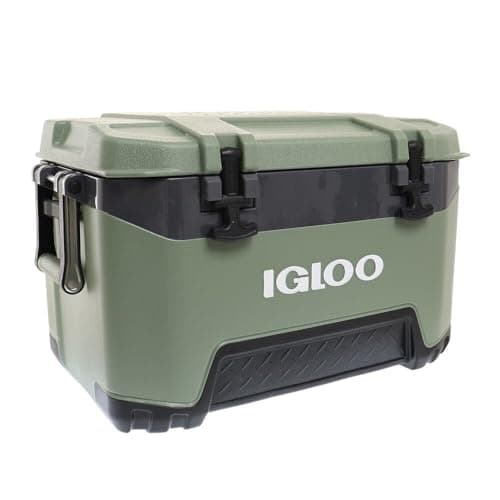
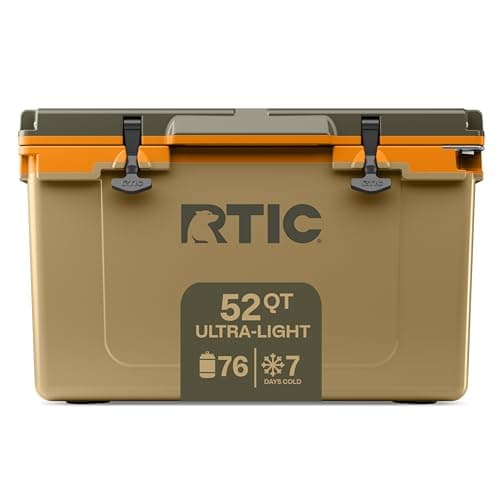
Buy the Coleman Classic 70-Quart if you want the most capacity per dollar and you camp weekends. Buy the Igloo BMX 52 if you want something one person can handle at 16.4 lb empty. Buy the RTIC 52 QT Ultra-Light if your trips run past three days and the ice genuinely has to last.
And spend some of what you saved on a set of block ice packs and a second small cooler for drinks. Both do more for ice retention than the next price tier of cooler would.
The picks in full
1. Best overall
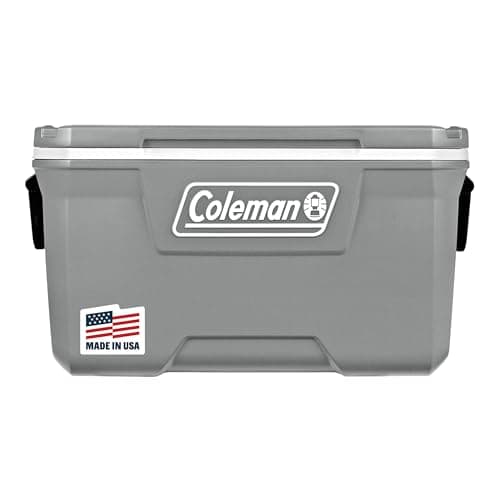
Coleman Classic 70-Quart Cooler
Coleman
70 qt holding up to 50 cans and 35 lb of ice with a published 3-day ice claim at 90 F, and a lid rated to sit on at 250 lb.
Coleman publishes a 70 qt capacity holding up to 50 cans and 35 lb of ice, an ice claim of up to 3 days at 90 F, TempLock FX insulation in the lid and body, a size of 31 by 15.75 by 17.5 in, a 12 lb 6.4 oz weight, and a Have-A-Seat lid rated to 250 lb with four cup holders.
Three days at 90 F is the headline and it is a laboratory figure, but the capacity is the real story: 70 quarts for a fraction of what a comparable premium box costs. For a family camping four weekends a year, the money saved buys the rest of the kitchen.
The drawback
Thin plastic walls and a hinge and latch system that is the first thing to fail. It is not a cooler that survives being thrown in a truck bed for a decade.
52 qt holding up to 83 cans at 16.4 lb empty, with the same published 5-day claim at 90 F.
Igloo publishes a 52 qt capacity holding up to 83 cans, an ice claim of up to 5 days at 90 F, an empty weight of 16.4 lb and outside dimensions of 26.2 by 16.42 by 16.06 in.
Sixteen and a half pounds empty is the number to notice. That is light enough that one person can position it, and it is the size that fits in a car alongside everything else rather than dictating the load.
The drawback
52 quarts fills fast once you add block ice, and at 26.2 by 16.42 in it is still a two-handed carry when loaded.
76 cans or 51 lb of ice behind up to 3 in of foam, with a published claim of up to 7 days, at 21 lb empty.
RTIC publishes a capacity of 76 cans or 51 lb of ice, an ice claim of up to 7 days, an empty weight of 21 lb, outside dimensions of 27.17 by 17.49 by 17.33 in, and up to 3 in of foam insulation.
Three inches of foam is what separates this from the Coleman and the Igloo, and it is where the extra money goes. It sits between the true budget boxes and the premium rotomolded ones on both price and performance.
The drawback
Up to 3 in of foam means the box is much larger outside than in: 27.17 by 17.49 in of exterior for 52 quarts of interior.
For a two-night weekend, usually not. You need ice to last about 48 hours, and a pre-chilled budget cooler with block ice at a two-to-one ratio does that. Premium boxes earn their price on long trips, in hot climates, on boats, and where IGBC bear certification is required.
QHow do I make a cheap cooler hold ice longer?
Pre-chill the cooler, use block ice for the base layer, aim for two parts ice to one part contents, keep drinks in a separate small cooler, leave the meltwater in, and keep it in the shade. Done together these beat a premium cooler used carelessly.
QDo cooler ice claims mean anything?
They are useful for ranking coolers against each other and are not promises. A published figure like five days at 90 F comes from a pre-chilled cooler, filled to the recommended ice ratio, closed and left unopened. Expect a fraction of it in real use.
QShould I drain the water out of my cooler?
No, while you are still using it. Cold meltwater holds cold and draining it replaces the water with air, which warms far faster. Drain it when you are repacking with fresh ice or at the end of the trip.
How we picked
Everyone else in this category will tell you they tested twenty of these. We have not tested any of them, and we would rather say so than pretend. There is no gear closet here and no test lab.
What we did instead: pulled the published specifications from each manufacturer's own spec sheet or manual, named the standard behind every rating so you can check what it actually promises, did the arithmetic that turns a spec into a decision, and pulled today's real retail price rather than quoting one from memory. Every pick states a drawback, because a list where nothing is wrong with anything is an advert.
The limits of that method, stated plainly: published specs do not capture zipper quality, seam durability, or how a tent behaves at 2am in a storm. Where that matters, we say so on the pick. The full method is here.