The Best Soft Coolers for Camping, and What They Are Actually For
A soft cooler is not a small hard cooler. It is a different tool with a different job, and buying it for the wrong one is why people end up disappointed.
Soft coolers hold cold for one to two days, not five to seven. They exist to move a day's food and drink from a campsite to a trailhead, a beach or a boat, and to stop the hard cooler being opened twenty times a day. That last job is the real one: every opening of a hard cooler costs ice, and a soft cooler absorbs those openings.
This is why comparing a soft cooler's ice retention against a rotomolded hard cooler misses the point. YETI publishes 37 lb of ice capacity for the Tundra 45 and 16 lb for the Hopper Flip 12; Coleman publishes an ice claim of up to three days at 90 F for the Classic 70-quart. Nothing soft-sided is competing in that conversation, and it is not trying to.
Owning both is the setup that works. The hard cooler is the refrigerator and stays shut. The soft cooler is the door of the refrigerator, packed each morning and raided all day. The rest of the ice-economy argument is in how long does ice last in a cooler.
Compared on published numbers
Cooler
Capacity
Exterior
Interior
Insulation
Empty weight
YETI Hopper Flip 12
24 cans or 16 lb ice
12 x 14.3 x 10.7 in
9.5 x 11.4 x 8.5 in
ColdCell closed-cell foam
3 lb
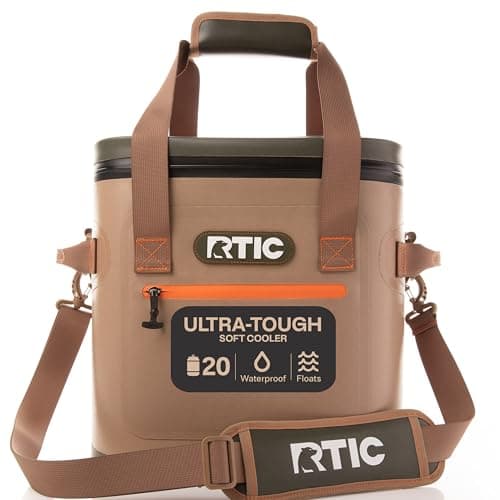
RTIC 20 Can Ultra-Tough
20 cans
not published
not published
up to 1.5 in closed-cell foam
not published
Igloo MaxCold+ 30-Can
30 cans
11.25 x 8.75 x 17.25 in
not published
heat-sealed liner
not published
Figures as published by each manufacturer.
Compare the exterior and interior figures rather than the can count. The YETI loses about 1.5 inches per side to insulation, and RTIC publishes up to 1.5 in of foam for the Ultra-Tough without publishing the dimensions to check it against. That wall is what you are buying, and it is also why these bags are so much larger on the outside than the capacity suggests.
The two failure points
Zippers first. A waterproof zipper on a soft cooler is under enormous tension by design, because that tension is what makes the seal. It is stiff when new, it gets stiffer if it dries out, and it will fail eventually if it is forced. Both YETI and RTIC sell a zipper lubricant for a reason; use it two or three times a season and the zipper outlives the bag.
Seams second. A soft cooler that lives in a car trunk under other gear develops pinholes at the corner seams where the foam is compressed hardest. Nothing fixes that. Packing it on top rather than at the bottom of a load is the whole prevention strategy.
Pre-chill it, and use block ice
A soft cooler has a fraction of the thermal mass of a hard one, so a warm bag eats ice faster than anything else you can do wrong. Put it in the freezer or fill it with sacrificial ice for an hour before you load it. Then use block ice or frozen water bottles rather than cubes: less surface area means slower melt, and a frozen bottle becomes drinking water instead of a puddle. The full ice arithmetic is in how to keep food cold camping.
Ice packs or ice?
Reusable gel packs are cleaner, do not flood the bag as they melt, and hold less cold than the same volume of water ice. For a soft cooler that is usually the right trade, because the contents are a day's food and a flooded lunch is a worse outcome than a slightly warmer one.
Frozen water bottles are the compromise worth knowing about: no flooding, close to the thermal performance of ice, and they turn into cold drinking water by the afternoon. A set of slim reusable ice packs sized to lie flat along one wall is the other approach, and it wastes less interior volume than loose cubes.
Which to buy
Buy the YETI Hopper Flip 12 if it is going into a boat, a truck bed or a river and you want it to survive that for a decade. Buy the RTIC 20 Can Ultra-Tough for the same job at a lower price. Buy the Igloo MaxCold+ if what you actually want is a large insulated bag for day trips and groceries, and do not expect it to hold ice overnight.
And if this is your only cooler, it is the wrong category — start with best coolers for camping instead.
The picks in full
1. Best overall
YETI Hopper Flip 12
YETI
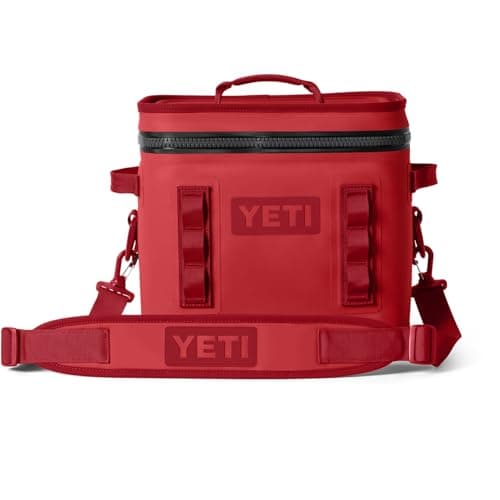
24 cans or 16 lb of ice inside closed-cell rubber foam, behind a waterproof zipper, at 3 lb empty.
YETI publishes a capacity of 24 cans without ice or 16 lb of ice, exterior dimensions of 12 H by 14.3 W by 10.7 D in, interior dimensions of 9.5 by 11.4 by 8.5 in, a 3 lb empty weight, a DryHide high-density fabric shell, ColdCell closed-cell rubber foam insulation and a HydroLok zipper.
The gap between the exterior and interior figures is the story: about 1.5 inches of wall on every side, which is what closed-cell foam that actually insulates looks like. That is also why it holds ice far better than a cooler bag with a thin liner, and why it does not fold flat.
The drawback
The HydroLok zipper is stiff enough that most people need two hands and a lubricant stick to work it, and 9.5 by 11.4 by 8.5 in of interior is genuinely small for the exterior size.
20 cans inside up to 1.5 in of closed-cell foam, in a heavy-duty nylon shell with a leakproof zipper, and it floats.
RTIC publishes a 20-can capacity, up to 1.5 in of closed-cell foam insulation, a heavy-duty nylon exterior, the RTIC EZ waterproof zipper it describes as 100% leakproof, a design that floats, and a claim of up to 2 days of cooling when you follow its own cooling tips. It publishes no interior, exterior or empty-weight figures.
Functionally this competes directly with the YETI, and the honest difference between them is price and zipper feel rather than performance. The wider brand comparison, on the hard cooler side where the published data is better, is in YETI vs RTIC coolers.
The drawback
RTIC publishes no interior, exterior or empty-weight figures for this cooler, so you cannot work out how much of the bag is actually usable before it arrives - which the discontinued Soft Pack it replaced did let you do.
Published specs
Capacity
20 cans
Insulation
closed-cell foam, up to 1.5 in
Exterior
heavy-duty nylon
Closure
RTIC EZ waterproof zipper, 100% leakproof
Floats
yes
Maker's retention claim
up to 2 days, following RTIC's own cooling tips; no standard test behind it
Sizes
12, 20, 30 and 50 can
Note
RTIC publishes no interior, exterior or empty-weight figures for the Ultra-Tough, unlike the discontinued Soft Pack it replaced
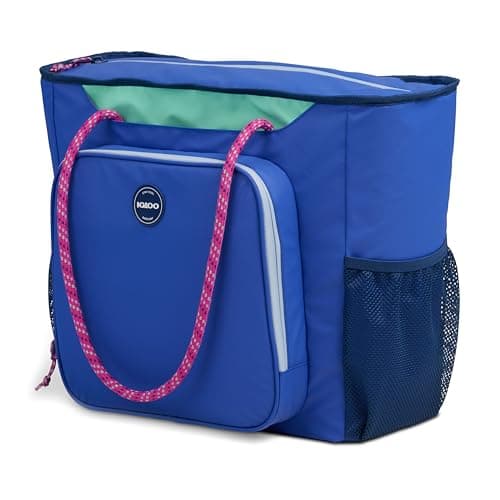
30 cans in a soft tote with a heat-sealed liner and an insulated quick-hatch lid, at 11.25 by 8.75 by 17.25 in.
Igloo publishes a 30-can capacity, exterior dimensions of 11.25 L by 8.75 W by 17.25 H in, a treated heat-sealed liner, an EVA grip bottom, an insulated quick-hatch lid and an adjustable shoulder strap.
The reason to own one of these is that it costs a fraction of a foam-walled soft cooler and holds three times as many cans for a similar footprint. It is the right tool for a day out and the wrong tool for a weekend of food.
The drawback
This is a cooler bag, not an insulated box. Igloo does not publish an insulation thickness, and a bag of this type holds cold for a day rather than overnight.
One to two days for a foam-walled soft cooler, and about a day for a lined cooler bag. They are day bags rather than replacements for a hard cooler, which is why makers publish ice weights of 16 lb against 37 lb for a comparable hard cooler.
QAre soft coolers worth it if I already have a hard cooler?
Yes, and that is the best case for one. Every opening of a hard cooler costs ice. A soft cooler packed each morning absorbs all the daily raiding, so the hard cooler stays shut and its ice lasts substantially longer.
QWhy is my soft cooler so big on the outside?
Insulation thickness. YETI's published exterior and interior dimensions differ by about 1.5 in per side, and RTIC publishes up to 1.5 in of closed-cell foam for the Ultra-Tough. That wall is what makes it hold cold, and it is why the interior is much smaller than the exterior suggests.
QShould I use ice or ice packs in a soft cooler?
Frozen water bottles are the best compromise: they hold cold close to as well as ice, do not flood the bag, and become drinking water. Gel packs are cleaner but hold less cold. Loose cubes work and flood the contents as they melt.
How we picked
Everyone else in this category will tell you they tested twenty of these. We have not tested any of them, and we would rather say so than pretend. There is no gear closet here and no test lab.
What we did instead: pulled the published specifications from each manufacturer's own spec sheet or manual, named the standard behind every rating so you can check what it actually promises, did the arithmetic that turns a spec into a decision, and pulled today's real retail price rather than quoting one from memory. Every pick states a drawback, because a list where nothing is wrong with anything is an advert.
The limits of that method, stated plainly: published specs do not capture zipper quality, seam durability, or how a tent behaves at 2am in a storm. Where that matters, we say so on the pick. The full method is here.