The Best Coolers with Wheels, and the Weight You Are Really Moving
A full 70-quart cooler weighs more than most people can carry. Wheels are not a luxury at that size, and wheel diameter decides whether they work on grass.
Ice weighs about 8 lb per gallon and a quart is a quarter of a gallon, so a 70-quart cooler filled two-thirds with ice is carrying roughly 90 lb of ice alone, before food and before the 20-odd pounds of empty cooler. A loaded 100-quart cooler is comfortably past 150 lb. That is a two-person lift at best, which is the entire reason wheels exist at this size.
Most people underestimate this because they think in quarts rather than pounds. It is also why the lid rating matters: Coleman publishes 250 lb for the Have-A-Seat lid, which is a genuine seat rather than a marketing line.
The other consequence is that a wheeled cooler is not a substitute for packing sensibly. If the cooler is the heaviest thing at the site, it should be the last thing in the car and the first thing out — see how to pack a car for camping.
Compared on published numbers
Cooler
Capacity
Wheels
Ice claim
Insulation
Weight
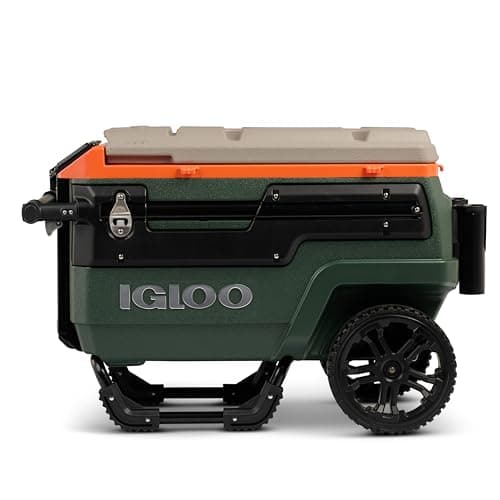
Igloo Trailmate Journey 70
70 qt / 112 cans
10 in never-flat
not published
THERMECOOL foam, body and lid
not published
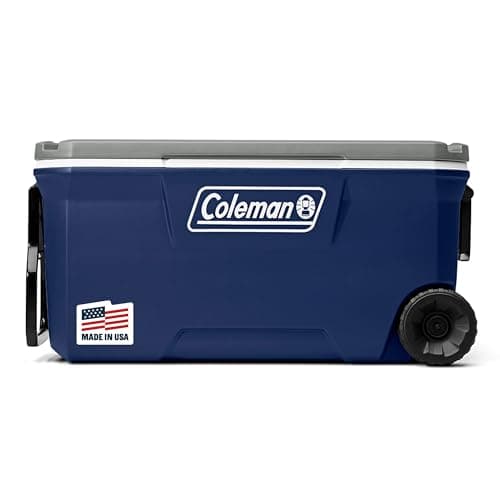
Coleman Classic 100 Wheeled
100 qt / 80 cans, 50 lb ice
6 in
up to 5 days at 90 F
TempLock FX, lid and body
not published
Figures as published by each manufacturer. Neither product page publishes an empty weight.
Wheel diameter decides where it goes
A wheel has to climb whatever it meets, and the smaller the wheel the steeper that climb is relative to its own radius. A 6 in wheel against a 2 in root is trying to climb a third of its diameter. A 10 in wheel barely notices the same root.
On sand the problem is different and it is about contact patch rather than diameter. A narrow hard wheel cuts in and you end up pushing a furrow; a wide wheel floats. Igloo publishing never-flat wheels rated for sand is a meaningful claim, and it is the reason to pay more if your camping involves beaches.
Coleman publishes up to 5 days at 90 F for the Classic 100 Wheeled. That figure comes from a cooler pre-chilled, filled to the maker's recommended ice ratio, closed, and left alone. Your cooler is opened twenty times a day, half full, and was loaded warm. Expect a fraction of the published number unless you actively manage it, and the things that make the biggest difference are in how long does ice last in a cooler.
What wheels cost you
Trunk space. Wheels and a telescoping handle add height and length to the same internal volume. A wheeled 70-quart takes noticeably more room than a static one.
Insulation, sometimes. The wheel wells intrude into the box on some designs, which is volume that is neither insulation nor storage.
Failure points. Axles, handle latches and telescoping tubes are the parts that break, and they are rarely repairable. A static cooler has nothing to fail.
Money. A wheeled cooler costs meaningfully more than the same capacity without wheels.
If your car parks on the pad and the kitchen is ten feet away, none of that is worth paying for. A static rotomolded box holds ice better per dollar — the options are in best coolers for camping.
Packing a wheeled cooler so it still works
Weight low and over the axle, exactly as with a wagon. A cooler loaded top-heavy tips when you tilt it onto the wheels, which is how lids pop and contents end up on the gravel.
Beyond that the rules are the same as any cooler: pre-chill it, use block ice rather than cubes for the base layer, fill air gaps, and keep drinks in a separate small cooler so the main box is not opened all day. The full routine is in how to keep food cold camping, and the day-bag approach is in best soft coolers for camping.
Which to buy
Buy the Igloo Trailmate Journey 70 if the cooler has to cross grass, sand or a walk-in site, because the 10 in wheels are doing something the alternatives cannot. Buy the Coleman Classic 100 Wheeled if you are feeding a large group on hard ground and capacity is the constraint.
And carry a drain hose adapter for either. Draining 50 lb of meltwater by tipping a cooler is how backs get hurt at campsites.
The picks in full
1. Best overall
Igloo Trailmate Journey 70 Qt
Igloo
70 qt on 10 in never-flat wheels with a telescoping steel handle, and THERMECOOL foam in the body and lid.
Igloo publishes a 70 qt / 66 L / 112-can capacity, 10 in never-flat wheels rated for sand and rough ground, a horizontal dual-trigger telescoping steel Glide handle, THERMECOOL foam insulation in body and lid, Cool Riser Technology raising the body off hot surfaces, and a lockable water-resistant compartment with an anti-leak gasket.
Ten-inch wheels are the specification that matters and the reason this is the pick. A small hard wheel against a tussock of grass or a tree root stops dead; a ten-inch wheel rolls over it. On sand, the larger contact patch is the difference between pulling and ploughing.
The drawback
Igloo does not publish a weight for it, and a cooler this tall with large wheels takes far more trunk space than its capacity suggests.
Published specs
Capacity
70 qt / 66 L / 112 cans
Wheels
10 in never-flat, rated for sand and rough ground
Handle
telescoping dual-trigger steel Glide handle
Insulation
THERMECOOL foam in body and lid
Base
Cool Riser Technology, body raised off hot surfaces
100 qt holding 80 cans and 50 lb of ice, with a lid rated to sit on at 250 lb and a published 5-day ice claim at 90 F.
Coleman publishes a 100 qt capacity holding up to 80 cans and 50 lb of ice, an ice claim of up to 5 days at 90 F, TempLock FX insulation in the lid and body, heavy-duty 6 in wheels with tow and swing-up handles, a Have-A-Seat lid rated to 250 lb with four cup holders, and a tethered leak-resistant drain plug.
A hundred quarts is more cooler than most groups need and it is the right answer for a large family over a long weekend, where the alternative is two coolers and two trips. Just be honest about the surface it will cross.
The drawback
6 in wheels. Loaded to capacity this is well over 100 lb on small wheels, which is fine on pavement and hard work on grass.
At 70 quarts and up, yes. Ice weighs about 8 lb per gallon, so a 70-quart cooler two-thirds full of ice carries roughly 90 lb of ice alone before food. That is a two-person lift. Below about 50 quarts, wheels mostly cost you trunk space.
QWhat size wheels should a camping cooler have?
As large as you can get if the ground is soft. A 6 in wheel against a 2 in root is climbing a third of its own diameter and stops; a 10 in wheel rolls over it. On sand, contact patch matters more than diameter, which is why never-flat wide wheels exist.
QHow much does a full cooler weigh?
More than people expect. Ice is about 8 lb per gallon, so a 70-quart cooler two-thirds full of ice is carrying roughly 90 lb of ice plus food plus the cooler itself. A loaded 100-quart is comfortably past 150 lb.
QDo wheeled coolers hold ice as well as regular ones?
Usually slightly less at the same external size, because wheel wells intrude into the box and take volume that is neither insulation nor storage. Published ice claims are lab figures from a pre-chilled, full, unopened cooler regardless of wheels.
How we picked
Everyone else in this category will tell you they tested twenty of these. We have not tested any of them, and we would rather say so than pretend. There is no gear closet here and no test lab.
What we did instead: pulled the published specifications from each manufacturer's own spec sheet or manual, named the standard behind every rating so you can check what it actually promises, did the arithmetic that turns a spec into a decision, and pulled today's real retail price rather than quoting one from memory. Every pick states a drawback, because a list where nothing is wrong with anything is an advert.
The limits of that method, stated plainly: published specs do not capture zipper quality, seam durability, or how a tent behaves at 2am in a storm. Where that matters, we say so on the pick. The full method is here.