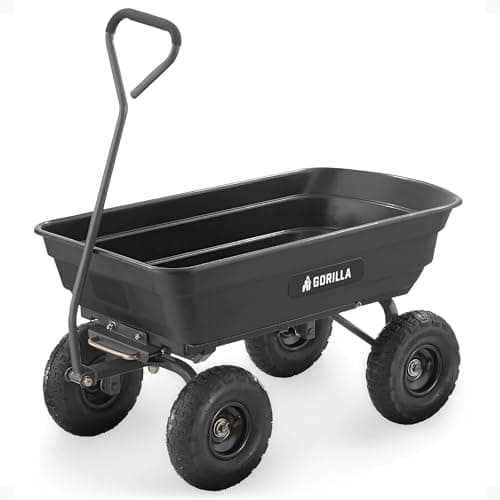
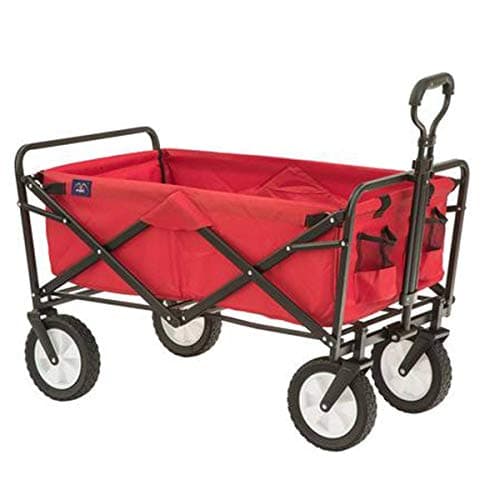
A hundred and fifty pounds covers a normal campground load, so for most trips capacity is not the differentiator. Wheel diameter and whether the tire is pneumatic are, because they determine whether the wagon rolls over a root and across soft ground or stops against it. Bigger wheels clear obstacles; air-filled tires spread load so they do not sink. Capacity only becomes the deciding number if you are hauling firewood and water rather than camp kit.
The physics is simple. A wheel has to climb an obstacle, and the smaller the wheel the steeper that climb is relative to its radius. A six-inch solid wheel against a two-inch root is trying to climb a third of its own diameter; a ten-inch pneumatic tire deforms around the same root and barely notices.
Sand is the other case, and it is about contact patch rather than diameter. A narrow hard wheel cuts in and you are then pushing a furrow. A wide, soft, slightly under-inflated tire floats over it, which is why beach carts use balloon tires.
Compared on published numbers
Cart
Capacity
Bed
Wheels
Weight
Folds
Mac Sports Collapsible Wagon
150 lb
32.5 x 17.5 x 10.5 in
small solid
about 24.5 lb
yes, to 29.5 x 20 x 8 in
Gorilla Carts GOR4PS
600 lb
36 x 20 in, 4 cu ft
four 10 in pneumatic
32 lb
no
Figures as published by each manufacturer.
Is a wagon worth the trunk space?
It depends almost entirely on one thing: how far your car parks from where the tent goes. At a drive-up site where the car is on the pad, a wagon is a luxury you will use twice. At a walk-in site a hundred yards from the lot, it turns four round trips into one and is the best purchase in the category.
The other case is beach and lakeside camping, where the distance is short but the surface is the problem. That is where the tire type stops being a detail.
A wagon with the weight over the wheels steers easily and pulls light. The same load pushed forward toward the handle puts that weight on your arm, and pushed to the back makes the handle lift. Put the cooler — almost always the heaviest single item — centered over the axle first, then build around it. This costs nothing and is the difference between a wagon that feels effortless and one that feels like a chore, especially on a slope.
Features that matter and features that do not
A removable or washable liner. Matters. The wagon carries firewood, coolers that leak and muddy boots, and a bed you can hose out lasts longer.
A quick-release dump. Matters more than it sounds for firewood and gravel, and not at all if you only carry bins.
Brakes. Genuinely useful on any site with a slope, and absent from most folding wagons.
Cup holders and side pockets. Do not matter. This is a thing that carries your gear a hundred yards twice a day.
A canopy. Only relevant if the wagon is carrying a small child rather than gear, which is a different purchase with different safety requirements.
Pneumatic tires have one maintenance job
They go flat in storage, and always between the trip where you last used the cart and the trip where you need it. Check pressure before loading the car rather than at the campground, and keep a small hand pump with a gauge with the cart.
Slightly under-inflating for sand is a real technique and worth knowing: dropping pressure widens the contact patch and stops the tire cutting in. Re-inflate for pavement, where an under-inflated tire rolls heavily and wears at the sidewall.
Which to buy
Buy the Mac Sports collapsible wagon if the surface is gravel, pavement or firm grass and trunk space is the constraint, which describes most campground camping. Buy the Gorilla Carts GOR4PS if you cross sand, soft ground or roots, or if you are moving firewood and water in quantity, and accept that it lives in the garage rather than the trunk.
The picks in full
1. Best overall
Mac Sports Collapsible Utility Wagon
Mac Sports
150 lb capacity over a 32.5 by 17.5 in bed, folding to 29.5 by 20 by 8 in with a carry case.
The listing publishes a 150 lb capacity, inside dimensions of about 32.5 by 17.5 by 10.5 in, outside dimensions of 35.5 by 20.2 by 22.5 in, a folded size of 29.5 by 20 by 8 in with a carry case, a steel frame with UV- and mildew-resistant 600 denier polyester, and model number WTC-109. Treat the weight as approximate: the bullets say 24.5 lb while the specification table says 10.2 kg, which is about 22.5 lb.
Mac Sports is not consistent about capacity, and it is worth knowing before you load it. Its Classic Wagon page claims 300 lb, its own two-tone page for the same wagon body claims 150 lb, and this listing publishes 150 lb in both the title and the specification table. The lower figure is the one used here.
The folded size is the specification that sells it. Collapsing to eight inches thick means it slots down the side of a loaded trunk rather than competing for the main space, and a wagon that does not fit in the car is a wagon that stays at home.
The drawback
Small hard wheels. On gravel and pavement it is excellent; on sand, deep grass or root-crossed ground it digs in and you end up dragging rather than pulling.
Published specs
Capacity
150 lb
Interior
about 32.5 x 17.5 x 10.5 in
Open size
35.5 x 20.2 x 22.5 in
Folded size
29.5 x 20 x 8 in, with a carry case
Weight
24.5 lb per the listing bullets; its spec table says 10.2 kg, about 22.5 lb
Build
steel frame with UV- and mildew-resistant 600 denier polyester
Model
WTC-109
Note
Mac Sports contradicts itself on capacity: its Classic Wagon page claims 300 lb while its two-tone page for the same wagon body claims 150 lb. This listing publishes 150 lb in both the title and the spec table, so that is the figure used
600 lb capacity on four 10 in pneumatic tires, with a 36 by 20 in poly bed and a quick-release dump.
Gorilla Carts publishes a 600 lb capacity, a 36 by 20 in rust-proof poly bed at 4 cubic feet, a 32 lb weight, a 19.5 in height, four 10 in pneumatic tires, a patented quick-release dump and a padded pull handle.
Ten-inch pneumatic tires are the reason to choose this over a folding wagon. An air-filled tire deforms around an obstacle and spreads load over a larger contact patch, which is what lets it cross sand and roots that stop a small solid wheel dead.
The drawback
32 lb and it does not fold. This is a cart that lives in a garage or a truck bed, not something you tuck beside the cooler.
It depends on how far the car parks from the pitch. At a drive-up site, a wagon is a luxury you use twice. At a walk-in site a hundred yards away, it turns four round trips into one and is the best purchase in the category.
QWhat size wheels should a camping wagon have?
As large as you can accept, and pneumatic if the ground is soft. A small solid wheel against a two-inch root is climbing a third of its own diameter; a 10 in air-filled tire deforms around it. On sand, contact patch matters more than diameter.
QHow much can a camping wagon carry?
Enough for a campground load, though less than some listings imply. This Mac Sports listing publishes 150 lb and Gorilla Carts publishes 600 lb, and Mac Sports' own site muddies it further by claiming 300 lb for the same wagon elsewhere. A normal camping load sits inside 150 lb, so choose on wheels, folded size and bed dimensions rather than on capacity - unless you are moving firewood and water, where the margin starts to matter.
QHow should I load a camping wagon?
Heaviest item centered over the axle first, then build around it. Weight pushed forward toward the handle ends up on your arm and weight at the back lifts the handle. This matters most on a slope and costs nothing to get right.
How we picked
Everyone else in this category will tell you they tested twenty of these. We have not tested any of them, and we would rather say so than pretend. There is no gear closet here and no test lab.
What we did instead: pulled the published specifications from each manufacturer's own spec sheet or manual, named the standard behind every rating so you can check what it actually promises, did the arithmetic that turns a spec into a decision, and pulled today's real retail price rather than quoting one from memory. Every pick states a drawback, because a list where nothing is wrong with anything is an advert.
The limits of that method, stated plainly: published specs do not capture zipper quality, seam durability, or how a tent behaves at 2am in a storm. Where that matters, we say so on the pick. The full method is here.