Your vehicle has a dynamic roof load rating in the owner's manual, commonly 100 to 165 lb on cars and crossovers, and it includes the crossbars and the box itself. A 41 lb box on a 150 lb roof leaves 109 lb of gear, not 165. Both boxes here publish a 165 lb load capacity, and on most vehicles that figure is unreachable.
Do the subtraction before you buy: roof rating, minus crossbars (typically 10 to 15 lb), minus the box, is what you can load. That is usually enough for sleeping bags, pads, chairs, clothing and a tent, and it is not enough for water, a cooler, firewood or tools.
This is why the standing advice is to put bulky light things up top and heavy things low in the vehicle. It is also better for handling: weight at roof height raises the center of gravity noticeably, and the effect on a crosswind or an emergency swerve is not subtle.
Compared on published numbers
Box
Capacity
Box weight
Load rating
Dimensions
Opening
Thule Force XT L
16 cu ft / about 453 L
41 lb
165 lb
74.75 x 33 x 18 in
dual side, locking
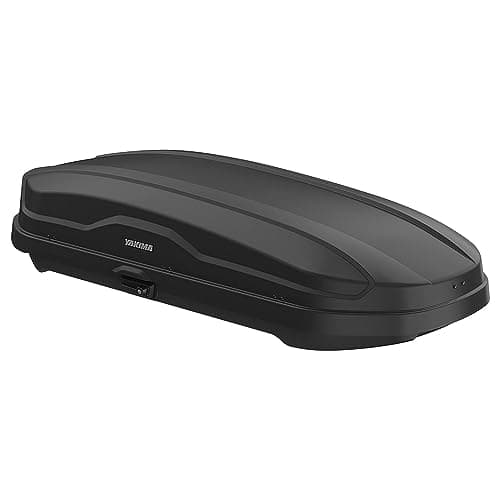
Yakima SkyBox 16 Carbonite
16 cu ft
47 lb
165 lb
81 x 36 x 15 in
dual side, SuperLatch one-handed
Figures as published by each manufacturer. The usable load is your vehicle roof rating minus bars and box.
Measure three things before you order
Crossbar spread. The distance between the bars, front to back. Yakima publishes 24 to 42 in for the SkyBox 16. Under the minimum, the box cannot be mounted safely.
Rear hatch clearance. Open the tailgate and check whether an 81 in box mounted where the bars are will be hit by it. This is the most common post-purchase surprise.
Total height. Vehicle height plus bars plus box. Write the number on something on the dashboard, because parking garages, drive-throughs and some campground entrances are lower than you think.
A roof box changes how the car drives
Expect a meaningful drop in fuel economy, more wind noise, and noticeably more sensitivity to crosswinds on exposed highway. Raising the center of gravity also lengthens the weight transfer in a swerve, which matters most on tall vehicles that are already prone to it. None of this is a reason not to use one; it is a reason to take the box off between trips rather than leaving it on all year, and to drive a little more conservatively when it is on.
Hard box, soft bag or hitch carrier
A hard box is lockable, aerodynamic and weatherproof, and it costs the most and needs somewhere to live in the off-season. It is the right answer if you will use it several times a year.
A soft roof bag is a fraction of the price, folds into a cupboard, and needs a roof rack or crossbars underneath it. It is less weatherproof at highway speed in sustained rain, and nothing in it is secure.
A hitch-mounted cargo carrier avoids the roof entirely, which keeps the center of gravity low and the load at waist height rather than overhead. It needs a hitch receiver, it can block the tailgate, and the tongue weight limit is the constraint rather than the roof rating.
Packing a roof box so it survives the drive
Load it so nothing can move. A box with room to slide will shift every corner, which loosens the mounts over a long drive and is audible from inside the car. Fill gaps with soft items, and put anything hard against the ends rather than loose in the middle.
Keep soft, bulky and light up top: sleeping bags, pads, pillows, clothing, the tent body. Keep water, coolers, tools, stoves and firewood in the vehicle. The rest of the loading logic is in how to pack a car for camping, and a cargo net or straps inside the box is the cheap way to stop things migrating.
Which to buy
Buy the Thule Force XT L if your roof rating is tight, because 41 lb of box leaves six more pounds of gear than the Yakima. Buy the Yakima SkyBox 16 Carbonite if your crossbars sit close together or you regularly load with one hand full, and check the 81 in length against your tailgate first.
If what you need is more organized space rather than more space, bins in the vehicle solve it for a fraction of the cost — see best gear storage bins.
The picks in full
1. Best overall
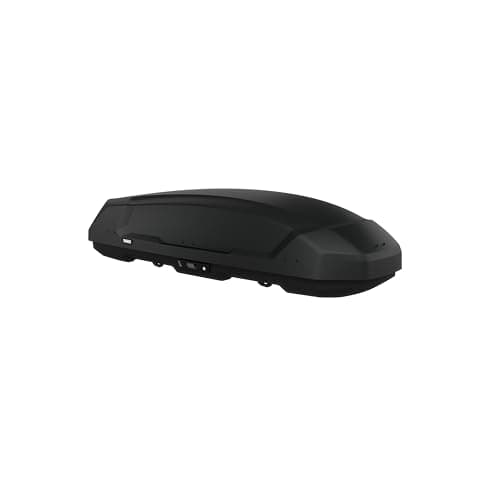
Thule Force XT L
Thule
16 cubic feet at 41 lb, rated to a 165 lb load, with dual-side locking opening.
Thule publishes a 16 cubic foot capacity, about 453 L, a box weight of 41 lb, a 165 lb load capacity, external dimensions of 74.75 by 33 by 18 in, internal dimensions of 70 by 28.75 by 16.25 in, and a locking dual-side opening.
Six pounds lighter than the Yakima for the same 16 cubic feet is the headline, and it matters twice: once when you are lifting it onto the roof alone, and again because every pound of box is a pound off what you can put inside it.
The drawback
74.75 in long. On a shorter vehicle that can overhang the windshield or foul a rear hatch, and there is nowhere to put a box this size in a garage.
16 cubic feet with a SuperLatch one-handed locking system and a 24 to 42 in crossbar spread.
Yakima publishes a 16 cubic foot capacity, a box weight of 47 lb, a 165 lb load capacity, dimensions of 81 by 36 by 15 in, dual-side opening with the SuperLatch one-handed locking system, and compatibility with crossbar spreads from 24 to 42 in.
The 24 in minimum crossbar spread is the specification to check against your own roof. Small cars and some crossover factory rails sit closer together than boxes expect, and a box that will not mount is an expensive mistake that a tape measure prevents.
The drawback
47 lb, six more than the Thule for the same volume, and at 81 in it is the longest box here by a clear margin.
Your vehicle roof rating minus the crossbars minus the box, not the box's own load rating. A 150 lb roof rating with 12 lb of bars and a 41 lb box leaves about 97 lb of gear, even though both boxes here publish a 165 lb capacity.
QWhat should I put in a roof box when camping?
Bulky light things: sleeping bags, pads, pillows, clothing, the tent body. Keep water, coolers, stoves, tools and firewood low in the vehicle, both because of the roof weight limit and because weight at roof height raises the center of gravity.
QDoes a roof box affect fuel economy?
Yes, noticeably, along with more wind noise and more sensitivity to crosswinds. That is the argument for taking the box off between trips rather than leaving it mounted all year.
QWill a roof box fit my car?
Check three things: crossbar spread against the box's published range, which is 24 to 42 in for the Yakima SkyBox 16; rear hatch clearance with the tailgate open; and total height with the box fitted, for garages and drive-throughs.
How we picked
Everyone else in this category will tell you they tested twenty of these. We have not tested any of them, and we would rather say so than pretend. There is no gear closet here and no test lab.
What we did instead: pulled the published specifications from each manufacturer's own spec sheet or manual, named the standard behind every rating so you can check what it actually promises, did the arithmetic that turns a spec into a decision, and pulled today's real retail price rather than quoting one from memory. Every pick states a drawback, because a list where nothing is wrong with anything is an advert.
The limits of that method, stated plainly: published specs do not capture zipper quality, seam durability, or how a tent behaves at 2am in a storm. Where that matters, we say so on the pick. The full method is here.