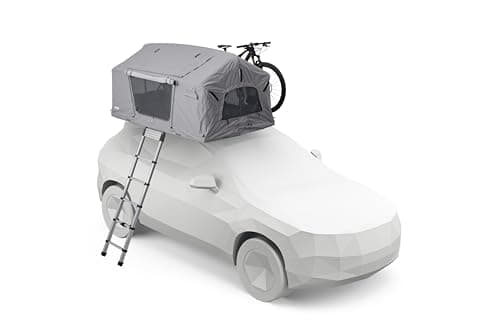
Check the roof rating first. Most people should stop here
The short answer
Your vehicle has two roof ratings. The dynamic rating is what the roof can carry while driving, and it is commonly around 100 to 165 lb on a normal car or crossover. The static rating — parked, with people in the tent — is far higher. The tents below weigh 108 and 117 lb before the rack. Add a 40 lb crossbar set to a 117 lb tent and you are over the dynamic limit of a great many vehicles with nobody in it.
The numbers live in the owner's manual and on the rack maker's fit guide, and they are not suggestions: exceeding the dynamic rating affects handling, braking and rollover behavior on a vehicle whose center of gravity you have just raised significantly. The rack has its own separate limit, and the lower of the two applies.
This is why rooftop tents cluster on trucks, 4x4s and vans rather than on family crossovers. If your dynamic rating is 100 lb, no tent on this page fits your vehicle, and the honest answer is a ground tent — best car camping tents.
Compared on published numbers
Tent
Sleeps
Closed size
Open size
Weight
Capacity
Thule Foothill
2
83 x 24 x 9.5 in
84 x 47 x 40 in
108 lb
400 lb static
Smittybilt Overlander 2783
2-3
56 x 47 x 11 in
56 x 95 x 51 in
117 lb (132 packed)
661 lb
Figures as published by each manufacturer or its listing.
The closed width is the specification to read against your rack, not the weight. Twenty-four inches leaves room beside it; 56 in does not. Everything else about living with a rooftop tent follows from that one number.
What you actually gain
A permanent bed. The mattress stays in the tent when it folds, along with the bedding in most cases. Arrival means unclipping a cover and unfolding, and departure is the reverse. No pad to inflate, ever.
Level ground, always. The roof of a car is flat. Rocks, roots, slope and puddles stop being site-selection criteria, which is the same argument a hammock makes.
Being off the ground. Dry in standing water, away from insects and ground-level wildlife curiosity, and considerably warmer than a floor that conducts heat away all night.
Setup speed. Genuinely a few minutes, and unaffected by wind or rain in a way that pitching a ground tent is not.
What it costs you, beyond money
These are the trade-offs that a spec sheet hides and that owners discover in month two.
The trade
What it means day to day
The car is the tent
Any trip into town packs up camp. You cannot leave a pitched site and drive somewhere.
Fuel economy and noise
A 108 lb box on the roof is aerodynamic drag at every speed, all year, unless you remove it.
Mounting is a two-person job
117 lb lifted above head height. Most owners leave it on permanently, which is why the drag matters.
Night trips down a ladder
Trivial for adults, a genuine consideration with small children or anyone unsteady.
Garage clearance
A closed tent adds 9.5 to 11 in of height. Measure the garage door and the parking structure.
Our summary of the practical trade-offs, drawn from the published dimensions.
Condensation happens up there too
A rooftop tent is a fabric shelter with people breathing in it, so it condenses exactly like a ground tent, and the foam mattress traps that moisture underneath where you cannot see it. Leave the windows cracked, and air the mattress on a dry day rather than folding a damp tent shut and driving home — mildew in a permanently installed mattress is not something you can wash out. The mechanism is in how to stop tent condensation.
Soft shell versus hard shell
Both tents here are soft shells: fabric that folds over a hinge, with a cover. Hard shells use a rigid lid that lifts on gas struts, open faster, are quieter at speed and generally weigh more and cost considerably more for less floor area.
For a first rooftop tent a soft shell is the sensible buy, because the fold-out design gives you far more sleeping area per pound, and the extra two minutes of setup is not what makes or breaks a trip. The denier figure is the durability proxy worth reading: the Smittybilt's 600D ripstop polyester is typical of the category.
What the specifications do not tell you
Nobody publishes a fabric waterproof rating in millimeters for either of these, which is standard in this category and unhelpful. On a ground tent you would compare hydrostatic head; here you cannot, so the rain fly design and seam sealing are what to inspect.
Nobody publishes a wind rating either. A tent 7 ft in the air is in considerably more wind than one on the ground, and parking nose-into the wind matters more than any specification.
Which to buy
Buy the Thule Foothill if you have one vehicle and need the rest of the roof, or if your rack budget is tight enough that 108 lb versus 117 lb matters. It is two people and no more.
Buy the Smittybilt Overlander 2783 if the vehicle can carry it and you want the most sleeping area and the thickest mattress for the money, and you accept losing the whole roof.
Buy neither until you have read your dynamic roof rating and your rack's limit. If either number is under about 150 lb, a fast-pitching ground tent plus a thick self-inflating mattress delivers most of the comfort for a fraction of the price and none of the drag.
The picks in full
1. Best overall
Thule Foothill
Thule
A 2-person tent that folds to 24 in wide, 108 lb, with an 84 by 47 in sleeping footprint and a 400 lb static rating.
Thule publishes a 2-person capacity, an open size of 84 by 47 by 40 in, a closed size of 83 by 24 by 9.5 in, an 84 by 47 in sleeping footprint, a 38 in peak interior height, a 108 lb weight and a 400 lb static weight capacity.
The 24 in closed width is the entire reason to buy this one. Most rooftop tents fold like a hamburger and occupy the whole roof; this folds lengthwise and takes up about half of a standard rack, leaving the other half for a kayak, a cargo box or a bike. For anyone with one vehicle and more than one hobby, that is the deciding feature.
A 38 in peak height means sitting up, not kneeling comfortably. Read it the same way you read a ground tent's center height — see what size tent do I need.
The drawback
108 lb on the roof, and 400 lb static is the lowest capacity here. Two adults plus bedding approaches it, and a third person is out of the question.
A 56 by 95 in footprint sleeping 2 to 3, with a 2 in foam mattress and a 661 lb load capacity.
Smittybilt publishes a 2 to 3 adult capacity, an open size of 56 by 95 by 51 in, a closed size of 56 by 47 by 11 in, a 117 lb weight (132 lb packed), a 661 lb load capacity, a 2 in high-density foam mattress, 600D ripstop polyester, and an anodized aluminum ladder extending to 6.8 ft rated to 265 lb. An annex, rain fly, LED strip and mosquito net are included.
The 661 lb load capacity and the 2 in foam mattress are what separate this from the Thule in use. A rooftop tent's mattress is the reason people buy them — it is permanently installed, it does not deflate, and it is thicker than most sleeping pads.
The cost is bulk. At 56 in wide closed it eats the roof, and at 117 lb it is genuinely difficult to mount without two people and a plan.
The drawback
117 lb, 132 lb packed, and it folds across the full roof at 56 in wide. That is most of a rack, most cars cannot carry it, and two people are needed to lift it up there.
Check the dynamic roof load rating in the owner's manual, and the rack's own limit; the lower of the two applies. Dynamic ratings on normal cars and crossovers are commonly around 100 to 165 lb, and the tents here weigh 108 and 117 lb before you add 40 lb of crossbars. Many vehicles simply cannot carry one legally or safely.
QWhat is the difference between static and dynamic roof load?
Dynamic is what the roof can carry while the vehicle is moving, and it is the limit that matters when choosing a tent. Static is what it holds parked, with people inside, and it is far higher. A tent rated 400 lb static is describing the tent's own capacity with occupants, not your car's.
QAre rooftop tents worth it?
If you camp often, move sites frequently, and own a vehicle rated to carry one. You get a permanent mattress, a level pitch anywhere and a few-minute setup. You give up the ability to leave camp without packing up, some fuel economy year-round, and considerably more money than a ground tent and a thick pad.
QSoft shell or hard shell rooftop tent?
Soft shell for a first purchase. Fold-out soft shells give far more sleeping area per pound and cost much less; hard shells open faster, are quieter at highway speed and weigh more for less floor. The extra two minutes of setup is rarely what decides a trip.
How we picked
Everyone else in this category will tell you they tested twenty of these. We have not tested any of them, and we would rather say so than pretend. There is no gear closet here and no test lab.
What we did instead: pulled the published specifications from each manufacturer's own spec sheet or manual, named the standard behind every rating so you can check what it actually promises, did the arithmetic that turns a spec into a decision, and pulled today's real retail price rather than quoting one from memory. Every pick states a drawback, because a list where nothing is wrong with anything is an advert.
The limits of that method, stated plainly: published specs do not capture zipper quality, seam durability, or how a tent behaves at 2am in a storm. Where that matters, we say so on the pick. The full method is here.