Car camping means the tent never goes further than the walk from a parking space. That single fact changes which specs matter, and it makes most of the tent industry's marketing irrelevant to you.
Weight stops mattering and space starts mattering, so buy roughly twice the capacity you need. Two people in a tent sold as a 4-person get about 31 square feet each and room for their bags. Two people in a 2-person tent get about 15 square feet each and sleep with their gear on their legs.
Nearly all tent marketing is written for a buyer who carries the tent. That buyer cares about packed weight, pole diameter and grams per square foot. You are not that buyer. Your tent is going to travel in a car and be carried the distance from a parking bay to a numbered pitch, which means the specs worth reading are floor area, height, door count and how quickly it goes up.
Tent
Floor
Peak height
Packed weight
Setup
Coleman Sundome 4
9 x 7 ft (63 sq ft)
4 ft 11 in
about 10 lb
poles and sleeves
Coleman Skydome 4
8 x 7 ft (56 sq ft)
56 in
10 lb 15 oz
poles and clips
CORE 6 Person Instant Cabin
11 x 9 ft (99 sq ft)
72 in
27 lb
from 60 seconds
Kelty Wireless 6
86.5 sq ft
74 in
19 lb
poles and clips
All figures as published by the manufacturers.
Doors and vestibules beat square feet
Once you are past about 25 square feet per person, extra floor stops improving the trip and two other things start to. The first is a second door, so nobody has to climb over a sleeping person at 3am. The second is a vestibule: covered ground outside the inner tent, under the fly, where boots and the cooler sit out of the rain. The Kelty here publishes 39 square feet of vestibule across two doors, which is more covered storage than the entire floor of a small backpacking tent.
Setup speed is a real spec, not a marketing one
The published setup times are honest in direction if not in precision. A hub-frame instant tent genuinely goes up in a couple of minutes because the poles stay attached; a pole-and-sleeve dome genuinely takes ten to fifteen the first few times you do it. What you are trading is packed size and weight, and the trade is worth making if you often arrive after dark or with small children who need the tent to exist immediately.
The counter-argument, honestly stated: instant frames have more moving joints, and joints are what break. We have not tested any of these tents to failure and will not pretend otherwise. Read the instant vs traditional comparison for the full trade-off.
Fit it to your car, not your campsite
A 48 in packed bag does not fit across most sedan trunks, and once it is in diagonally it costs you the space a cooler needed. Measure the trunk before you buy the biggest tent you can afford. Our car camping guide covers packing order, and the car camping checklist is what to put in it.
What we did not test
Nothing here has been pitched by us in a storm, left out for a season, or taken apart to check the seams. Every number above comes from a manufacturer's published specification. What we have done is convert those numbers into the decisions they affect: area per person, height against standing room, packed length against a trunk.
The picks in full
1. Best overall for two people
Coleman Sundome 4-Person Tent
Coleman
63 square feet for two people, which is the ratio that turns a tent from a shelter into a room.
Coleman lists 9 by 7 ft, so 63 square feet, and says it fits one queen airbed. For two people that is 31 square feet each, generous enough that bags, a lantern and a pair of boots all fit inside without anyone lying on them. Buying a 4-person tent for two people is the single easiest upgrade in camping, and it costs almost nothing.
The 4 ft 11 in center height is the real compromise. You can sit upright anywhere in the middle of the tent; you cannot stand. At around 10 lb it is light enough to pitch alone in a few minutes.
The drawback
The 4 ft 11 in center height means nobody stands up in this tent. It is a sit-up-and-shuffle design.
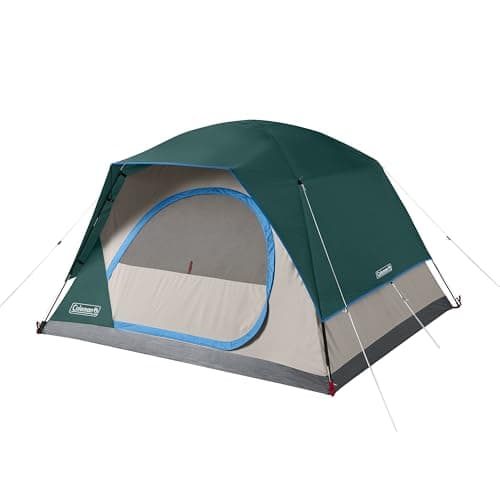
Smaller floor than the Sundome but a full-fly vestibule, which is where wet gear goes instead of your sleeping area.
Coleman publishes 8 by 7 ft, 56 square feet, with a 56 in peak height and a packaged weight of 10 lb 15 oz. The version worth buying is the one with the full-fly vestibule: a rainfly that reaches the ground and creates covered space outside the door.
That matters more than it sounds. In sustained rain, the difference between a tent you tolerate and a tent you resent is whether there is anywhere dry to leave boots, and whether you can open the door without rain landing on your sleeping bag.
The drawback
56 square feet is a real step down from the Sundome 4's 63, and the 56 in peak is barely taller. You are paying for the fly, not the space.
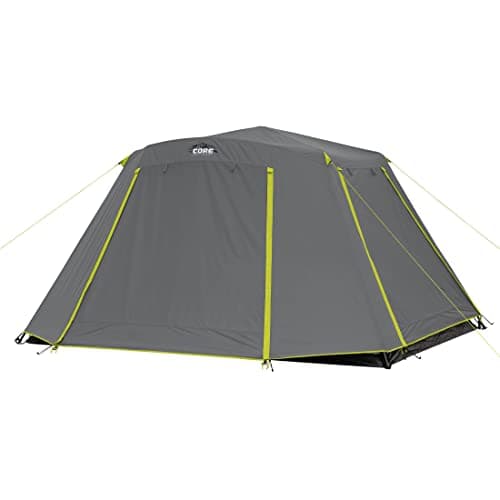
99 square feet, 72 in of height, and CORE quotes setup from 60 seconds because the poles never leave the tent.
The pre-attached hub frame is the entire argument. Every tent on this page is straightforward to pitch in daylight in calm conditions; the differences show up at 9pm in wind with a flashlight in your teeth. CORE lists 11 by 9 ft with a 72 in center height and, refreshingly, publishes the honest capacity as “3 + gear” alongside the 6-person industry figure.
Fabric is listed as 68D polyester at 1200 mm hydrostatic head with a taped full rainfly.
The drawback
27 lb, and the packed bag is 48 in long. It is a genuine two-hands carry and it eats trunk space that a folded dome tent would not.
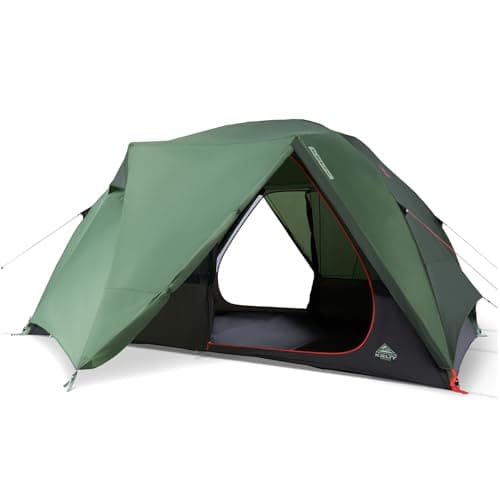
86.5 square feet, two doors, and 39 square feet of vestibule across both sides.
Buying a 6-person tent for two people sounds absurd until you have spent a wet weekend in a 2-person one. Kelty publishes 117.5 by 106 in of floor, a 74 in peak and two 19.5 square foot vestibules. Two doors means the second person is not climbing over the first at night, which is a bigger quality-of-life difference than any fabric spec.
The weight penalty against the Sundome 4 is about 9 lb, and it never has to be carried more than a hundred feet.
The drawback
Fiberglass poles and 19 lb packed. It is the most tent here by volume and not the most tent by pole quality.
Yes, and it is the right size for most pairs. A 4-person tent at about 63 square feet gives two people roughly 31 square feet each, which is enough for two sleeping pads, two bags and gear inside the tent rather than under your legs.
QAre cheap tents worth it for car camping?
For car camping, largely yes. The weaknesses of budget tents are weight, pole quality and wind performance, and only the last of those affects a campground pitch in a decent forecast. Where cheap tents cost you is in a real storm and over years of use.
QDo you need a tent footprint for car camping?
It is optional. A footprint protects the floor from abrasion on gravel pitches and keeps the packed tent cleaner. It does not make a tent more waterproof, and cut wrong it can actively collect water under the tent.
QWhat tent is best for heavy rain?
A tent with a full-coverage rainfly that reaches close to the ground, taped seams, and a vestibule big enough to store wet gear outside the sleeping area. Full-fly coverage matters more than a higher hydrostatic head number on the fabric.
How we picked
Everyone else in this category will tell you they tested twenty of these. We have not tested any of them, and we would rather say so than pretend. There is no gear closet here and no test lab.
What we did instead: pulled the published specifications from each manufacturer's own spec sheet or manual, named the standard behind every rating so you can check what it actually promises, did the arithmetic that turns a spec into a decision, and pulled today's real retail price rather than quoting one from memory. Every pick states a drawback, because a list where nothing is wrong with anything is an advert.
The limits of that method, stated plainly: published specs do not capture zipper quality, seam durability, or how a tent behaves at 2am in a storm. Where that matters, we say so on the pick. The full method is here.