Inexpensive tents cut cost in four places: fly coverage, pole material, fabric weight and zipper quality. Only the first two reliably ruin a trip. A partial fly and fiberglass poles are the compromises to interrogate. Heavier fabric and a stiff zipper are annoyances you will live with for years.
Fly coverage comes first because it decides whether rain reaches you. A full-coverage fly runs close to the ground and creates a vestibule; a partial fly covers the roof and leaves mesh upper walls exposed. In still rain that works. In wind-driven rain it does not, and no amount of seam sealer fixes geometry.
Pole material is second because it decides whether a failure is recoverable. Aluminum bends and can be splinted with a sleeve and tape. Fiberglass splinters, and a splintered pole usually means driving home.
Compared on published numbers
Tent
Sleeps
Floor area
Weight
Poles
Fly rating
Coleman Sundome 4
4 listed / 2 real
63 sq ft
about 10 lb
fiberglass
not published
Coleman Sundome 3
3 listed / 2 real
49 sq ft
about 9 lb
fiberglass
not published
Kelty Late Start 2P
2
30.6 sq ft
4 lb 12 oz
aluminum
1200 mm
Naturehike Cloud Up 2
2
82.7 x 49.2 in
about 3.04 lb
7001 aluminum
3000 mm+ fly, 4000 mm+ floor
Figures as published by each manufacturer. Coleman does not publish hydrostatic head figures for these models.
What a cheap tent will not have
Factory-taped fly seams. Floors are usually taped; flies often are not at this price. A tube of seam sealer applied at home before the first trip is a 20-minute job that changes how the tent performs.
Usable stakes. The included wire stakes bend on the first root. Replacing them is the cheapest meaningful upgrade in camping.
Enough guy points. Budget tents give you two or four, and they are the difference between a tent that stands in wind and one that flexes all night. Use every one.
A footprint. Almost never included, and on 20D fabric it stops being optional — see do you need a tent footprint.
Pitch it in the yard before you take it anywhere
Every cheap tent has one part that arrives wrong: a missing stake bag, a pole section that will not seat, a fly with the guy lines uncut. Finding that on the lawn on a Tuesday costs you nothing. Finding it at a campsite at dusk in the rain costs you the weekend. Pitch it, check the parts against the instructions, seam-seal the fly, and pack it back properly. The first-time routine is in how to set up a tent for the first time.
Used is often the better budget
A three-year-old mid-range tent is usually a better buy than a new entry-level one, because the parts that fail on cheap tents — poles, zippers, fly coating — are the parts mid-range tents build properly and which do not wear out quickly.
Check the fly for a sticky or flaking polyurethane coating, work every zipper end to end, and count the pole sections against the sleeves. What to inspect is in how to buy used camping gear. If the tent is fine but the stakes are not, a set of proper aluminum stakes is a five-dollar fix for the most common failure.
Which to buy
Buy the Sundome 4 for a first car camping tent and accept the partial fly. Buy the Sundome 3 if the price is the whole constraint and it is two of you. Buy the Kelty Late Start 2P if there is any chance you will carry it. Buy the Naturehike Cloud Up 2 if weight is the argument and you will be careful with 20D fabric.
And if the budget is tight but the trip is wet, spend the difference on the fly rather than the floor space — the tents that keep people dry are in best tents for rain.
The picks in full
1. Best budget car camping tent
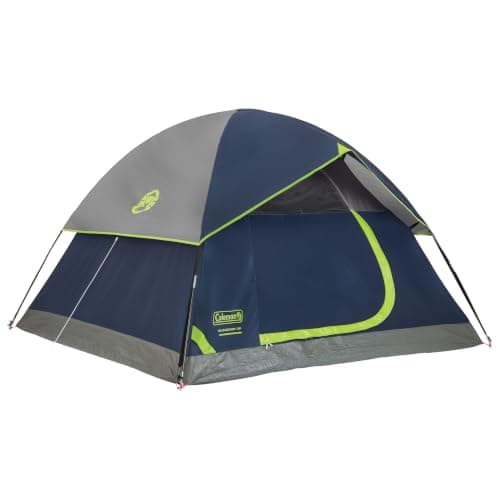
Coleman Sundome 4-Person Tent
Coleman
63 sq ft of floor at about 10 lb, from a line stocked widely enough that spare parts are genuinely findable.
Coleman publishes a 9 by 7 ft floor, a 4 ft 11 in center height and about 10 lb, with room for a queen airbed. Nothing about it is clever. Everything about it works, and replacement poles and flies sit on a shelf in most sporting goods stores in the country.
For a first tent that is worth more than any specification. A tent you can repair on a Saturday morning outlives a better tent you cannot.
The drawback
A partial roof fly rather than full coverage. In driven rain the exposed mesh walls pass spray, and there is no vestibule for boots.
49 sq ft at 7 by 7 ft with a WeatherTec tub floor, at about 9 lb.
Coleman publishes a 7 by 7 ft floor at 49 sq ft, a 4 ft 4 in center height, a weight of about 9 lb, a WeatherTec tub-style floor, a three-season rating and room for one queen airbed.
The tub floor is the feature to note at this price. A floor that curves up the sides before the seam means the seam sits above standing water rather than in it, which is the single most common way cheap tents leak.
The drawback
A 4 ft 4 in ceiling is the lowest here, and 49 sq ft is genuinely tight for two adults with gear once a queen airbed goes in.
4 lb 12 oz packaged on aluminum poles with a 1200 mm fly, which is a real backpacking tent rather than a car tent with a small footprint.
Kelty publishes a 4 lb 12 oz packaged weight, 4 lb 5 oz minimum, 30.6 sq ft of floor, a 7.4 sq ft vestibule, 89 by 54 by 42.5 in dimensions, 68D polyester rated 1200 mm and aluminum poles.
Aluminum poles at this price is the point. Aluminum bends before it breaks and can be splinted in the field; fiberglass splinters. On a tent you carry, that difference is worth more than an ounce saved anywhere else.
The drawback
30.6 sq ft of floor and a 42.5 in peak. It is a two-person tent for two people who like each other, and the single 7.4 sq ft vestibule is small.
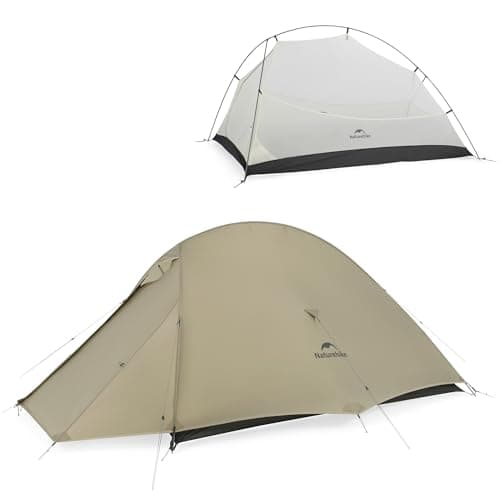
About 3.04 lb minimum with 20D silicone-coated nylon rated 3000 mm+ on the fly and 4000 mm+ on the floor, on 7001 aluminum poles.
Naturehike publishes about 1.38 kg minimum and 1.8 kg packed, a 210 by 125 by 105 cm pitched size, a 12 by 45 cm packed size, a 20D nylon ripstop fly with silicone and PU to 3000 mm+, a 20D floor to 4000 mm+, and 7001 one-piece aluminum poles.
Those are unusually good numbers for the money, and the reason is denier: 20D fabric is roughly a third the thread weight of the 68D used on the car camping tents here. It is lighter, and it will not take the same abuse.
The drawback
One door and one vestibule, and a 41.3 in peak. 20D fabric is thin enough that a groundsheet stops being optional.
For summer campground use, yes. The compromises that matter are fly coverage and pole material; heavier fabric and stiffer zippers are annoyances rather than trip-enders. Interrogate whether the fly reaches the ground and whether the poles are aluminum.
QWhat is the cheapest tent that will keep me dry?
One with a full-coverage rainfly, a tub-style floor and seam-sealed fly seams. Fly geometry beats any waterproof rating: a partial roof fly over mesh walls passes wind-driven rain no matter how high the millimeter figure is.
QAre fiberglass tent poles a dealbreaker?
Not for car camping, where a failure means an inconvenient evening. For anything you carry, aluminum is worth paying for, because aluminum bends and can be splinted while fiberglass splinters and cannot.
QShould I buy a cheap new tent or a used better one?
Usually the used better one. Poles, zippers and fly coatings are where cheap tents fail and where mid-range tents are built properly. Check the fly for flaking polyurethane, run every zipper end to end, and count pole sections before you pay.
How we picked
Everyone else in this category will tell you they tested twenty of these. We have not tested any of them, and we would rather say so than pretend. There is no gear closet here and no test lab.
What we did instead: pulled the published specifications from each manufacturer's own spec sheet or manual, named the standard behind every rating so you can check what it actually promises, did the arithmetic that turns a spec into a decision, and pulled today's real retail price rather than quoting one from memory. Every pick states a drawback, because a list where nothing is wrong with anything is an advert.
The limits of that method, stated plainly: published specs do not capture zipper quality, seam durability, or how a tent behaves at 2am in a storm. Where that matters, we say so on the pick. The full method is here.