Tent capacity is a floor-area calculation at roughly 20 to 22 inches of shoulder width per person, with no allowance for gear, elbows or a dog. A standard 20 by 72 in sleeping pad occupies 10 square feet, so four of them need 40 square feet before anyone puts a bag down. Four bodies fit. Four people plus their belongings do not.
Run that against the numbers. The Sundome 4 publishes 63 sq ft, leaving 23 square feet for boots, packs, a lantern and the space to sit up. The Skydome 4 publishes 56, leaving 16. Neither is impossible with four people; both are genuinely comfortable for two adults, who get 28 to 31 square feet each.
This is why the standing advice is to buy one size above your headcount. It is not upselling — it is the difference between a tent you live in for three days and one you tolerate. The full version is in what size tent do I need.
Compared on published numbers
Tent
Floor
Area
Peak height
Weight
Coleman Sundome 4
9 x 7 ft
63 sq ft
4 ft 11 in
about 10 lb
Coleman Skydome 4
8 x 7 ft
56 sq ft
56 in
10 lb 15 oz
CORE 4 Instant Dome
9 x 7 ft
63 sq ft
54 in
not published
Eureka Copper Canyon LX 6
10 x 10 ft
100 sq ft
84 in
21 lb 15 oz
Figures as published by each manufacturer. CORE does not publish a weight for this model.
The three true four-person tents sit within seven square feet of each other, so floor area is not what separates them. Peak height varies by 30 inches, and that is what does: 54 in is a tent you crawl in, 84 in is a room.
Peak height is measured at one point
On a dome the ceiling falls away steeply from the center, so a 56 in peak means you are kneeling everywhere except dead middle. On a cabin with near-vertical walls, a 7 ft peak means most of the floor has standing headroom.
Whether that is worth 11 lb and a bigger pack size depends on how long you stay put. For a one-night stop, no. For a family base camp where someone has to get four people dressed each morning, it is the biggest quality-of-life difference in the category.
Measure your airbed before you buy
A queen airbed is about 60 by 80 in, or 33 square feet. In a 9 by 7 ft tent that leaves a strip roughly 24 inches wide down one side and nothing at the ends. In an 8 by 7 ft tent it does not fit lengthwise without touching both walls, which is how condensation ends up on your bedding. Measure the bed you already own rather than the one on the box — and see how to stop tent condensation for why wall contact matters.
What none of these publish
Hydrostatic head is the honest gap. Coleman does not publish a millimeter rating for the Sundome or Skydome flies, and Eureka publishes construction detail rather than a number. CORE publishes 68D polyester with H2O Block treatment. We are not going to invent figures to fill a column — what the ratings mean is in tent waterproof ratings explained.
Wind performance is the second gap, because no maker publishes a wind rating. Pole diameter is the closest proxy, and Coleman publishing a 9.5 mm main pole on the Skydome is more informative than any sentence on the box. Technique closes more of the gap than the tent does — see how to pitch a tent in wind.
What to buy with it
Every tent here ships with stakes that bend on the first root. A set of heavier steel or aluminum stakes is the cheapest upgrade in camping and the fix for the most common failure. Whether a groundsheet is worth it is argued in do you need a tent footprint.
If your headcount is closer to five or six, skip this size entirely and read best 6-person tents. If it is two or three, best 3-person tents is the right size up.
The picks in full
1. Best overall
Coleman Sundome 4-Person Tent
Coleman
63 sq ft of floor at 9 by 7 ft under a 4 ft 11 in ceiling, at about 10 lb, with room for a queen airbed.
Coleman publishes a 9 by 7 ft floor, a 4 ft 11 in center height, a weight of about 10 lb and room for one queen airbed. That is 63 square feet, the most floor area in this group, and the reason this tent still outsells almost everything else in the size.
The rainfly is the compromise. It is a roof fly rather than a full-coverage one, so weather protection depends on the seams and the taped floor rather than on fabric reaching the ground. In ordinary summer rain that is fine.
The drawback
A partial roof fly rather than full coverage. In wind-driven rain the exposed mesh upper walls pass spray, and there is no vestibule for boots.
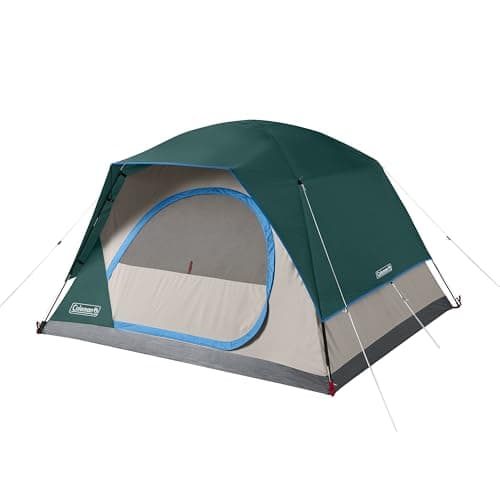
A full fly with a vestibule over a 56 sq ft floor, a 56 in peak and a 9.5 mm main pole.
Coleman publishes an 8 by 7 ft floor at 56 sq ft, a 56 in peak height, a packaged weight of 10 lb 15 oz and a 9.5 mm main pole. The specification that matters is the full fly with a vestibule: fabric that reaches the ground and gives you somewhere covered outside the door for boots.
If you camp between March and May or September and November, this is the version of the Coleman dome to own. The reasoning is in best tents for rain.
The drawback
56 sq ft is seven square feet less than the Sundome for more money. You are buying weather protection rather than space, and four adults will not fit happily.
9 by 7 ft of floor up in 30 seconds on a pre-attached frame, with H2O Block fabric and sealed seams.
CORE publishes a 9 by 7 ft floor, a 54 in center height, a 30-second setup, capacity for four or one queen air mattress, 68D polyester with H2O Block treatment and sealed seams, a gear loft with a lantern hook and a closable electrical port.
100 sq ft under a genuine 7 ft peak with near-vertical walls, which is what four people need rather than four people fit in.
Eureka publishes a 10 by 10 ft floor at 100 sq ft, a 7 ft peak height, a 21 lb 15 oz weight, a steel-and-fiberglass frame and one door.
It is in a four-person roundup deliberately. If your honest headcount is four people with belongings, this is the tent that houses them, and the 37 square feet it adds over the Sundome is the difference between tolerating a wet afternoon and sitting through one.
The drawback
21 lb 15 oz on a steel-and-fiberglass frame, one door, and it is a six-person tent you are buying because the four-person sizes are tight.
Two adults comfortably, with room for gear. Four adults fit only if nobody brings anything inside: four standard 20 by 72 in pads take 40 square feet, and these tents publish 56 to 63 square feet total.
QIs a 4-person tent big enough for a family of four?
For two adults and two small children in summer, yes, particularly at 63 square feet. For four full-sized people over several nights, buy a 6-person instead. The capacity number counts bodies, not belongings.
QDoes a 4-person tent fit a queen air mattress?
A queen bed is about 60 by 80 in, so it fits a 9 by 7 ft tent with a strip left over and only just fits an 8 by 7 ft one. Coleman publishes a fits-one-queen figure for the Sundome 4. Measure the bed you own.
QWhich 4-person tent is best for rain?
The one with a full-coverage rainfly. Among these, the Coleman Skydome 4 publishes a full fly with a vestibule while the Sundome 4 uses a partial roof fly. Fly geometry matters more than any waterproof rating on the box.
How we picked
Everyone else in this category will tell you they tested twenty of these. We have not tested any of them, and we would rather say so than pretend. There is no gear closet here and no test lab.
What we did instead: pulled the published specifications from each manufacturer's own spec sheet or manual, named the standard behind every rating so you can check what it actually promises, did the arithmetic that turns a spec into a decision, and pulled today's real retail price rather than quoting one from memory. Every pick states a drawback, because a list where nothing is wrong with anything is an advert.
The limits of that method, stated plainly: published specs do not capture zipper quality, seam durability, or how a tent behaves at 2am in a storm. Where that matters, we say so on the pick. The full method is here.