How to Stop Tent Condensation, and Tell It Apart From a Leak
Two people breathing overnight put roughly a liter of water into a tent. It has to go somewhere, and if it cannot get out through a vent it comes back as rain.
Trail & Tarp earns a commission from qualifying purchases made through links on this page, at no extra cost to you. Full disclosure.
Is it condensation or a leak?
The short answer
Condensation is even, covers the whole inner surface of the fly, and is worst on the coldest side. A leak is local: it appears in one place, usually at a seam, a zip or a pole sleeve, and it gets worse while it is raining rather than overnight. If you wake to a uniform film of droplets on the inside of the fly after a still, clear night, the tent is working correctly and physics is doing the rest.
The clearest test is timing. Condensation is at its worst at dawn, on the calmest and clearest nights, and it appears whether or not it rained. A leak tracks the weather: it starts when the rain starts, it is directional, and you can usually find the entry point by running a finger up from the wet patch and feeling for the seam above it.
Why it happens
Warm air holds more water vapor than cold air. Inside an occupied tent the air is warm and very humid: an adult exhales water vapor all night, wet clothes and boots add more, and damp ground evaporates upward into the tent through the floor. That warm, saturated air rises, meets a fly cooled by the night sky to below the dew point, and the vapor condenses out onto it as liquid.
This is why condensation is worst on exactly the nights people expect to be easy. A clear, still night radiates heat to the sky and cools the fly hard, and there is no wind to carry the humid air away. Cloudy, breezy nights produce far less.
What to do, ranked by how much it helps
Action
Why it works
Effect
Open every vent, including in rain
Lets humid air leave before it condenses
Large
Keep the fly off the inner
Contact wicks condensation straight through
Large
Pitch away from water and hollows
Damp ground and still air both raise humidity
Large
Keep wet gear in the vestibule
Boots and waterproofs evaporate all night
Moderate
Never cook or run a stove inside
Burning fuel produces water vapor directly
Moderate, and a safety issue
Use a groundsheet under the floor
Reduces evaporation up through the floor
Small to moderate
Wipe the fly down before bed
Removes the film that drips when knocked
Small, but instant
In practice the first three account for most of the difference.
Ventilation, which people close exactly when they need it
The instinct in bad weather is to seal everything. It is precisely wrong. A closed tent traps the moisture you produce, and you will get wetter from your own breath than the rain would have made you. Tent vents are designed with hoods and baffles so they can stay open in rain, and they should be.
Cross-ventilation is what actually clears humid air. One vent open is a dead end; two, on opposite sides, gives the air a route. If your tent has a single vent, leave a door zip open a hand's width at the top — the top, because warm humid air rises and that is where it wants to leave.
The fly touching the inner is the invisible cause
Condensation on the fly is harmless while it stays on the fly. The moment the fly touches the inner tent, capillary action wicks it straight through and you get a wet patch that looks exactly like a leak — usually above someone's head, usually where a guy line was not pegged out. Tension every guy line, not four. Repeg after rain, because wet fabric stretches and a fly that was taut at bedtime is slack at 3am. This single fix resolves more “leaking” tents than any product does.
Where you pitch changes everything
Cold, humid air sinks and pools, so the bottom of a valley, a hollow in a field and the bank of a river or lake are all worse than a slight rise twenty feet away. Long grass holds moisture and releases it all night. A spot under trees is often better than open ground, because the canopy slows radiative cooling and the fly stays warmer.
Getting some morning sun on the pitch is worth planning for. A tent that catches early light dries itself while you have breakfast, which turns the whole problem into a non-event and means it goes home dry — which is the thing that actually matters for storing it.
Living with it
You will not eliminate condensation, and a tent with none of it is usually a tent that is drafty enough to be cold. The realistic goal is to keep the water on the fly and off your sleeping bag.
Practical habits: keep your bag away from the tent walls, which is the other way it gets damp; wipe the fly with a small cloth before bed and again in the morning; do not knock the walls when you move around, because the film runs down and drips when disturbed; and get the fly into daylight for twenty minutes before packing.
A damp sleeping bag loses loft and therefore warmth, which is the mechanism behind why you get cold in a sleeping bag. If your bag is picking up moisture from the tent wall every night, a wider tent or a taller tent with more space between the sleeping area and the walls solves it more reliably than any accessory.
Things sold to fix this that mostly do not
Chemical dehumidifier tubs are made for caravans and static spaces; in a tent with any airflow at all they absorb a trivial fraction of a liter of overnight vapor. Battery fans help a little by moving air, but a vent that is open does the same for nothing. Sprays and coatings do not touch condensation, because the problem is not the fabric — it is the air.
The only purchase that reliably helps is a tent with genuine ventilation designed into it: vents high on the fly, a full-coverage fly you can tension away from the inner, and enough volume that the inner walls are not against your bag. Those are the same features that make a tent good in weather generally, which is the argument in best tents for rain.
The gear this page points to
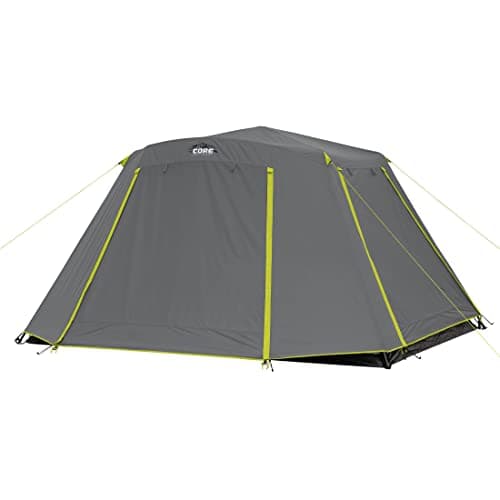
CORE 6 Person Instant Cabin Tent
CORE Equipment
A full rainfly you can tension clear of the inner, and 72 in of height so your sleeping bag is not resting against a wet wall.
Almost always condensation rather than a leak. Warm, humid air from breathing and damp gear meets a fly cooled below the dew point and the vapor condenses on it. It is worst after still, clear nights and appears whether or not it rained.
QHow do I tell condensation from a tent leak?
Condensation is even and covers the whole inner face of the fly, and is worst at dawn. A leak is local, appears at a seam, zip or pole sleeve, and gets worse while it is actively raining rather than overnight.
QShould I close tent vents when it rains?
No. Tent vents are hooded so they work in rain, and closing them traps the moisture you produce. A sealed tent makes you wetter from your own breath than the rain would have. Leave vents open and aim for cross-ventilation.
QDoes a groundsheet stop tent condensation?
It helps a little by reducing evaporation up through the floor, but it is a minor factor. Ventilation, keeping the fly from touching the inner, and pitching away from hollows and water account for most of the difference.
Sources
Every figure on this page comes from a published source. We have not tested this gear, so the numbers are the manufacturer's or the standard body's, not ours. How we research.