The Best Backpacking Tents for Beginners, Judged on Weight You Actually Carry
A backpacking tent is a car camping tent with the comfort engineered out to save four pounds. The question for a first one is how much comfort you are willing to lose, not how light it can go.
Minimum weight (sometimes called trail weight) is tent, fly and poles only. Packed weight is everything in the bag, including stakes, guy lines, stuff sacks and the repair kit. The number on the shelf tag is usually the minimum weight, and the number in your pack is usually the packed weight. The gap is real: Kelty publishes 4 lb 5 oz minimum and 4 lb 12 oz packaged for the same tent. Compare like for like or you will be comparing one brand's best case with another's honest one.
There is a third number some people quote, the “fast pitch” or fly-and-footprint weight, which assumes you leave the inner tent at home and sleep under the fly on a footprint you bought separately. It is a legitimate way to camp and a misleading way to shop, because you cannot do it with the tent as sold. Ignore it for a first tent.
Tent
Minimum weight
Floor area
Doors / vestibules
Fly fabric
Kelty Late Start 2P
4 lb 5 oz
30.6 sq ft
1 / 1 (7.4 sq ft)
68D polyester, 1200 mm
Naturehike Cloud Up 2
about 3 lb 0 oz
210 x 125 cm pitched
1 / 1
20D nylon, PU 3000 mm+
ALPS Mountaineering Lynx 2
5 lb 4 oz
37.5 sq ft
2 / 2 (20 sq ft)
75D floor, 2000 mm
All figures as published by the manufacturers. Fabric rows quote the figure each brand publishes, which is not always for the same component.
How much tent weight is too much?
The rule this site uses everywhere is that a loaded pack should sit around 20% of body weight for a beginner, and lower if you can manage it. For a 160 lb adult that is a 32 lb ceiling for everything. A 5 lb tent split between two people costs each of them 2.5 lb, or about 8% of that ceiling. A 3 lb tent costs 1.5 lb each, or under 5%.
Put like that, the difference between the lightest and heaviest tent here is roughly one pound per person — noticeable at the end of a long day, and nowhere near the biggest lever available to a beginner. The biggest levers are food you did not need, water you carried past a refill, and the second pair of shoes. Fix those first and the tent choice stops mattering as much as the marketing implies.
The pitch that decides whether the tent works
Every tent here is freestanding, meaning the inner stands up on its poles without stakes. That is enormously helpful for a beginner — you can pitch it, pick it up, and move it three feet left when you find the rock. It is not the same as not needing stakes. The fly, the vestibules and the guy points all need tensioning, or the fly touches the inner and wicks water through. If you take one habit from this page, take that one, and read how to stop tent condensation for why it matters more than the waterproof rating.
Floor area per person, and the thing the number hides
Car camping tents get judged at 20 to 25 sq ft per sleeper. Backpacking tents live at 15 to 19 sq ft for two, which is why a “two-person” backpacking tent feels like a different product from a two-person family tent. The Lynx 2 at 37.5 sq ft is 18.75 sq ft each. The Late Start at 30.6 sq ft is 15.3 sq ft each.
The number that actually decides comfort is width, not area. A standard sleeping pad is 20 in wide, so two pads need 40 in of floor at shoulder height. All three of these tents are 49 in or wider at the floor, but domes taper, so measure at the shoulder rather than the widest point. Anything under 50 in of usable width means the outer edges of both pads ride up the walls, and a pad against a damp wall is a cold pad — the mechanism is in why you get cold in a sleeping bag.
What a backpacking tent is not for
If your camping is a campground with a parking space next to the pitch, none of these is the right tent. You will pay a weight premium in comfort you did not need to spend, and you will get a smaller, lower, less pleasant shelter than a car camping tent at the same price. The difference between the two categories is set out in car camping tent vs backpacking tent, and the family-sized options are in the family tent roundup.
We have not slept in any of these. Every figure above is the manufacturer's published specification with a link to where it was read, which is the only kind of number this site uses. See how we research.
The picks in full
1. Best all-round first backpacking tent
Kelty Late Start 2P Tent
Kelty
4 lb 5 oz minimum weight over 30.6 sq ft of floor, on aluminum poles, with the same 68D fabric and 1200 mm rating as a family tent.
Kelty publishes a 4 lb 12 oz packaged weight and a 4 lb 5 oz minimum weight, a 30.6 sq ft floor with dimensions of 89 by 54 by 42.5 in, a 7.4 sq ft vestibule, aluminum poles, and 68D polyester at 1200 mm on both the fly and the floor.
That 68D figure is the reason to start here. Backpacking tents drop weight mostly by going thinner: 20D and 15D nylons are half the weight of 68D polyester and roughly the thickness of a supermarket carrier bag. They are perfectly durable in the hands of somebody who has pitched a tent two hundred times and knows to clear the sticks out from under the floor. They are punishing for somebody learning. A first backpacking tent built from the same fabric family as a car camping tent forgives the mistakes you are going to make.
The weight penalty for that forgiveness is about a pound. Split between two people it is eight ounces each, which is the weight of a full water bottle and less than most beginners over-pack in snacks. See the first backpacking trip guide for where the rest of the weight goes.
The drawback
One door and a 7.4 sq ft vestibule, so the person on the inside climbs over the person on the outside, and wet boots and a pack compete for the same porch.
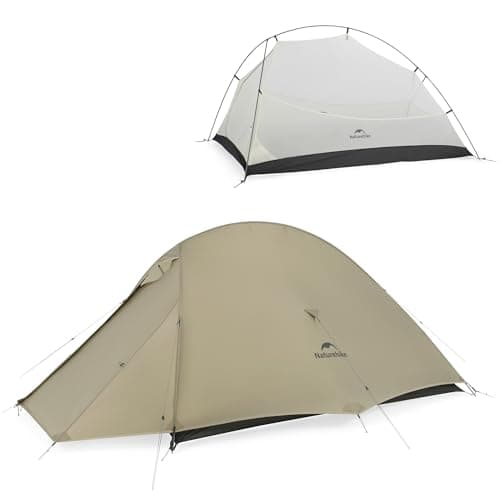
About 3 lb 0 oz minimum weight and a 4.7 by 17.7 in packed size, on 20D silicone-coated nylon rated PU 3000 mm and up.
Naturehike publishes a minimum weight of about 1.38 kg (3.04 lb) and a packed weight of about 1.8 kg (3.97 lb), a pitched size of 210 by 125 by 105 cm, a packed size of 12 by 45 cm, a 20D nylon ripstop rainfly with silicone coating rated PU 3000 mm and up, a 20D groundsheet at PU 4000 mm and up, and one-piece 7001 aluminum alloy poles.
This is what a pound saved looks like in practice: the same two sleepers, a narrower floor, thinner everything, and a fly that needs to be pitched taut to work. Nothing here is fragile in absolute terms — 20D silnylon is standard on tents costing four times as much — but it is unforgiving of a pitch on gravel or a boot dragged across the floor.
The single door is the compromise most beginners underestimate. Two people in a one-door tent means one of them is climbing over the other every time anyone gets up in the night. It is entirely survivable and it is the reason experienced pairs often pay the extra half pound for two doors.
The drawback
82.7 by 49.2 in of floor at a 41.3 in peak is genuinely two people touching, with one door and one vestibule. The 20D fabric wants a groundsheet and a cleared pitch.
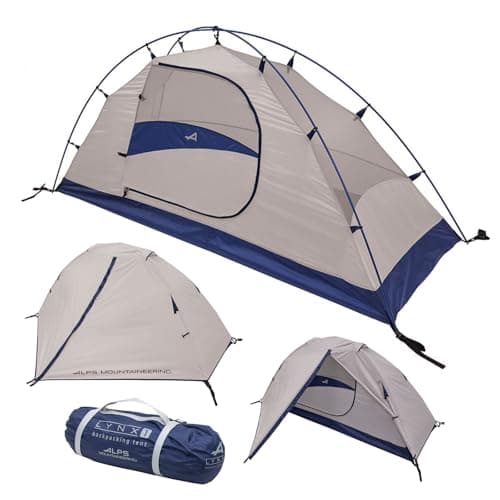
37.5 sq ft of inner floor, 20 sq ft of vestibule across two porches and two doors, for a 5 lb 4 oz minimum weight.
ALPS Mountaineering publishes a 90 by 60 in floor giving 37.5 sq ft of inner area, 20 sq ft of vestibule area across two vestibules, a 46 in peak height, a 5 lb 4 oz minimum weight and 5 lb 12 oz total, a 20 by 6 in packed size, a 75D poly taffeta floor with a 2000 mm coating, and factory-sealed fly and floor seams.
Seven square feet of extra floor over the Kelty does not sound like much until you realize the entire difference between a cramped tent and a comfortable one is about that much. At 60 in wide this fits two full-width sleeping pads side by side without either person's pad riding up the wall, which is the single thing that ruins sleep in a small tent.
Two doors and two vestibules is the other argument. Each person has their own exit and their own porch for boots and pack, so nobody crawls over anybody and wet gear does not have to share. The price is a pound over the Kelty and more than two over the Naturehike — carried by two people, about a pound each. If you are splitting the tent between two packs, as described in how to pack a backpacking backpack, that is a fair trade for a first season.
The drawback
The heaviest here by a clear pound, and 46 in of peak height on a rectangular dome means sitting up, not much more.
For two people sharing, anything with a minimum weight under about 5 lb 8 oz is fine, because split between two packs that is under 3 lb each. A beginner gains far more from cutting food, water and spare clothing than from chasing the last pound of tent.
QWhat is the difference between minimum weight and packed weight?
Minimum weight is the inner tent, fly and poles only. Packed weight includes stakes, guy lines, stuff sacks and any repair kit, so it is what actually goes in your pack. Kelty publishes 4 lb 5 oz minimum and 4 lb 12 oz packaged for the Late Start 2P.
QIs a two-person backpacking tent big enough for two people?
It fits two, and it is tight. Backpacking two-person tents typically give 15 to 19 sq ft total against the 20 to 25 sq ft per person used for car camping. Floor width matters more than area: two standard 20 in pads need 40 in of usable width at the shoulder.
QDo I need a footprint for a backpacking tent?
Not strictly, but thin backpacking floors benefit more than thick family tent floors do. A 20D silnylon floor is far more vulnerable to grit and sticks than a 75D poly taffeta one. Clearing the pitch properly does most of the same job for free.
How we picked
Everyone else in this category will tell you they tested twenty of these. We have not tested any of them, and we would rather say so than pretend. There is no gear closet here and no test lab.
What we did instead: pulled the published specifications from each manufacturer's own spec sheet or manual, named the standard behind every rating so you can check what it actually promises, did the arithmetic that turns a spec into a decision, and pulled today's real retail price rather than quoting one from memory. Every pick states a drawback, because a list where nothing is wrong with anything is an advert.
The limits of that method, stated plainly: published specs do not capture zipper quality, seam durability, or how a tent behaves at 2am in a storm. Where that matters, we say so on the pick. The full method is here.