The Best Family Camping Tents for a First Season Outdoors
A tent that says it sleeps six will not sleep six adults with their bags. Here is what the published numbers actually mean for a family of four, and which tents survive that arithmetic.
Plan on 20 to 25 square feet of floor per person, then buy the tent whose capacity number is two higher than the number of people sleeping in it. A tent's advertised capacity assumes adults lying shoulder to shoulder with no gear in the tent. For a family of four that means a tent sold as a 6-person, and about 85 to 100 square feet of floor.
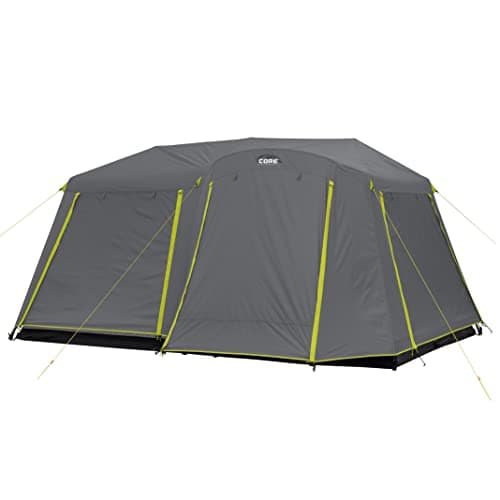
Manufacturer capacity is not a lie, it is a measurement of something you would never actually do. CORE Equipment is unusually straight about this: its 14 by 9 ft tent is published as “9 (industry standard) / 4 + gear (most comfortable)”. That second number is the real one, and the ratio holds across brands. Take the number on the box, subtract two, and you have a family that can also put their bags somewhere.
Tent
Listed floor
Sold as
Comfortable for
Sq ft per person at 4
Coleman Sundome 6
10 x 10 ft (measured 9'8" x 9'7")
6
4
about 23
Coleman Skydome 6
10 x 8 ft 6 in (85 sq ft)
6
4
21
Kelty Wireless 6
86.5 sq ft
6
4
22
Eureka Copper Canyon LX 6
10 x 10 ft (100 sq ft)
6
4-5
25
CORE 9 Person Instant Cabin
14 x 9 ft (126 sq ft)
9
4 + gear (maker's own figure)
31
Floor areas as published by each manufacturer; Sundome measured figure from OutdoorGearLab.
Height matters more than the extra square foot
Two tents can have the same floor area and feel completely different. A dome loses usable space at the edges where the walls curve in, so a 100 square foot dome might give you 70 square feet you can sit upright in. A cabin tent with near-vertical walls gives you almost all of it. That is why the Eureka at 7 ft of peak height reads as a much bigger tent than the Sundome at 72 in, despite an identical listed floor.
The practical test: can an adult stand up to pull on trousers? Below about 6 ft of center height the answer is no, and on a wet morning with two children in the tent that is the difference between a nuisance and a memory nobody wants to repeat.
The four specs that decide the purchase
Usable floor area, not capacity. Work out square feet per sleeper. Under 20 is cramped, 20 to 25 is comfortable, over 25 is generous.
Center height. Under 5 ft is a crawl-in tent. Around 6 ft is standing room for most adults. Over 6 ft 6 in is a cabin.
Waterproof rating. Most family tents publish a hydrostatic head in millimeters. The CORE tents here list 1200 mm. We explain what that number is measured with, and what it does and does not promise, in tent waterproof ratings explained.
Packed weight and packed length. 40 lb in a 48 in bag is a real constraint when the trunk also has to hold a cooler, chairs and four sleeping bags. Check it against your car before you check it against your back.
The thing beginners buy in the wrong order
Most people spend their whole first budget on the tent and then sleep badly anyway, because what makes you cold at night is the ground, not the tent. If your money is finite, buy an adequate tent and a good sleeping pad, not an excellent tent and a foam mat. R-value explains why.
What we did not consider
Everything here is a car camping tent, meaning it gets carried from a parking space to a pitch. None of them are appropriate for carrying on your back, where the weights above become absurd. If you are heading toward a first trip on foot, start with the first backpacking trip guide instead.
We also did not rank tents on storm performance. Doing that honestly needs field testing in weather, and we have not done it. What we can tell you is which construction choices make a tent more exposed: tall vertical walls, single doors, fiberglass poles and large unbraced panels all trade wind resistance for space or price.
The picks in full
1. Best overall for a family of four
Coleman Skydome 6-Person Tent
Coleman
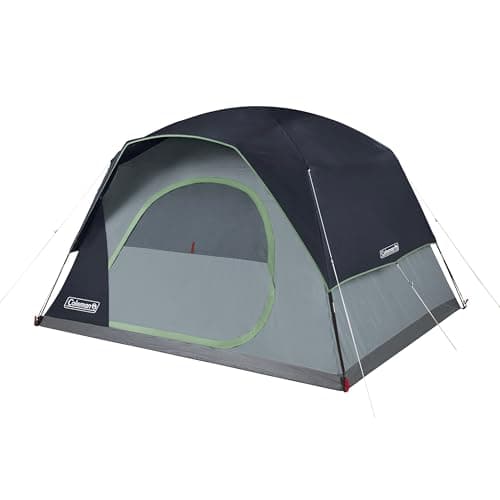
85 square feet and a full 6 ft of standing height, which is the combination most families actually need.
Coleman lists this tent at 10 ft by 8 ft 6 in, which is 85 square feet, with a 6 ft center height. Split four ways that is 21 square feet each, comfortably above the 20 square feet per sleeper we use as the line between usable and cramped. The height matters more than families expect: at 6 ft, most adults can stand up to get dressed instead of doing it kneeling.
Coleman rates setup at under five minutes. That is a pole-and-clip design rather than an instant frame, so it is slower than the CORE tents below but noticeably lighter at around 16.8 lb, and lighter tents are the ones that keep getting used.
The drawback
The 8 ft 6 in width is tight if you want two queen airbeds plus a walkway. Coleman says it fits two queens, and it does, with almost no floor left over.
126 square feet with 78 in of headroom and a two-minute setup, and CORE publishes an honest capacity figure.
CORE lists 14 ft by 9 ft, so 126 square feet, with a 78 in center height. What makes this tent worth singling out is the spec sheet itself: CORE publishes two capacity numbers, “9 (industry standard)” and “4 + gear (most comfortable)”. That is a manufacturer telling you outright that the number on the box is a lying-shoulder-to-shoulder figure. Almost nobody else does that, and it is the single most useful line on any tent spec sheet we read for this page.
The fabric is listed as 68D polyester at 1200 mm hydrostatic head, with a fully taped rainfly. Setup is quoted from two minutes because the poles stay attached to the tent.
The drawback
40 lb, and the packed bag is 48 in long. This is a two-person carry from the car and it will not fit in a small trunk alongside everything else.
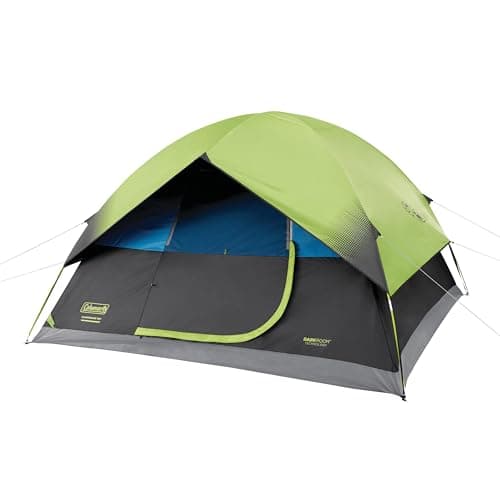
The default cheap family dome, and the one whose gap between listed and measured floor size is worth knowing about.
Coleman lists 10 ft by 10 ft with a 72 in center height. Independent measurement puts the real floor at about 93 square feet, which is still 23 square feet per person for a family of four and is genuinely fine. We flag it because it is the clearest example on this page of why you should treat a listed floor size as a maximum rather than a promise.
The square footprint is more forgiving than the Skydome's rectangle if you are arranging two airbeds plus a couple of kids on sleeping pads. At around 16 lb packed it is easy to move, and at this price a first season that goes badly costs you very little.
The drawback
The floor is smaller than the box says. OutdoorGearLab measured 9 ft 8 in by 9 ft 7 in against a listed 10 by 10, so roughly 93 square feet rather than 100.
A 7 ft peak with near-vertical walls, so the whole 100 square feet is usable rather than just the middle.
The cabin shape is the point. A dome tent's listed floor area includes the perimeter where the walls slope in and you cannot stand, sit upright or stack anything. A cabin tent with a 7 ft peak gives you close to the full 100 square feet as floor you can actually use, which changes what a rained-out afternoon feels like with children in it.
Eureka lists a steel and fiberglass frame with pole sleeves, corner hubs and quick clips, and describes it as a one-person setup. It is the heaviest tent here by a wide margin, which is a fair trade for the space if the tent is going 30 feet from a car.
The drawback
21 lb 15 oz with a steel frame, and the near-vertical walls that make it liveable also catch wind. This is a fair-weather-forecast tent, not a ridge-line tent.
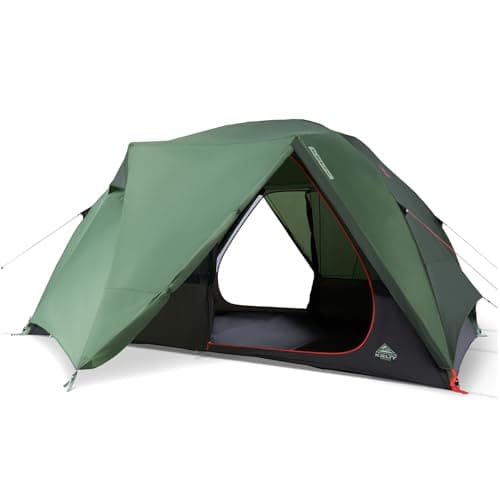
86.5 square feet, a 74 in peak and two vestibules totaling 39 square feet of covered gear space.
Kelty lists 117.5 by 106 in of floor, a 74 in peak and 19.5 square feet of vestibule at each door. Vestibules are the spec families underrate: they are where wet boots, the cooler and the bag of firewood live instead of inside the tent with you. Two doors also means one adult can get out at 2am without climbing over anyone.
This is the tent to buy if a cheaper one has already disappointed you and you want the same size with better detailing rather than more square feet.
The drawback
Fiberglass poles at this price point, and 19 lb packed. The vestibules are the reason to buy it; the poles are the reason it is not more expensive.
A tent sold as a 6-person, which typically gives 85 to 100 square feet of floor. That works out at 21 to 25 square feet per person, which leaves room for bags and a walkway. A tent sold as a 4-person gives a family of four roughly 14 square feet each with nowhere to put anything.
QAre instant tents worth it for families?
If you regularly arrive at a campsite after dark with tired children, yes: pre-attached poles turn a 15-minute job into a 2-minute one. The trade is weight and packed size. The CORE 9-person here is 40 lb in a 48 in bag against 16.8 lb for the Coleman Skydome 6.
QDo I need a footprint under my family tent?
Not always, but it is the cheapest way to extend the life of the floor and it keeps the packed tent cleaner. It matters most on gravel or hard-packed pitches. We cover when it earns its place, and when it actively causes problems, in our footprint guide.
QWhat is a good waterproof rating for a family tent?
Around 1200 to 1500 mm hydrostatic head is the normal range for family tents and is adequate for typical rain. Higher numbers help in sustained downpours, but seam taping and a full-coverage rainfly matter at least as much as the headline millimeter figure.
QHow much should a first family tent cost?
Prices move constantly, so we do not quote them here. What we can tell you is that the spread between the cheapest and most expensive tent on this page is large, and the cheapest one is genuinely usable. Check today's price on each and buy the smallest gap between what you need and what you pay.
How we picked
Everyone else in this category will tell you they tested twenty of these. We have not tested any of them, and we would rather say so than pretend. There is no gear closet here and no test lab.
What we did instead: pulled the published specifications from each manufacturer's own spec sheet or manual, named the standard behind every rating so you can check what it actually promises, did the arithmetic that turns a spec into a decision, and pulled today's real retail price rather than quoting one from memory. Every pick states a drawback, because a list where nothing is wrong with anything is an advert.
The limits of that method, stated plainly: published specs do not capture zipper quality, seam durability, or how a tent behaves at 2am in a storm. Where that matters, we say so on the pick. The full method is here.