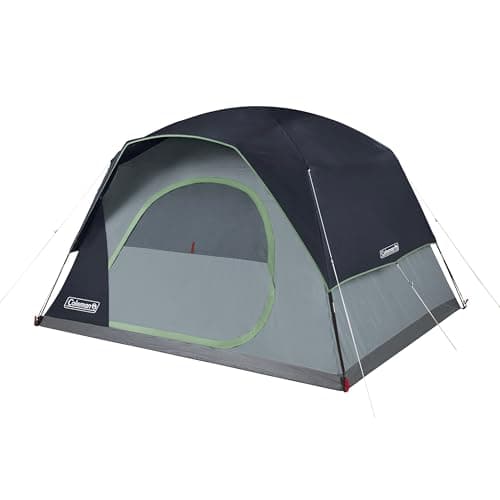
Coleman Skydome 6-Person Tent
Coleman
85 sq ft, 6 ft center height, under 5 minutes to pitch. The faster, steeper-walled one.
$179.99 · Check price on Amazon
#ad how this is funded · price as of October 23, 2026
These are the two tents most first-time campers end up choosing between, and the spec sheets look almost identical. One number explains the price gap.
Trail & Tarp earns a commission from qualifying purchases made through links on this page, at no extra cost to you. Full disclosure.
The short answer
The Sundome is the cheaper, lighter, simpler tent and it is enough for fair-weather campgrounds. The Skydome buys you pre-attached poles, a faster pitch and steeper walls that give you usable headroom at the edges rather than only in the middle. If you camp twice a year in summer, the Sundome. If you pitch in the dark, in weather, or with children underfoot, the Skydome earns its difference.
Both are 6-person tents by Coleman's counting, which means neither sleeps six adults. The honest capacity of both is four people with gear, or two with a queen airbed and room to move — the arithmetic is in what size tent do I need.
| Skydome 6 | Sundome 6 | |
|---|---|---|
| Floor | 10 x 8 ft 6 in (85 sq ft) | 10 x 10 ft listed; 9 ft 8 in x 9 ft 7 in measured |
| Center height | 6 ft | 72 in (6 ft) |
| Weight | about 16.8 lb | about 16 lb packed |
| Packed size | not published | 28 x 9 x 9 in |
| Setup | under 5 minutes | not published |
| Airbeds | fits 2 queen | not published |
On paper the Sundome looks like the bigger tent: 10 by 10 ft against 10 by 8 ft 6 in. That is the listing figure, and an independent measurement came in at 9 ft 8 in by 9 ft 7 in, which is roughly 93 sq ft against the Skydome's 85. So the Sundome genuinely has more floor, and the Skydome costs more anyway. The reason is shape.
Both publish a 6 ft center height, and center height is almost meaningless on a dome tent. What matters is how quickly the walls fall away from that peak, because that decides how much of the floor you can actually stand or sit upright on.
The Skydome's selling point is exactly this: steeper walls that hold height further toward the edges. A traditional dome like the Sundome reaches 6 ft at a single point above the middle and slopes hard from there, so the usable headroom is a cone, not a room. In a tent you are sheltering in during an afternoon of rain, that is the difference you notice.
Coleman publishes an under-5-minute setup for the Skydome, achieved with pre-attached poles that unfold rather than thread. The Sundome uses conventional shock-corded poles you sleeve and clip, and Coleman publishes no setup figure for it.
This is worth more than it sounds for two groups: anyone arriving after dark, and anyone pitching alone. A conventional dome is a two-person job the first few times and a one-person job after that. The broader trade is covered in instant tent vs traditional tent — the Skydome sits between the two camps rather than being a true instant tent.
Both have the same weakness in sustained rain
Neither of these is a full-coverage-fly tent. Coleman's partial roof flies leave mesh upper walls exposed, which is excellent for ventilation on a warm night and a liability in wind-driven rain. Neither maker publishes a hydrostatic head figure for these models, so we cannot compare their fabrics on paper. If rain is likely, pitch a tarp over the door — best camping tarps — or start from best tents for rain instead.
More than the comparison suggests, and it is most of why either one is a reasonable first tent:
| If this is you | Buy |
|---|---|
| Summer campgrounds, fair forecast, tight budget | Sundome 6 |
| You want the most floor per dollar | Sundome 6 |
| Arriving after dark, or pitching alone | Skydome 6 |
| You will sit out a wet afternoon inside | Skydome 6 |
| Camping with small children | Skydome 6, for the setup speed |
| You need a full-coverage fly | neither; see best tents for rain |
For a household buying a first tent, the Sundome is the honest value pick and the Skydome is the one most people are happier with a year later. Neither is a mistake. The wider field, including the CORE instant cabins that compete with both, is in best family camping tents and Coleman vs CORE tents.
Coleman
85 sq ft, 6 ft center height, under 5 minutes to pitch. The faster, steeper-walled one.
#ad how this is funded · price as of October 23, 2026
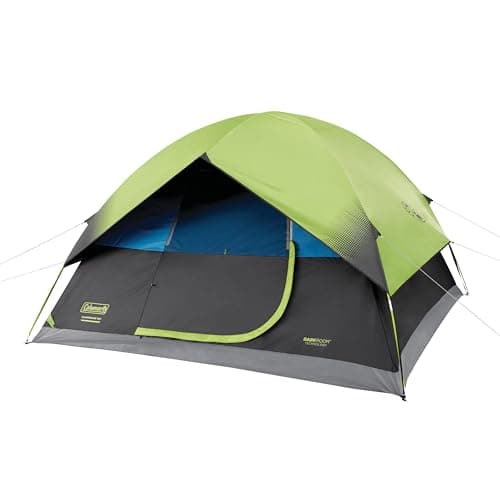
Coleman
About 93 sq ft measured, 72 in center, roughly 16 lb. More floor for less money.
#ad how this is funded · price as of October 23, 2026
Coleman
If two of you are sharing, the 4-person version is the same tent in the size you need.
Wall shape and setup. The Skydome has steeper walls that hold headroom toward the edges and pre-attached poles that pitch in under five minutes; the Sundome is a conventional dome with sleeved poles and no published setup time. The Sundome actually has slightly more floor, measured at 9 ft 8 in by 9 ft 7 in against the Skydome's 85 sq ft.
If you pitch in the dark, pitch alone, or expect to spend daytime hours inside, yes. The faster setup and the usable headroom at the edges are what you are paying for. For fair-weather summer campgrounds, the Sundome does the same job for less.
No. Both are 6-person by Coleman's floor-area counting, which allows no space for gear, elbows or a dog. Realistically both fit four people with gear, or two people with a queen airbed and room to move.
Both use a WeatherTec tub floor with welded corners, which handles ground water well. Both use a partial roof fly that leaves mesh upper walls exposed, so wind-driven rain can get in, and Coleman does not publish a hydrostatic head rating for either. Add a tarp over the door if heavy rain is forecast.
Every figure on this page comes from a published source. We have not tested this gear, so the numbers are the manufacturer's or the standard body's, not ours. How we research.