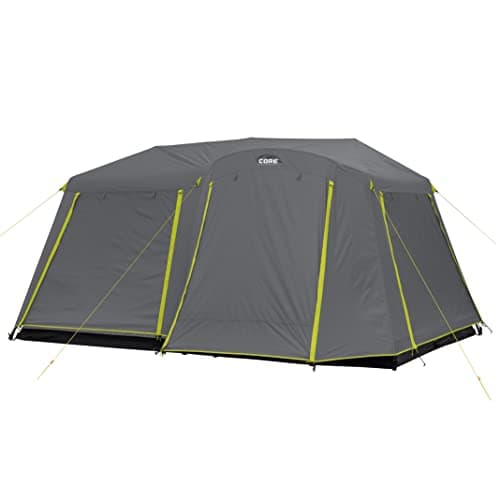
CORE 9 Person Instant Cabin Tent
CORE Equipment
126 sq ft at 78 in of height, pitched from 2 minutes. The cabin, at 40 lb.
$429.99 · Check price on Amazon
#ad how this is funded · price as of October 23, 2026
A cabin tent gives you a room you can stand up in. A dome gives you a shape the wind slides over. You cannot have both, and the forecast decides which you should want.
Trail & Tarp earns a commission from qualifying purchases made through links on this page, at no extra cost to you. Full disclosure.
The short answer
Cabin tents have near-vertical walls, so almost the whole floor is usable standing height and the listed square footage is real. Domes have sloping walls that shed wind and rain but waste the edges. Sheltered campground in summer, take the cabin. Anywhere exposed, take the dome.
| CORE 9 Person Instant Cabin | Coleman Sundome 6 | |
|---|---|---|
| Shape | cabin, near-vertical walls | dome, sloping walls |
| Floor | 14 x 9 ft (126 sq ft) | 10 x 10 ft listed; 9 ft 8 in x 9 ft 7 in measured |
| Center height | 78 in | 72 in |
| Weight | 40 lb | about 16 lb packed |
| Fabric | 68D polyester, 1200 mm | not published |
| Setup | from 2 minutes | not published |
| Maker's capacity | 9 standard, or 4 plus gear | 6 |
Six inches separates the two center heights, and that understates the difference completely. At 78 in the CORE is standing height for most adults across most of its floor; at 72 in the Sundome is standing height at one point in the middle, and the walls fall away fast from there.
The weight row is the other half of the story: 40 lb against about 16 lb. A cabin tent is a structure, and the poles that hold walls vertical are what you carry.
A dome is a series of arcs. Wind hitting it is deflected over and around, and the load is spread through curved poles that flex and recover. That is why domes are the shape used for every serious mountain tent.
A cabin presents a flat wall, which catches wind like a sail and transfers the load into near-square pole junctions that were designed for headroom rather than force. In a gust a cabin tent visibly deforms, and in a genuine blow it is the shape that fails first.
This is not a reason to avoid cabins — it is a reason to match the tent to the site. A wooded, sheltered campground loop in July is not a wind test. An exposed lakeshore or a shoulder-season trip is. Pitching technique closes some of the gap: how to pitch a tent in wind.
Cabin square footage is honest in a way dome square footage is not
When a dome and a cabin both list 100 sq ft, the cabin has more usable room, because floor area says nothing about the volume above it. A dome's corners are too low to sit in, so a queen airbed pushed to the wall has its edges under the slope. Cabins lose almost nothing at the edges. Read published floor area alongside center height and wall shape, or it will mislead you — the sizing method is in what size tent do I need.
| Cabin | Dome | |
|---|---|---|
| Usable floor | nearly all of it | the middle |
| Standing up | yes, across the tent | at the peak only |
| Wind | poor; a flat wall catches it | good; deflects over the curve |
| Rain shedding | flatter roof panels can pool | steep curve sheds well |
| Weight and pack size | heavy and bulky | lighter, packs smaller |
| Room dividers | common; the height allows them | rare |
| Setup | more poles, or an instant frame | fewer poles, quicker by hand |
Most of the modern cabin market is instant: CORE publishes setup from 2 minutes on the 9-person, with poles pre-attached and telescoping. That removes the traditional objection to cabins, which was that a big tent with many poles took two people and half an hour.
It does not remove the weight objection — 40 lb is 40 lb — and pre-attached poles are harder to replace than a standard shock-corded set. The trade is covered in instant tent vs traditional tent.
| If this is you | Buy |
|---|---|
| Family base camp at a sheltered campground | cabin |
| You will spend rainy afternoons inside | cabin |
| You want separate sleeping areas | cabin, with a divider |
| Exposed sites, ridges, coast or shoulder season | dome |
| You move camp often | dome; lighter and faster |
| Two people and a queen airbed | dome; a cabin is more tent than you need |
| Carrying it any distance at all | dome |
For a household camping a few summer weekends at developed campgrounds, a cabin is usually the happier tent and the wind risk is mostly theoretical. For anyone camping outside that pattern, the dome is the safer shape. The roundups are in best family camping tents and best car camping tents, and the fabric ratings that neither maker fully publishes are explained in tent waterproof ratings explained.
CORE Equipment
126 sq ft at 78 in of height, pitched from 2 minutes. The cabin, at 40 lb.
#ad how this is funded · price as of October 23, 2026
Coleman
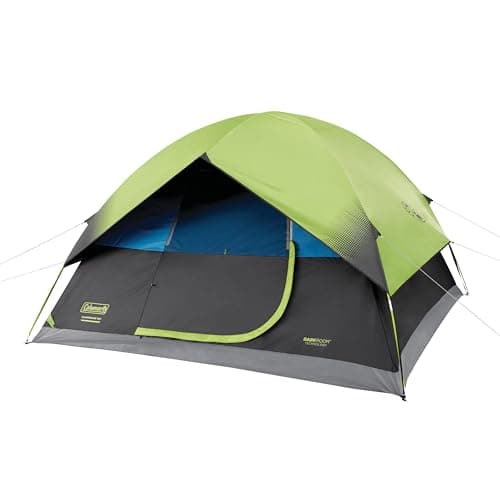
About 93 sq ft measured at 72 in, roughly 16 lb. The dome that handles weather.
#ad how this is funded · price as of October 23, 2026
Coleman
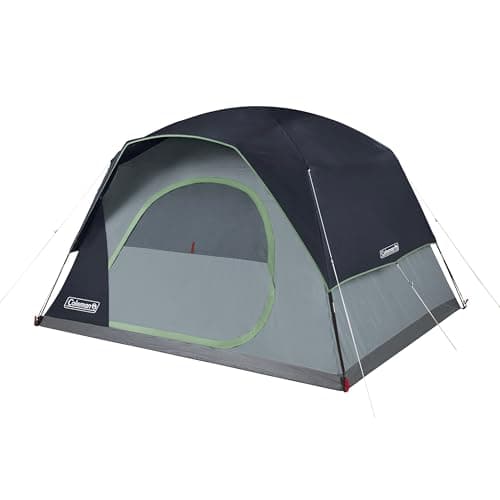
The middle ground: dome geometry with steeper walls for more usable headroom.
#ad how this is funded · price as of October 23, 2026
Wall angle. Cabin tents have near-vertical walls, so nearly all the floor is usable at standing height; dome tents have curved walls that slope in, wasting the edges but shedding wind and rain far better.
They are worse than domes. A flat vertical wall catches wind like a sail and loads near-square pole junctions designed for headroom, not force. A dome deflects wind over its curve and flexes with it. On sheltered wooded campgrounds this rarely matters; on exposed sites it does.
Yes. Floor area says nothing about the volume above it, and a dome's corners are too low to sit in. Two tents listing the same square footage will not feel the same, which is why center height and wall shape should be read alongside the floor figure.
A cabin, if you camp at sheltered campgrounds and expect to spend time inside. The standing headroom across the whole floor and the option of a room divider are what families actually use. Pick a dome instead if your sites are exposed or you move camp often.
Every figure on this page comes from a published source. We have not tested this gear, so the numbers are the manufacturer's or the standard body's, not ours. How we research.