No photo
Exped MegaMat 10
Exped
A high published R-value for cold-weather car camping, measured under the same ASTM F3340 method as everything else.
R-value is the one camping spec that is genuinely standardized across brands. Here is the test behind it, and the number you need for the ground you are actually sleeping on.
Trail & Tarp earns a commission from qualifying purchases made through links on this page, at no extra cost to you. Full disclosure.
The short answer
R-value measures how well a pad resists heat flowing out of your body into the ground. Higher is warmer, and the scale is additive. For summer camping you want about R 1 to 2; for three-season camping R 3 to 4; for frozen ground R 5 or more. Since 2020 every pad sold in the US is measured under the same standard, ASTM F3340, so numbers are comparable between brands.
| R-value | Season | Ground it handles | Typical pad |
|---|---|---|---|
| 1.0 - 2.0 | Summer only | Warm ground, mild nights | Basic inflatable, Klymit Static V Base at 1.3 |
| 2.0 - 3.0 | Late spring to early fall | Cool ground, no frost | Closed-cell foam, Z Lite Sol at 2.0 |
| 3.0 - 5.0 | Three-season | Cold ground, close to freezing | Insulated inflatables |
| 5.0 - 8.0+ | Winter capable | Frozen ground and frost | MondoKing 3D at 7.0, MegaMat 10 at 8.1 |
The test is ASTM F3340-18, Standard Test Method for Thermal Resistance of Camping Mattresses Using a Guarded Hot Plate Apparatus, adopted industry-wide in 2020. Before that, every brand used its own method and R-values were not comparable, which is why old reviews and new specs sometimes disagree.
The method, plainly:
The less energy required, the better the pad resists heat flow, and the higher its R-value. It is a physical measurement of a physical property, which is exactly why it is the most trustworthy number in the sleep category.
Air is a poor conductor; earth is a good one. Lying on the ground puts you in direct contact with a large, cold mass that keeps drawing heat away for as long as you are touching it. Meanwhile the insulation in the bottom of your sleeping bag is compressed flat under your own weight, so its trapped air — the thing doing the insulating — is squeezed out.
The result is that the pad does nearly all of the work below you, and the bag does nearly all of the work above. Buying a warmer bag to fix a cold night usually fixes nothing. See why you get cold in a sleeping bag for the full list of causes in order of likelihood.
R-values stack, and this is the cheap way to get warm
Put a closed-cell foam pad under an inflatable and add the two numbers. A Z Lite Sol at R 2.0 under a Klymit Static V Base at R 1.3 gives R 3.3, a true three-season setup for the price of two inexpensive pads. It also protects the inflatable from punctures.
Say you camp in fall and overnight lows reach about 35 F, with ground colder than the air after a clear night. R 1.3 leaves you conducting heat into cold ground for eight hours, and you will wake up cold no matter what bag you use. R 3 to 4 handles it. R 7 is more than you need but costs you nothing except weight and bulk, which for car camping is not a real cost.
That asymmetry is why we tell beginners to over-buy R-value and under-buy almost everything else: too much is merely bulky, too little is a ruined night.
The pads themselves, with their published R-values, are in best sleeping pads for car camping.
Exped
A high published R-value for cold-weather car camping, measured under the same ASTM F3340 method as everything else.
Klymit
A mid R-value insulated pad, which is the range that covers spring and autumn camping.
Therm-a-Rest
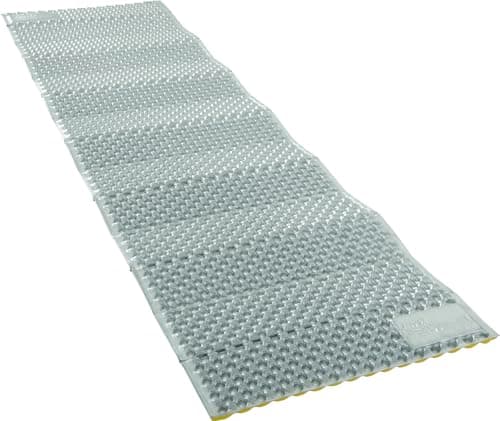
Closed-cell foam: a modest R-value that cannot puncture, and the cheapest way to add insulation on top of another pad.
#ad how this is funded · price as of October 23, 2026
It is a measure of thermal resistance: how well the pad stops your body heat escaping into the ground. Higher numbers are warmer, and the values from different brands are comparable because all pads sold in the US are tested to ASTM F3340.
R 5 or higher for camping on frozen ground, with many winter campers preferring R 6 to 8. The MondoKing 3D publishes 7.0 and the Exped MegaMat 10 publishes 8.1, which are both winter-capable figures.
Yes. Stacked pads give approximately the sum of their individual R-values, which makes a cheap closed-cell foam pad a genuinely effective way to add warmth under an existing inflatable.
Under ASTM F3340, the pad is placed between a hot plate at 35 C, standing in for a body, and a cold plate at 5 C, standing in for the ground. Testers measure the energy needed to hold 35 C over four hours at three points on the pad.
Every figure on this page comes from a published source. We have not tested this gear, so the numbers are the manufacturer's or the standard body's, not ours. How we research.