The Best Sleeping Pads for Side Sleepers, Ranked by Thickness
Side sleepers put their whole body weight through two small points. That changes which specification matters, and it is not the one on the front of the box.
A side sleeper puts most of their body weight through the hip and the shoulder, so the pressure per square inch at those two points is several times what a back sleeper applies anywhere. That compresses the pad locally, and if there is not enough loft, the hip reaches the ground. Three inches of thickness is roughly where that stops happening for most people; 2.5 inches is the practical minimum.
This is why the usual pad advice misfires here. The standard recommendation optimizes R-value per ounce, which is the right answer for warmth and the wrong answer for a hip. Both matter and they are separate specifications: R-value tells you how well the pad resists heat loss, thickness tells you whether it is still doing that under a concentrated load.
The second effect is quieter and more annoying. Side sleepers roll. On a narrow 20-inch pad, rolling puts an arm or a knee onto the tent floor, which is cold and usually damp. Twenty-five inches of width is a meaningfully different night.
Compared on thickness first
Pad
Thickness
R-value
Width
Weight
Type
Coleman SupportRest Queen
18 in
not published
60 in
not published
air bed
Therm-a-Rest MondoKing 3D
4.25 in
7.0
25 in
4 lb 6 oz (large)
self-inflating
Exped MegaMat 10
3.9 in
8.1
25.6 in
about 4.6 lb
self-inflating
NEMO Tensor All-Season
3.5 in
5.4
not published
13 oz (mummy)
inflatable, insulated
Therm-a-Rest Z Lite Sol
0.75 in
2.0
20 in
14 oz
closed-cell foam
Figures as published by each manufacturer. R-values measured under ASTM F3340 where published.
The Z Lite Sol is in that table as a warning and as a tool. At 0.75 in it is the worst pad here for side sleeping on its own, and it is the best thing to put underneath a thin inflatable, because it adds R 2.0 and cannot puncture.
The two-pad stack
R-values are additive under ASTM F3340. A closed-cell foam pad at R 2.0 under an inflatable at R 5.4 gives you R 7.4, and the foam also acts as a puncture barrier and a backup if the inflatable fails at midnight.
For car camping the stack is simpler: an air bed for the thickness with a self-inflating or foam pad on top for the insulation. Comfort from one layer, warmth from the other. The arithmetic is in sleeping pad R-value explained.
Inflate a thick pad softer than you think
The most common side-sleeper mistake is over-inflating. A drum-tight pad has no give, so the hip cannot sink in and instead presses against a rigid surface. Fill it fully, then let out enough air that pressing a palm into it near the hip sinks about an inch. On a self-inflating pad, open the valve, lie down for ten seconds, then close it with your weight still on it.
The pillow is part of the problem
Side sleepers need a taller pillow than back sleepers, because the gap between the ear and the pad is the full width of the shoulder. A flat pillow leaves the neck bent all night, which is usually what people are describing when they say a pad was uncomfortable.
For car camping, buy the MondoKing 3D if thickness is the priority or the MegaMat 10 if cold ground is; both are thick enough that side sleeping is a non-issue, and the difference between R 7.0 and R 8.1 will not decide a night. For backpacking, buy the Tensor All-Season and put a foam pad under it in cold weather.
If you are currently on an uninsulated air bed and waking up cold, the pad is not the problem you think it is — why you get cold in a sleeping bag explains what is happening underneath you.
The picks in full
1. Best overall
Therm-a-Rest MondoKing 3D
Therm-a-Rest
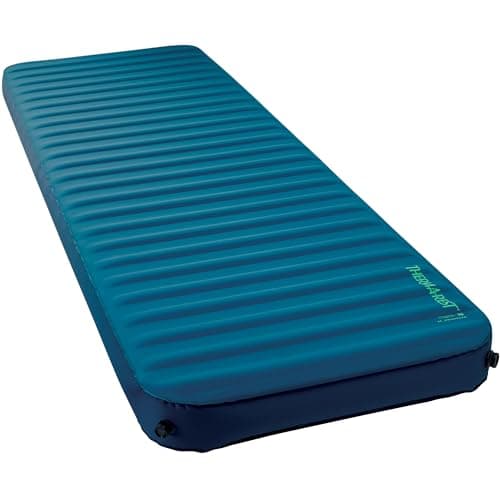
4.25 in of self-inflating foam, the thickest here, at an R-value of 7.0 in a 77 by 25 in large.
Therm-a-Rest publishes an R-value of 7.0, a thickness of 4.25 in / 11 cm, a large size of 77 by 25 in at 4 lb 6 oz, an XXL at 80 by 30 in and 5 lb 8 oz, a packed size of 26 by 10.3 in for the large, and StrataCore self-inflating construction with a TwinLock valve.
For a side sleeper the thickness is the whole argument. Your hip and shoulder press into the pad far harder per square inch than a back sleeper's whole body does, and 4.25 inches is enough loft that there is still material left between you and the ground under that load.
The drawback
4 lb 6 oz in the large and a packed bundle 26 by 10.3 in. This does not go in a backpack, and rolling the air out takes real effort.
R 8.1, the highest published figure here, over 3.9 in of self-inflating foam at 72 by 25.6 in.
Exped publishes an R-value of 8.1, a thickness of 3.9 in, a 72 by 25.6 in medium size and a weight of about 4.6 lb. That R-value is measured under ASTM F3340, the same standard everyone now uses, so it compares directly against the others here.
The 25.6 in width is worth noting separately. Side sleepers change position more at night, and a couple of extra inches is what stops an arm ending up on the cold tent floor.
The drawback
About 4.6 lb in the medium and a large packed volume, and it is 0.35 in thinner than the MondoKing, which a heavier side sleeper can feel.
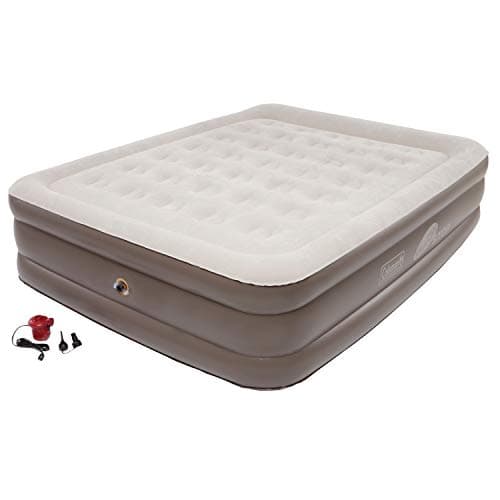
18 in of height with a built-in pump and a 600 lb capacity, at 78 by 60 in.
Coleman publishes a 78 by 60 by 18 in size, a 600 lb capacity, a built-in pump and about three to four minutes to inflate. Nothing else here is as comfortable to lie on for a side sleeper, because 18 inches of air cannot bottom out.
The catch is thermal rather than structural. Air beds publish no R-value because they have essentially none, and convection inside the chamber actively moves body heat to the ground. Put a foam pad on top and the problem goes away — see best air mattresses for camping.
The drawback
An air mattress has almost no insulation value. The air inside circulates, carrying your heat to the cold ground all night, and no thickness figure fixes that.
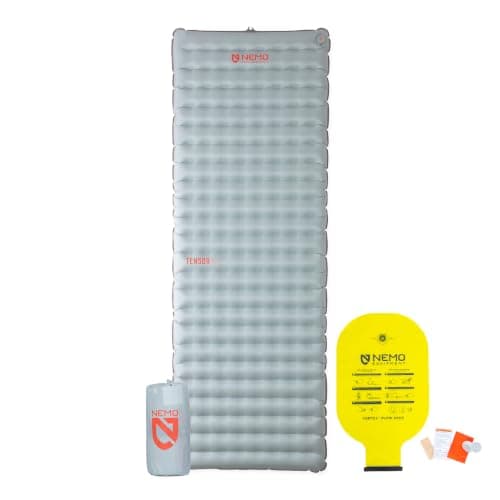
3.5 in of loft at 13 oz in the mummy, with an R-value of 5.4 from suspended metallized film.
NEMO publishes an R-value of 5.4, weights of 13 oz for the mummy and 13.9 oz for the regular rectangular, a thickness of 3.5 in, and two suspended layers of metallized Thermal Mirror film inside each baffle.
Three and a half inches is the most loft available at anything like this weight, and it is the specification that makes backpacking possible for a side sleeper without compromising. The rest of the category is in best backpacking sleeping pads.
The drawback
3.5 in of loft on a narrow pad feels tippy compared with a flatter design, and rolling toward the edge of an inflatable is a different sensation from rolling on foam.
Published specs
R-value
5.4
Weight
13 oz mummy; 13.9 oz regular rectangular
Thickness
3.5 in
Insulation
two suspended layers of metallized Thermal Mirror film
QHow thick should a sleeping pad be for a side sleeper?
About three inches or more. Side sleeping concentrates body weight through the hip and shoulder, which compresses the pad locally, and 2.5 inches is the practical minimum before the hip reaches the ground. Car camping pads at 3.9 to 4.25 inches remove the problem.
QIs R-value or thickness more important for side sleepers?
They answer different questions. R-value is how well the pad resists heat loss to the ground; thickness is whether it still has loft under a concentrated hip load. Side sleepers need to check both, because a high R-value on a thin pad still bottoms out.
QIs an air mattress good for side sleepers?
For comfort, yes: 18 inches of air cannot bottom out. For warmth, no. Air beds publish no R-value because they have almost none, and the air circulating inside carries body heat to the ground. Put a foam or self-inflating pad on top for cold nights.
QCan I stack two sleeping pads?
Yes, and you should if you are carrying a thin one. R-values are additive under ASTM F3340, so a foam pad at R 2.0 under an inflatable at R 5.4 gives R 7.4, plus a puncture barrier and a backup if the inflatable fails.
How we picked
Everyone else in this category will tell you they tested twenty of these. We have not tested any of them, and we would rather say so than pretend. There is no gear closet here and no test lab.
What we did instead: pulled the published specifications from each manufacturer's own spec sheet or manual, named the standard behind every rating so you can check what it actually promises, did the arithmetic that turns a spec into a decision, and pulled today's real retail price rather than quoting one from memory. Every pick states a drawback, because a list where nothing is wrong with anything is an advert.
The limits of that method, stated plainly: published specs do not capture zipper quality, seam durability, or how a tent behaves at 2am in a storm. Where that matters, we say so on the pick. The full method is here.