All modern pads publish R-value under ASTM F3340, which makes the numbers directly comparable across brands for the first time. For backpacking, divide the R-value by the weight in ounces: above 0.3 is excellent, around 0.15 is average, and below 0.1 means you are carrying weight that is not buying warmth.
This is the calculation that reorders the category. A pad with a high R-value is not automatically the right pad; a pad that delivers that R-value for 12 ounces instead of 30 is. And the standardized test is what makes the comparison honest, because before ASTM F3340 every manufacturer measured R-value its own way.
Compared on published numbers
Pad
R-value
Weight
Thickness
R per ounce
Type
NEMO Tensor All-Season
5.4
13 oz mummy
3.5 in
about 0.42
inflatable, insulated
Therm-a-Rest NeoAir XLite NXT
4.5
12.5 oz
3 in
about 0.36
inflatable, insulated
Therm-a-Rest Z Lite Sol
2.0
14 oz
0.75 in
about 0.14
closed-cell foam
Klymit Static V Base
1.3
18.7 oz
2.5 in
about 0.08
inflatable, uninsulated
R-values as published under ASTM F3340. R per ounce is our calculation from the published figures.
How much R-value you actually need
Conditions
Target R-value
What that looks like
Summer, above about 50 F
R 1 to 2
an uninsulated inflatable, or a foam pad
Three-season, down to about 30 F
R 3 to 4
one insulated inflatable
Late autumn, down to about 20 F
R 4 to 5
an insulated inflatable, or a stack
Winter, on snow
R 5 and up
an insulated inflatable plus a foam pad underneath
Our working guide. Individual tolerance varies more than any of these ranges.
R-values are additive under ASTM F3340, which is the most useful fact in the category. A Z Lite Sol at R 2.0 under an XLite NXT at R 4.5 gives you R 6.5 for 26.5 ounces, which is a genuine winter system assembled from two three-season pieces you may already own. The arithmetic is worked through in sleeping pad R-value explained.
The pad matters more than the bag
Body weight crushes the insulation underneath you flat, so whatever your sleeping bag is rated to, the warmth on the ground side comes from the pad. This is why people in expensive bags on cheap pads wake up cold and blame the bag. If your budget is fixed, spend it here first — the mechanism is in why you get cold in a sleeping bag.
The failure you have to plan for
Inflatable pads puncture. Not often, but the consequence is total: an air pad with a hole is an R 0 groundsheet, and on cold ground that is a genuinely bad night rather than an inconvenient one.
Two mitigations, and you should use one. Carry a patch kit and know how to find a leak in the dark, which is covered in how to repair a sleeping pad. Or carry a thin foam pad as well, which cannot fail and adds R-value on top. In winter, do both.
Inflation, and the mistake everyone makes
Do not inflate by mouth if you can avoid it. Breath carries moisture into the pad, and moisture inside an insulated pad reduces its R-value, corrodes the internal films over time and eventually grows mold you cannot reach. Both the XLite NXT and the Tensor ship with or support a pump sack, and it takes about the same time as blowing it up does.
Then under-inflate slightly. A drum-tight pad has no give, so your hip presses against a rigid surface instead of sinking in. Fill it fully, then let out enough air that pressing a palm in near the hip sinks about an inch. A spare pump sack doubles as a dry bag, which is the reason to carry one rather than the inflation.
Which to buy
Buy the NeoAir XLite NXT for three-season trips where weight is the argument. Buy the NEMO Tensor All-Season if your season runs into October or you sleep cold. Buy the Z Lite Sol as a second pad, a winter layer, or a first pad for someone who will destroy an inflatable. Buy the Klymit Static V Base for summer on a budget, and put foam under it when the ground gets cold.
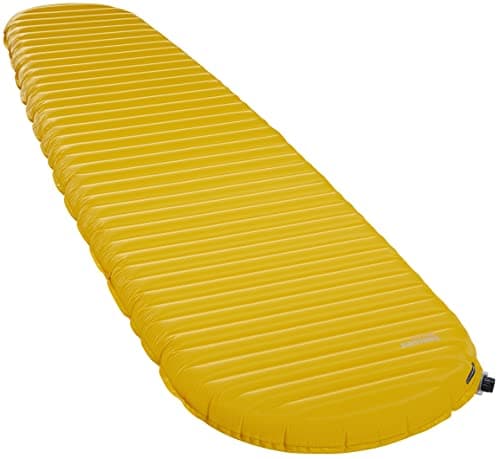
R 4.5 at 12.5 oz and 3 inches thick, which is the best warmth-per-ounce figure here by a wide margin.
Therm-a-Rest publishes an R-value of 4.5, a regular weight of 12.5 oz / 354 g, a thickness of 3 in / 7.6 cm, lengths of 72 in regular and 77 in long, a packed size about that of a 1 L water bottle, and construction using ThermaCapture film over a Triangular Core Matrix.
Divide it out: 4.5 R-value from 12.5 ounces is 0.36 R per ounce. Nothing else here comes close, and that ratio is the entire reason this pad has dominated the category for a decade. Three inches of thickness is also enough that side sleepers do not bottom out.
The drawback
Thin fabric that punctures if you are careless with it, and even after an 83 percent noise reduction the ThermaCapture film is still audible when you move.
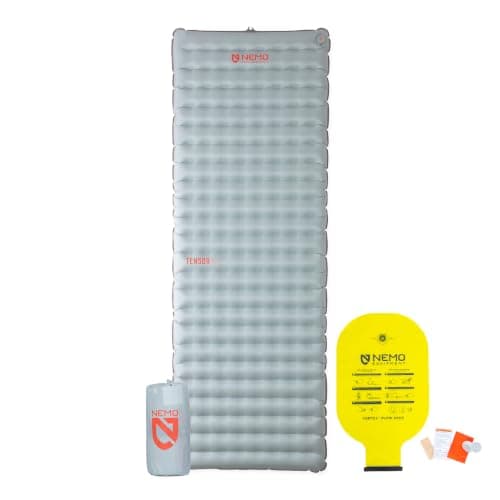
R 5.4 at 13 to 13.9 oz and 3.5 inches thick, with two suspended layers of metallized film.
NEMO publishes an R-value of 5.4, weights of 13 oz for the mummy and 13.9 oz for the regular rectangular, a thickness of 3.5 in, and an insulation system of two suspended layers of metallized Thermal Mirror film inside each baffle.
That works out to about 0.42 R per ounce on the mummy, which is fractionally better than the XLite NXT, and it comes with an extra half inch of loft. If your trips run into October, this is the more useful pad of the two.
The drawback
3.5 inches of loft on a narrow pad makes it feel tippy compared with a flatter design, and the extra insulation is dead weight on a July trip.
Published specs
R-value
5.4
Weight
13 oz mummy; 13.9 oz regular rectangular
Thickness
3.5 in
Insulation
two suspended layers of metallized Thermal Mirror film
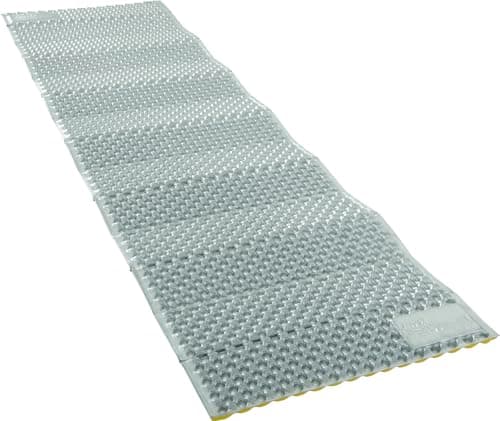
R 2.0 at 14 oz in closed-cell foam, with nothing to puncture and no inflation required.
Therm-a-Rest publishes an R-value of 2.0, a regular size of 72 by 20 by 0.75 in, a weight of 14 oz and closed-cell foam construction.
The case for foam is that it has no failure mode. An inflatable pad that punctures at 11pm on day three leaves you on the ground; a foam pad has already survived everything that could happen to it. It also doubles as a sit pad, a splint and a pack frame.
The drawback
0.75 in of thickness. It is genuinely uncomfortable for side sleepers on hard ground, and it straps to the outside of a pack because it does not compress.
2.5 in of loft at 18.7 oz, packing to 8 by 3 in, with a V-chamber layout designed to limit air movement.
Klymit publishes an ASTM R-value of 1.3, a size of 72 by 23 by 2.5 in, a weight of 18.7 oz and an 8 by 3 in packed size. It is an uninsulated inflatable and the R-value is honest about what that means.
0.08 R per ounce is the worst ratio here by an order of magnitude, and the pad is still worth knowing about because it is a fraction of the price of the others. Stack it on the Z Lite Sol and you have R 3.3 for 30.6 oz, which is a workable three-season system.
The drawback
R 1.3 under ASTM. That is a summer-only pad and it will be cold on any ground below about 50 F without a foam pad underneath it.
About R 1 to 2 for summer above 50 F, R 3 to 4 for three-season use down to around 30 F, R 4 to 5 for late autumn, and R 5 or more for snow. R-values are additive, so stacking a foam pad under an inflatable sums them.
QWhat is the best sleeping pad for backpacking?
By warmth per ounce, the NEMO Tensor All-Season at R 5.4 and 13 oz, and the Therm-a-Rest NeoAir XLite NXT at R 4.5 and 12.5 oz. Both are around 0.36 to 0.42 R per ounce, where most pads are nearer 0.15.
QShould I blow up my sleeping pad by mouth?
No, if you can avoid it. Breath carries moisture into the pad, which reduces R-value over time, corrodes the internal reflective films and can grow mold you cannot reach. Use a pump sack, which takes about the same time.
QIs a foam pad or an inflatable better for backpacking?
An inflatable gives far more R-value per ounce and far more comfort; a foam pad cannot fail. The common answer is an inflatable as the main pad plus a thin foam pad for winter warmth and as insurance against a puncture.
How we picked
Everyone else in this category will tell you they tested twenty of these. We have not tested any of them, and we would rather say so than pretend. There is no gear closet here and no test lab.
What we did instead: pulled the published specifications from each manufacturer's own spec sheet or manual, named the standard behind every rating so you can check what it actually promises, did the arithmetic that turns a spec into a decision, and pulled today's real retail price rather than quoting one from memory. Every pick states a drawback, because a list where nothing is wrong with anything is an advert.
The limits of that method, stated plainly: published specs do not capture zipper quality, seam durability, or how a tent behaves at 2am in a storm. Where that matters, we say so on the pick. The full method is here.