Skip to content
Trail & Tarp

Sleep

The Best Sleeping Pads for Car Camping, Ranked by R-Value

The pad, not the sleeping bag, is what decides whether you are cold. Since 2020 every R-value on the market has been measured the same way, so for once you can compare numbers directly.

By Sawyer V.Published September 3, 2026Last updated September 3, 2026How we research
A sleeping pad laid out inside a tent

Trail & Tarp earns a commission from qualifying purchases made through links on this page, at no extra cost to you. Full disclosure.

Quick picks

#ProductBest forPrice
1
No photo

Best overall for car camping

Therm-a-Rest MondoKing 3D

R-value 7.0 and 4.25 in of thickness, which is more warmth and more cushioning than a car camper is likely to need.

Anyone camping into fall, side sleepers
2
No photo

Warmest

Exped MegaMat 10

R-value 8.1, the highest here, at 3.9 in thick with a claimed -40F temperature rating.

Cold-weather car camping, campers who sleep cold
3
No photo

Best backup and best budget

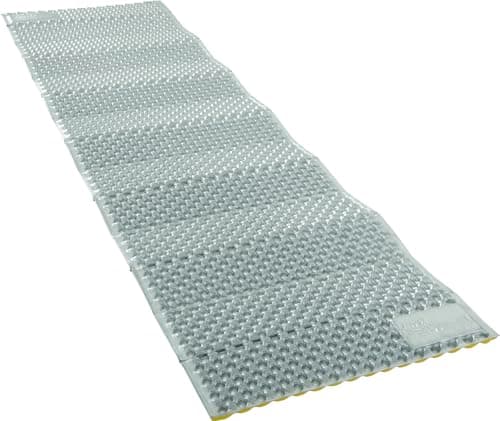
Therm-a-Rest Z Lite Sol

R-value 2.0 in 14 oz of closed-cell foam that cannot go flat, ever.

A second layer, kids, or a pad that cannot puncture
4
No photo

Best for summer and for guests

Klymit Static V2

16.6 oz, packs to 8 by 3 in, and an honest ASTM R-value of 1.3 that tells you exactly where its limit is.

Warm nights, spare pads, a first pad on a budget

What R-value do you need?

The short answer

R 1 to 2 for summer, R 3 to 4 for three-season camping, R 5 and up for freezing ground. R-value measures resistance to heat flowing out of you and into the ground. Since 2020, every pad sold in the US is tested under the same standard, ASTM F3340, so the numbers are directly comparable between brands for the first time.

R-valueSeasonGround conditionsExample from this page
1.0 - 2.0SummerWarm ground, above about 50 FKlymit Static V2 (1.3)
2.0 - 3.0Late spring, early fallCool ground, no frostZ Lite Sol (2.0)
3.0 - 5.0Three-seasonCold ground, near freezingStacking Z Lite + Static V2 (3.3)
5.0 - 8.0+Winter capableFrozen ground, frostMondoKing 3D (7.0), MegaMat 10 (8.1)
R-values as published by each manufacturer under ASTM F3340. Bands are ours.

Why the pad matters more than the bag

Insulation works by trapping air. When you lie down, your body weight crushes the fill underneath you until it is nearly solid, and solid material conducts heat away efficiently. So the bottom half of even an excellent sleeping bag contributes almost nothing, and the ground — which is usually much colder than the air, and never stops absorbing heat — is in direct thermal contact with you all night.

This is the most common single mistake we see beginners make: an expensive bag on a foam camping mat, and a cold night blamed on the bag. Full explanation in sleeping pad R-value explained.

R-values add up

Two pads stacked give you the sum of their R-values. A 14 oz Z Lite Sol (R 2.0) under a Klymit Static V2 (R 1.3) is R 3.3, which is a genuine three-season setup assembled from two cheap pads. It is also the cheapest way to extend a summer setup into fall without replacing anything.

Thickness is comfort, R-value is warmth

They are separate specs and they do not track each other. The Z Lite Sol is 0.75 in thick with R 2.0; the Klymit is 2.5 in thick with R 1.3. The thicker pad is the colder one.

For side sleepers, thickness is the spec that decides whether you wake up. Hips and shoulders concentrate weight, and under about 2 in most people bottom out. Three inches and up is where it stops being an issue, which is where both self-inflating mats here sit.

Self-inflating, inflatable or foam?

For anything sleeping on a camp bed instead, see air mattress vs sleeping pad vs cot — the R-value point applies to airbeds too, and it is the reason a summer airbed is a cold bed in October.

The picks in full

1. Best overall for car camping

Therm-a-Rest MondoKing 3D

Therm-a-Rest

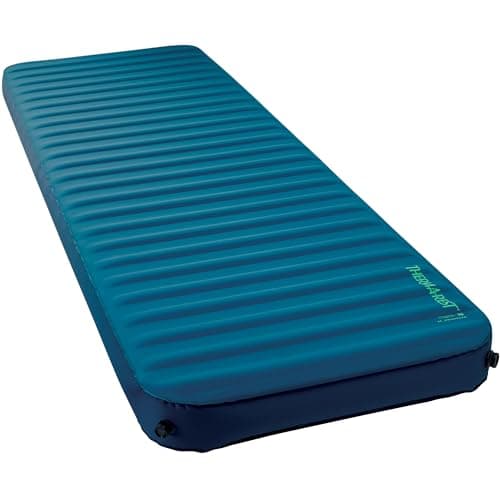
R-value 7.0 and 4.25 in of thickness, which is more warmth and more cushioning than a car camper is likely to need.

Therm-a-Rest publishes an R-value of 7.0 at 4.25 in thick, in a 77 by 25 in large. An R-value of 7 is winter-capable insulation; on a summer campground pitch it is overkill in the best way, which means you will never be cold from below again.

The 4.25 in of loft is the other half. Side sleepers bottom out on thin pads because hip and shoulder concentrate weight in a small area; four inches of self-inflating foam means you do not reach the ground.

The drawback

4 lb 6 oz and it packs to about 26 by 10 in. It is genuinely bulky, and it is self-inflating so it needs storing unrolled at home.
No product photo: we don't take our own

Published specs

R-value
7.0
Thickness
4.25 in
Size (large)
77 x 25 in
Weight (large)
4 lb 6 oz
Type
self-inflating

Specs: Cascade Designs (Therm-a-Rest) product page

2. Warmest

Exped MegaMat 10

Exped

R-value 8.1, the highest here, at 3.9 in thick with a claimed -40F temperature rating.

Exped publishes R-value 8.1 with a 3.9 in thickness. That is more insulation than the MondoKing for slightly less loft, and the practical difference between R 7 and R 8.1 is small for anyone camping above freezing.

Buy this if your camping season runs into real cold. If it does not, the extra R-value is money spent on a margin you will not use.

The drawback

About 4.6 lb and a 26.4 by 7.1 in packed size, plus a price that only makes sense if you camp in genuinely cold conditions.

No product photo: we don't take our own

Published specs

R-value
8.1
Thickness
3.9 in
Size (medium)
72 x 25.6 in
Weight (medium)
about 4.6 lb
Type
self-inflating

Specs: Exped USA product page

3. Best backup and best budget

Therm-a-Rest Z Lite Sol

Therm-a-Rest

R-value 2.0 in 14 oz of closed-cell foam that cannot go flat, ever.

Therm-a-Rest publishes R-value 2.0 at 72 by 20 in and 14 oz. The number that matters here is not the R-value, it is the failure mode: closed-cell foam has nothing to puncture, so it works after being dragged over gravel by a child.

R-values are additive, which makes this pad useful out of proportion to its rating. Stack it under an inflatable and you add 2.0 to whatever that pad has.

The drawback

0.75 in thick. It is a thin, firm mat, and side sleepers will feel the ground through it. Its real job is as a layer under something else.

No product photo: we don't take our own

Published specs

R-value
2.0
Size (regular)
72 x 20 x 0.75 in
Weight (regular)
14 oz
Type
closed-cell foam

Specs: Therm-a-Rest Z Lite Sol published specs

4. Best for summer and for guests

Klymit Static V2

Klymit

16.6 oz, packs to 8 by 3 in, and an honest ASTM R-value of 1.3 that tells you exactly where its limit is.

Klymit publishes an ASTM R-value of 1.3 at 72 by 23 by 2.5 in and 16.6 oz. This is the pad to buy when the ground is warm and the budget is small, or as a spare for visitors.

Note that Klymit also sells an insulated version of this pad at R 4.2. The uninsulated one is the cheap one, and the two are easy to confuse on a retail listing. Check which one you are looking at.

The drawback

R 1.3 is a summer-only rating. On cold ground you will be cold, no matter how good your sleeping bag is.

No product photo: we don't take our own

Published specs

R-value
1.3 (ASTM)
Size
72 x 23 x 2.5 in
Weight
16.6 oz
Packed
8 x 3 in
Type
inflatable, uninsulated

Specs: Klymit Static V2 published specs

Questions people actually ask

QWhat R-value sleeping pad do I need?

R 1 to 2 for summer, R 3 to 4 for three-season use, R 5 and above for camping on frozen ground. R-values are additive, so stacking a foam pad under an inflatable adds the two together.

QIs a sleeping pad necessary for camping?

Yes, for warmth rather than comfort. Your body weight compresses the insulation under you until it stops working, so without a pad the ground draws heat out of you all night regardless of how good your sleeping bag is.

QDo I need a sleeping pad if I have a good sleeping bag?

Yes. The insulation beneath you in any bag is crushed flat by your own weight and contributes almost nothing. The pad handles everything below you; the bag handles everything above.

QWhat should I put under a sleeping pad?

On a campground pitch, nothing is required. A closed-cell foam pad underneath adds its own R-value to the total and protects an inflatable from punctures, which is a good use of an inexpensive pad.

How we picked

Everyone else in this category will tell you they tested twenty of these. We have not tested any of them, and we would rather say so than pretend. There is no gear closet here and no test lab.

What we did instead: pulled the published specifications from each manufacturer's own spec sheet or manual, named the standard behind every rating so you can check what it actually promises, did the arithmetic that turns a spec into a decision, and pulled today's real retail price rather than quoting one from memory. Every pick states a drawback, because a list where nothing is wrong with anything is an advert.

The limits of that method, stated plainly: published specs do not capture zipper quality, seam durability, or how a tent behaves at 2am in a storm. Where that matters, we say so on the pick. The full method is here.

Sources for this page